Monday, May 29, 2006

Tips for doing Role Play


Doing role play is not easy because I find that it is very difficult for a lot of adolescent learners in Japan to adlib in English or play the role of someone else. A few weeks ago I tried to do a role play in an English class of 40 students I teach at the nursing school. The role play went well. I made pairs by matching students with high scores on a quiz I gave on vocabulary which was to be used in the role play with students who got low scores. Those students who scored in about the middle were matched with eachother. The thinking behind this was that the students who understood the chapter we were studying would help the students who were struggling.

Today, I tried a role play again but this time I paired the students randomly. Role play did not go well and some groups were absoluetly lost. I realized that in a class with students with a range of abilities and degree of motivation in English that random pairings for a challenging task might not be a good idea. Let the learners teach each other, don't try to be a superhero.

Wednesday, May 24, 2006

The Problem with Translating Programs

In a freshman English class that I teach, I asked the students to write a paragraph about a coincidence that happened to them. Over half of the students used a translating program to do the assignment and their writing was impossible to understand. I asked my English Teaching Methodologies 3 students in our Issues in EFL in Japan blog to explain why so many students felt that they had to use a translating program when they could have done a better job writing the short essay themselves. I received some very interesting comments. To read the post and the students' comments please click here.

Sunday, May 21, 2006

Using Vocabulary Notebooks in English Class

This year, I have started using vocabulary notebooks for two English classes I teach outside of Iwate University. In this post I will talk about the vocabulary notebooks I use at the nursing school I teach at.

Last year in a class I taught at a nursing school, I gave vocabulary quizes every week that our class met. The main reason why I gave the quizes was because it was the way I had been taught Japanese and it was very successful in getting me to memorize many Japanese words. Although most of the words I learned were in my "receptive knowledge" and not my "productive knowledge", I slowly learned how to use the words after hearing them multiple times and trying to sue them myself. In the nursing school, I found that weekly quizes were effective for about 20 out of 40 learners in that they understood the words and could use them in writing. However, there were about 5 students who routinely got zeroes on the test and 15 students who would maybe get 1 or 2 of 5 words correct on a quiz and had very limited command of the nursing vocabulary we studied. I realized that some students in the class knew how to study words and others did not. So, this year I decided to introduce vocabulary notebooks to encourage students to develop strategies for learning words and to help them keep track of their own learning.

At the beginning of the year I asked students to purchase a binder and I created sheets with the kind of layout I wanted them to use to record their vocabulary (Click here to see what a blank sheet looks like). The idea for this layout came from an article I read by Schmitt & Schmitt (1995) in the ELT Journal and the Word Surfing Technique developed by Will McCulloch.
In the left column of the Front Page (Click here to see a sample), learners write the translation of the word they want to learn in Japanese. In the right column they write a key word or key picture which will help trigger their memory of the word.

On the corresponding section of the back page (Click here to see a sample) learners write the following in the left column:
1)The word they want to learn in English.
2) The pronunciation of the word in using the phonetic alphabet.
3) The part of speech of the word
4) Derivations of the word
In the right column learners can write a connecting word which is a word that is used often with the word they want to learn as well as a sentence containing the word.

Here are some ways we have used the vocabulary notebooks in class:
  • Students write dialogues referring to their vocabulary notebooks
  • Students create vocabulary quizes for each other using the sample sentences in their vocabulary notebooks.
  • Before we start a chapter in the textbook, I give students a list of words that I would like them to write into their vocabulary notebooks.
Right now, students are only writing words that I tell them to write in their vocabulary notebooks. Once we all get used to them, I will encourage students to write other English words they encounter into their notebooks and would like to learn. We will also probably start organizing the pages in our vocabulary notebooks in the near future.

Next week, I will collect the nursing students vocabulary notebooks and see how have they been used. I will teach this class once a week for 23 weeks this year, and we have already had 6 weeks of class. I want to encourage students to use the vocabulary notebooks but I do not want to overwhelm them to the point where they become discouraged. For this reason, I am moving very slowly with the vocabulary notebooks and not trying to suddenly force them completely on the students. I hope that by the end of the semester some of the students who seldom wrote down words before the class or were at a loss as to how to study vocabulary will think that making and mainitaing a vocabulary notebook was a good way to help them learn nursing English.

Friday, May 12, 2006

My Son's Language Acquisition after 1 year and 8 months

In the past month and a half my son's vocabulary has increased at an absolutely explosive pace. He seems to be saying something new every day. My son says both English and Japanese words, but he has yet to say more than one word in one sentence unless it is a fixed phrase. I thought that I would list the words I think he knows and approximately which month he started saying them. The words in italics are Japanese. He will actually repeat a lot of what he hears but the below words are what he says on his own. You can listen to some of the words by clicking on them.

September/October 2005
Daddy (His first word!)
Dog

November/December 2005
achi (=there!)
chizu(=cheese)
baba (=granny)
jiji(=gramps)
bye bye
anpanman(= beanpaste man - a popular cartoon character)

January/February 2006
What's that?
atta (A Japanese verb he uses when he finds something he was looking for.)
denki (light)

March 2006
atsui (hot)
one, two, three
wan wan (= bark bark or doggy)
mama
oishii (= delicious - he said this once in November but did not say it again until March)
apple
duck
juice
deta (Can be translated as "It went out". My son says this after he poos.)

April 2006
ba-gu (= hamburger)
ball
hi!
slide
baby
happy
pee pee
poo poo
flower
eye
bunny
mommy
car
okataduke (=let's clean up)
owl
how are you?
doggy
kitty
issai (=one-year old)
swing
clock
bath
momo (The name of his Japanese grandparents' dog)
ojiji (Great grandfather)
obaba (Great grandmother)
paipai (breast)
mimi (ear)
owl
clock
pizza
pasta
tea
douzo (It means "here you are" but my son uses it to say "give me this!"
pooh (Winnie the Pooh)
stereo
hat
banana (he says "ba")

May, 2006
densha (train)
Raliegh (The name of the daughter of a friend)
sensei (teacher)
tissue
newspaper
this way
possessive s his first grammar!
shoe
no no san (the mother of a friend)
mao kun (a friend)

Saturday, April 22, 2006

Skills necessary for Teachers and Students for Effective Group Work

I just read Jack C. Richard's 1987 TESOL Quarterly Article titled "The dilemma of teacher education in TESOL". Citing Tikunoff (1985), he implies that for teachers to lead effective language learning task they must consider the following:
Order of tasks: In what sequence should tasks be introduced (to lead to one goal).
Pacing: How much time should learners spend on tasks?
Products (of the task): will it be the same for all students?
Learning strategies: What learning strategies will be recommended for particular tasks?
Participation: Will all learners be assigned the same task?
Materials: What materials will be available for completing the task.

Still citing Tikunoff, he writes that learners of limited proficiency in the second language need the following competencies to do a language learning task:
Participative Competence: The ability to respond appropriately to to class demands and to the procedural rules for accomplishing them. (I interpreted this as meaning the ability to follow directions.)
Interactional Competence: Interacting appropriately with peers and adults while accomplishing class tasks.
Academic Competence: The ability to acquire new skills, assimilate new information, and construct new concepts.

This made me reflect on the way I hold language learning tasks in the classroom. Pacing for me is the biggest challenge. Sometimes, a task will go much slower than I anticipated. I think a good teacher should challenge the learners to attain a challenging but attainable goal in a limited time. To do this a teacher has to conceive of an appropriate language learning task to match the skills and interests of the learners. The moral of this is that you should never do a language learning task exactly how it is written in a book because it was practiced with learners other than your own. A good teacher always adapts tasks to the students.

Call me an over-critical teacher, but I also think that sometimes language learning tasks have not gone well for me because learners have lacked Interactional Competence and Academic Competence. Namely, groups of 3 or more learners cannot cooperate to accomplish a task in the target language, and sometimes learners do not actively try to develop new skills such as skimming, scanning or learning convenient phrases for writing and reading. It is not that the learners are trying to rebel, they just look lost and uncomfortable.

My opinion: If you want to try things such as group learning in an apprehensive EFL class, start with very simple tasks that they can accomplish so they can build confidence. Also, hold langauge learning tasks where the goal is to learn to interact in the second language (one example of such a task is a fishbowl) or tasks that focus more on developing learning strategies rather than encouraging learners to use learning strategies they do not have.
Sources:
Richards, J. (1987). The dilemma of teacher education in TESOL. TESOL Quarterly 21, pp.209-226
Tikunoff, W.J., (1985). Developing Student Functional Proficiency for LEP Students. Portland: Northwest Regional Education Labratory.

Friday, April 21, 2006

How I Learned Japanese

The Beginning Period
I have been living in Japan for 8 years. Before I came to this country I took a 6 week long Japanese class and learned most of one of the Japanese alphabets, hiragana, as well as how to say simple sentences using polite verbs that ended in -masu or desu. The class was very difficult for me as the teacher used a lot of grammatical terms I had never heard before such as "verbals", "nominals" and "adjectival verbs". I did not know what the difference between a "verbal" and "verb" was and I had no idea what an "adjectival verb" (ex. omoshirokatta desu, tanoshikatta desu) was.
When I came to Japan I was shocked that nobody spoke much using the -desu, -masu forms of verbs. For the first six months all I could say was "Where is the bathroom" and "Dozo yoroshiku onegashimasu" (It is hard to translate but is said after you meet someone and means "Please be nice to me"). I started studying Japanese because I lived in a small town and had very few Japanese friends. I found a textbook that someone had left at my school a called "Japanese for everyone". The book had a lot of dialogues and grammatical expressions. I learned the grammatical expressions and when I heard them actually being spoken I would remember them. I also made my own vocabulary notebook and would enter about 20 random words in it every day. Sometimes, I would learn random difficicult words such as "yuujufudan" (indecisive) or "tenshinranman" (purely innocent) and try hard to use them in conversations to impress people. I aslo would enter the vocabulary in my computer, print out the sheets and tape them on the walls of my apartment and toilet area. As a language learner, I like output (speaking, writing) more than input. My first two years in Japan, I tried to learn as much as the language as I could by speaking and writing it. After two years, I had many Japanese friends and was sad to leave the country.
The Intermediate Period
I went back to the USA to attend graduate school. I signed up for a Japanese class and was placed in the third year class after an interview with the teacher. I will never forget being reprimended by another Japanese teacher for not using polite language. In my two years in Japan, I had learned informal Japanese but had not picked up formal Japanese. In the USA, I realized that if I wanted to return to Japan and find a good job, I would have to learn to speak formal Japanese. I realized that the polite "masu" and "desu" verbs I learner a few years back were actually important. In my Japanese class, I also finally realized what an adjectival verb was and how to use one. In the class, we also learned a lot of the Chinese characters used to write Japanese. To learn the chinese characters I would make many cards and study them as well as write them over and over again to prepare for quizes. I think that what really helped me learn to write them, though, is the writing assignments we had. In the class we had daily assignments where we had to write answers to questions about the readings we were doing in the class or videos we had to watch. Gradually, I relied less and less on the dictionary to look up Chinese characters when writing the assignemts.
The summer after I finished graduate school I went to a special "Japanese camp" at the Middlebury Summer Language School. There, I only spoke Japanese for 6 weeks and had about 5 hours of Japanese class a day and 4 hours of homework. I was placed in the highest level class (4 nensei) but my Japanese was the worst of anyone in the class. My teachers were frustrated with me and one told me after the first test that I was not 4 nensei level. While listening to the Japanese teachers, I noticed the difference between how the teachers spoke and how I spoke. Thanks to this experience, I realized for the first time how a good Japanese speaker talks and writes. This was very important for my development in the language.
The Advanced Period
After the Middlebury Summer Language School I received a scholarship to study at the Hokkaido University of Education as a research student. I took seminars with the Japanese students and was expected to do all the readings in Japanese. Sometimes I would also have to present the reading and speak for an hour! Somehow I did it but I feel sorry for my classmates who had to sit through it. Through this experience, I developed the ability to read difficult academic works in Japanese without relying on a dictionary. In other words, I developed good skimming skills in reading. After a year at the graduate school I realized that I could read novels (written in modern Japanese meaning post world war II) and newspapers. Comics, though, are still difficult for me to read. I also passed the first level of the Japanese Proficiency test my second year.
The Fossilized Period
I came to Iwate University a little over three years ago. I have been very busy at my new job and actually use a lot of English. Sometimes I write papers in Japanese or do academic presentations in Japanese. However, I do not read as much as I used to in Japanese because I do not have much time. This year I have only read two books in Japanese and they were about English Education (Book 1: How to teach debating skills and Book 2: Applying the input hypothesis to English education in Japan). My Japanese has not improved much in the past 3 years. In fact, it might have even regressed. I am probably what you would call a fossilized speaker. I really need to read more novels in Japanese and watch more movies in the langauge as well as keep a vocabulary notebook (I recently started one). This year, I hope I can improve. Language learning is really a life long endeavor.

Thursday, April 20, 2006

Students of Teaching English in Japan - A New Blogging Project!

I have started a new project with my English Teaching Methodologies 3 (ETM3) class called "Students of Teaching English in Japan."
We will be doing both group and individual blogging work and have three types of blogs: A group discussion blog, individual llearner blogs, and a blog to post assignments, resources or announcements.
The first blog is called "Students of Teaching English in Japan". It is to serve as a group blog for ETM3 as well as my advisees and a portal to the individual blogs. Every week, I or another learner will summarize the hot topics appearing in the learners' individual blogs and link to them. Sometimes this blog will also host discussions with English teachers inside and outside Japan. The current topics on the group blog are Japanese Teacher Employement Tests and Comparing English Teaching in Thailand to English Teaching in Japan.
In the second type of blog or individual blog, learners will reflect on their own teaching, what they have learned in ETM3 and their own theories about teaching English. They are also free to write about anything they want. The goals for ETM 3 learners is to 1) Increase their understanding of English teaching and 2) Improve in English. This blog is my individual blog.
The
third type of blog will simply serve as a bulletin board for assignments, relevant anouncements and class resources.
I hope that you will come join us!

Sunday, April 09, 2006

A conversation with my son

Keywords: Baby language
I speak English to my son and my wife speaks Japanese but he seems to have learned some kind of other language as his first. Whatever he speaks, I love it.
Click hereto listen:
You can listen to more of my son on my voice blog

Friday, April 07, 2006

A Proposal for Research in Blogging

I am about to start a new blogging project with my English Teaching Methodologies III class. But I am not sure as to whether or not to have one class blogs that all students contribute to like M-Hetherington does or to have students create their own blogs like I did last year. I am also depating whether or not to use blogger or switch to James Farmer's Learner Blogs . Each option, group blogs or individual blogs, blogger or Learner Blogs, has is pluses and minuses (See Aaron Campbell's Comparative Review of Common Blogging Applications.
I am curios as to what other educators are doing. I think a survey of a number of teachers who use blogs in their class would be helpful to help practitioners like myself learn how other teachers employ blogging in their classes and also how other teachers have employed their blogging applications. Does such a survey exist? If not, would anyone be interested in doing one?

Thursday, March 30, 2006

How can we succeed in teaching English in jr. and sr. high schools?

On March 26, I gave a workshop titled "How can we succeed in teaching English in jr. and sr. high schools?". The workshop was sponsored by Iwate JALT and the Iwate University Faculty of Education. Althogether there were 20 people including me. The participants consisted of 6 American(to my knowledge) teachers, 2 teachers and research fellows from the Philippines, 2 graduate students from China, 7 Japanese university students (most of them had experience teaching), a translator, a Japanese teacher of English, and a Japanese Univeristy Professor. It was an excellent mix of people from different backgrounds and the number of participants was just right.

The goal of the workshop:
As the title suggests the goal of the workshop was to discuss how we can improve English education in Junior and Senior high schools. We were to do this by sharing our own teaching stories and learning from them.

I tried to make the topics of the discussion concrete. To do this, I gave the participants the following information at the beginning of the workshop:

According to second language acquisition theory the following two conditions are necessary for language learning:
Condition 1) Learners should have plenty of exposure to the target language and the language that they hear should be comprehensible for their level of proficiency
Condition 2) Learners need the opportunity to use the target language to communicate meaning and test their knowledge either by speaking or writing.

These conditions, 1, providing learners with written or spoken input that they can understand, and, 2, encouraging learners to use the target language in speaking and writing so that they can test and develop their understanding of the language, seem easy to provide but in reality can be difficult in the Japanese junior and senior high school classroom.

I hoped that the participants would share some of their strories of successful or non-successful language learning activities they designed so we could come up with conclusions as to how we could provide conditions 1 and 2.

What did we do?
1. Spanish Lesson
After the ice-breaking, I gave a demonstration Spanish lesson to show how condition 1 might be met. I used mostly Spanish during the lesson. I used English toward the ending to confirm the meaning of the new words and talk about the masculine and feminine word rule in Spanish. At the beginning of the lesson, I showed a video to the participants. The video was of my trip to Thailand. It showed the following images accompanied by the following captions: a train station (esta es una estacion), a train (esto es un tren), a street (esta es una calle), a boat (esto es un barco), a man (esto es un hombre), a woman (esta es una mujer), a very female looking man (esto/esta es un/una ?), another very female looking man (???), a school (esta es una escuela) and a market (Esto es un mercado).
(The video can be viewed by clicking here. I was introduced to an amazing site to upload your videos on. You should be able to watch the video soon after clicking on the link. )

I read the captions while we watched the video. We watched the video twice. Next I showed pictures of each image accompanied with their original captions. I confirmed the meaning of the sentences. Then we practiced saying the sentences, but as we did this I gradually took out words from each sentence as we practiced saying them. The purpose of doing this was to make the learners aware of the masculine/ feminine word rule in Spanish. The power point file I used to do this can be seen here.

The purpose of this exerice was to show how pictures, creativity, and a low-key atmosphere can make a foreign language comprehensible to learners who have never studied it before. In other words, it served as a suggestion as to how condition 1 can be supplied.

2. My story of a lesson that did not go well:
Secondly, I shared an experience where I taught a "demonstration class" or 研究授業 to 40 junior high school students. The goal of the lesson was to get them to use English communicatively by conducting a survey to find out the classes favorite television show. In other words, the goal was to provide the students with condition 2. The class did not go well and I learned the following lessons:
1) Never do too many new activities at one. If a teacher wants to try something different and the students are used to a particular learnings style, he should make gradual changes. My lesson was too drastic.

2) The class group should be cohesive meaning that members have to feel accepted by their peers, not necessarily likes. The teacher also should be an accepted member of the group. I was not an accepted member of the group.

3) Quite often a class will have norms that make it difficult to conduct communicative language activies. An example of detrimental norms are:
•"We are not good at English."
•"We will not speak in front of our classmates. "
•"A class is where a teacher speaks and the students listen."
The teacher must negotiate new norms with the students but this is done over the span of weeks or months.

3. Group Discussion:
After my presentation we took a break and then broke into 4 groups of 4 to 5 people. We had about an even number of teachers and students per group. It was a great mix! I gave groups the choice of one of two very specific topics:


  1. Please discuss some of your experiences with each other; what listening-focused activities have been easy (or difficult) for your students to understand. Why?
  2. Do you have any stories of successful lessons or unsuccessful lessons where the goal was to get students to use new language communicatively? Why was the lesson successful or why was the lesson not successful?
The topics were a little too specific and many of the group members shared their English teaching stories irrespective of the topic to which they were assigned. After the four groups had shared what they had discussed by dispatching a "diplomat" and "official recorder" to the other groups, a few of the participants said they had learned or been reminded of the following through the discussion:

MB, an English teacher from the USA, said:


  1. Music can be useful in relaxing the class and changing the atmosphere for the better. It can also help students pick up and understand vocabulary. A combination of music and movement can help children learn English.
  2. (quoting what she heard in a previous presentation) “the basic building block of English lessons is building relationships
Mr. C, an English teacher from Japan, said:


  1. Music can be effective but we have to remember that some of the songs that children like might be too difficult. We need a balance between what children like and what is possible.
  2. Establishing human relationships with students is most important.

RC, a Mathematics teacher and research fellow from the Philippines, listed the following important points:

  1. Teachers should give importance to motivation and materials
    - the needs of students
    - the capability of students
  2. Teachers should make the lesson lively by showing pictures, songs, and establish rapport (good relationship)
  3. Teachers need to unlock difficult words, which means provide a means for students to understand difficult words.

J, a graduate student from China, said:


  • There is a saying in China that if we really want to win the war you have to understand your own strengths and weaknesses as well as the enemy's. To be an effective teacher it is not only important for the teacher to understand his students but also his own strengths and weaknesses. The teacher when choosing his teaching style should make his decision based on what style will work particularly for him.
My Reflection
Good Points:
The atmosphere was great and almost each group had an American speaker of English, a Japanese speaker of English, either a Philippine or Chinese speaker of English. I thought this combination of different perspectives made the small group discussions work well. As a teacher, it was very rewarding to see my students from the university participate actively in the discussion. Each one of us on that day met someone new and that also made the experience very memorable. One of the main messages from that came from the workshop was that knowing and building a good relationship with your students is one of the most important elements in creating a good language learning environment. Personally, knowing the importance of establishing a good, trusting relationship with the students and maintaining it through the inevitable ups and downs will have an influence on how I teach my university classes. It will also influence how I do my future "demonstration classes" at elementary, junior, and senior high schools. Perhaps the foundation of effective teaching is establishing trust and on top of the foundation comes technique.

Points of Improvement:
The workshop was a little disorganized on my part and I think that I could have done a better job in relaying to the participants what the purpose of the demonstration lesson and my story telling was. I also spent too long talking and should have given the participants more discussion time. Lastly, the discussion topics seemed to be a little difficult to talk about because they were too specific.

To the Participants,
If I have left out something important, made a mistake, or you would just like to say something please write a comment!

Thursday, March 23, 2006

Congratulations Class of 2006

Congratulations Hope, Bonsai, and YuS


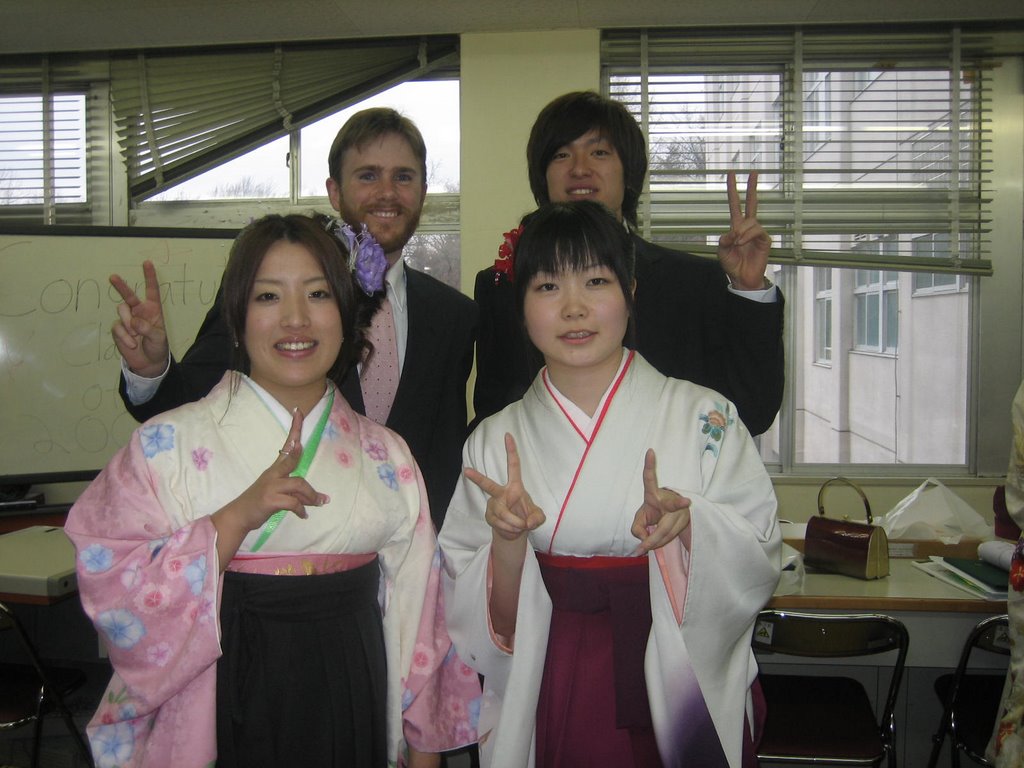
Today Hope, Bonsai and YuS graduated from Iwate University. Although I am very happy for them I am also sad to see them go. Hope, Bonsai and YuS had been furiously working on their graduate theses after November and had little time to update their blogs. I also worked with each of them on an individual level and I think they they should be proud of their papers. Below, I will briefly summarize their papers:

YuS (Top Right) Wrote about "Why do students fail in English and how can we help them?". He gave a questionnaire to students at a nursing school and asked them to answer questions about their experience in their junior and senior high school English classes. Among his manydiscoveries were that students evaluated their classes lower and lower as they advanced in grades and many students found their classes montonous. This did not mean, though, that students did not want to learn English; many students did. Citing Nakajima (1997) he recommended that teachers create activities that emphasize the pleasure of learning English, teachers should meet and try to strive for similar goals in their classes (e.g. students can become frustrated when one teacher one year emphasizes speaking and another teacher the second year emphasizes grammar) and teachers should encourage cooperative learning among their students.

Bonsai (Bottom right) wrote about "What are the roles of ALTs and HRTs in effective English teaching. Bonsai read a lot of books and made a list of what the roles of ALTs and HRTs should be according to the literature. Below I have cited the roles Bonsai listed from her blog

(The roles of ALTs)
①To teach the pleasure of English
②English shower
③To improve students' communication skills
④Motivation for understanding other cultures and Japanese culture
⑤To praise and give confidence

(The roles of HRTs)
①Host
②Class control
③Model as a learner for students
④To remove the students anxiety and relieve
⑤Translator
⑥To connect the knowledge and skills to other subjects

Afterwards, Bonsai gave a detailed questionnaire to 8 ALTs designed to see how concious they were of the above roles. She found that for the most part they were but she added that for team teaching to be effective the ALTs and JTEs should meet before class and confirm their roles and pland the class together. Unfortunately, she discovered, this was rare.

Hope (bottom left) wrote about "The future of English education in Japan - What is the best cooperation between elementary schools, junior high schools, and high schools." She read a lot of literature on the topic and concluded that it was highly likely that English would become a subject in Japanese elementary schools in the future. Because of this, she argued, a cohesive English curriculum from Elementary to High School would be necessary. Thus, in the future the three levels of school will need to cooperate more to strive for common goals. To determine how schools can do this Hope conducted a few case studies and showed how junior high schools and elementary schools can cooperate by inviting junior high school students to elementary schools as guest teachers.

(The barbarian-like creature on the top left is yours truly!)

Monday, March 13, 2006

Hawaii


As I have gotten older, I have become less tolerant of the cold weather. Last week, I took my family to Maui for 5 days. At first, my son was petrified of the water either at the pool or on the beach. He remained petrified until his mother took him down the water slide in the hotel pool. The excitement of the slide made him forget about his fear of the water. In the picture to the left, my son and I are going down the water slide at the hotel. To the right is the path I walked down every day to go to the beach.
After living in Japan for 7 years, my stomach has told me it has decided it prefers Japanese food to American food. When I first came to Japan I thought the food was bland and unfilling. Now, though, rice is a staple and when I go to the states I find the food either too oily, salty, sweet or just too much.

Thursday, March 02, 2006

Cops and Foreigners in Japan

This morning I became very bothered by an e-mail I read. The e-mail came from David Arudou, a naturalized Japanese citizen who is active in defending the rights of non-Japanese residing in Japan or Japanese citizens who are of a different ethnicity. In the e-mail, he shared the following article in which a Japanese woman was mistaken for a South East Asian woman and arrested and detained for 14 hours for refusing to show the police her passport.
This reminded me of an experience I had with the police last December 27. I was driving from the city of Morioka, where I live, to the city of Hachinohe in Aomori prefecture with my 1 year-old son and wife. We were going to Hachinohe to take the ferry to the Island of Hokkaido where my wife's family lived. The drive to Hachinohe was about 150 kilometers. Usually we take the highway and it takes us about 2 hours. Our ferry was to leave at 7AM on December 27 and up until then we had had about 3 days of constant snow fall. The major highway was closed so we left our house at 2:30 AM and took the back roads to Hachinohe. At about 5 AM we were passing through the outskirts of a small city called Ichinohe. We were hungry so we stopped at a convenience store to get breakfast. One thing that really impressed me when I first came to Japan was how polite convenience store clerks were. When you enter the convenience store you are usaully greeted with an "irasshaimase" which means something close to "welcome" and after buying something the store clerk will thank you. When I entered this convenience store the clerk was very quiet and seemed to avoid looking me in the eye. It did not bother me because I was with my one-year old son and had my hands full as I was trying to let him walk around the convenience store to stretch his legs while prevent him from touching the convenience store merchandise.
We bought our breakfast and ate it in the car outside the convenience store. While we were eating, a police car drove by us in the parking lot. The car was moving at an extremely slow speed and I noticed that the two policeman were looking right at me. They stopped, backed up and parked their car. They came to my car and shined their flashlights at me and knocked on my window. I opened the window and one of the policeman asked me what I was doing at the convenience store at that time at night. The other policeman was shining his light at the back seat of my car and they soon realized that my wife and son were sitting in the back seat. Once they saw that I was not alone, their tone became much more polite. They told me that they were surprised to see me because they never see foreigners in that area, especially at that time of night. They then asked to see my driver's license, wrote down information about my license in their notebooks and left.
I was tired after driving 2 and a half hours through a snow storm and just wanted to get to Hachinohe in one piece. When we were actually on the ferry, I started to think about the incident and became very disturbed. If I had an Asian face, there is no way the policemen would have questioned me. So, me being a foreigner made me a suspect. My son has both Asian and caucasian characteristics and is also a Japanese national. Will he also be considered a suspect based on his ethnicity when he stops at a convenience store in the early morning?

Tuesday, February 21, 2006

The Worst Dialogue ever made for Nurses

In my time as an English teacher in Japan, I had accomplished very little until now.
I wrote the below dialogue as part of the listening section for a final exam of a class I taught to nursing students. It was full of the important terms we had learned over the semester such as bowel movements, acute pain and diarrhea. After writing the dialogue, I attempted to record it with a friend of mine. I played the nurse and he played himself, Mr. B. As is apparent in the recording, we said the dialogue with straight faces until Mr. B shared his diarrhea problem with me. After that, I realized how bizarre the dialogue was and we both could not say it without laughing. After over 100 tries and two hours we were finally able to act the dialogue from beginning to end without laughing. I saved all 100 of our attempts for posterity and decided to put some of our funnier blunders on the internet. Please click here to listen or press "play" below. I also challenge anyone to try to say this with a buddy and keep a straight face.

Mr. B hurries to the hospital; it is an emergency
Mr. B: Help me.
Nurse: What seems to be your problem?
Mr. B: I have a terrible pain in my stomach!
Nurse: Could you describe the pain?
Mr. B: It’s an acute pain!
Nurse: How long have you had the pain?
Mr. B: For about two hours!
Nurse: Have you taken your temperature?
Mr. B: No I haven’t.
Nurse: Ok. Let me take your temperature. It’s 38.9 degrees Celsius! You have a fever. How are your bowel habits?
Mr. B: I have diarrhea.
Nurse: I think that you might have the flu.

Note: I am current experimenting with embedding the sound files in the blog. Click play below and maybe you can listen to the above dialogue.

Wednesday, February 15, 2006

Honest Talk about Studying in America

Gami, who is in Illinois for a year, is writing about her experience studying at a US university on her blog. She has made some pretty interesting observations about the differences between Japanese and US universities. Keep us posted Gami!

Thursday, February 02, 2006

The Difference Between Thai and Japanese Middle/ High Schools

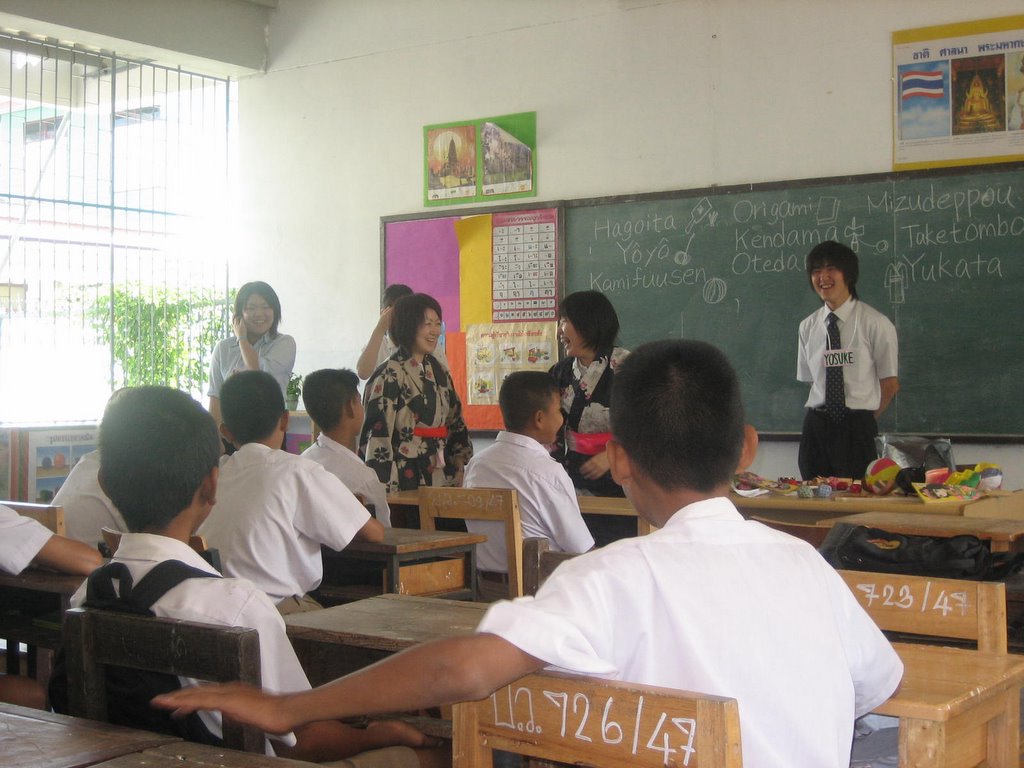
(To the left is an English class in Thailand taught by Japanese teachers.)
Today Eri, Ayu and I had an interesting talk about the differences we observed between the middle school/upper school we visited in Ayutthaya and the middle schools we have taught at or been students at in Japan. Cube, who will be going to the school this month, also participated in the discussion. As Eri mentioned in her blog, it is hard to tell for certain what the differences are because we were only in Thailand for a brief time and only saw one school. So this post will be about the differences we observed.

  1. Both Ayu and Eri mentioned that when they studied English in Japan, their teachers focused on vocabulary and grammar. Ayu said she felt the Thai students were a little more fluent because they spent their time in class practicing and learning phrases. Eri said that the school she observed tended to focus more on listening and speaking than in Japan.
  2. Eri mentioned that in the Thai classroom the teacher stood closer to the students. In the Japanese classroom the teacher stands on a podium and is farther away from the students.
  3. Another big difference was that at the school in Ayutthaya, the teachers made their own materials. In the Japanese classroom, teachers tend to use a textbook.
  4. Japanese students are required to have textbooks. In the school we visited students were not required to have textbooks and quite often the teachers provided the material.
  5. In the Japanese English classroom it is more difficult to call on a student. Let me give an example: I ask a student in class "How is the weather?". The student mumbles something I cannot understand. So, I ask "Excuse me, can you say that again?" The student looks embarrassed and freezes. He asks his friends what he should do. His friends tell him to say the phrase again. He hesitates to speak. His friends encourage him more and eventually he says the phrase again. Even if I still do not understand him, I will pretend that I do because I do not want to waste any more time. When I taught in Thailand, I asked a student a question. She answered, but I did not understand her. I asked her to repeat what she said in a louder voice. She repeated what she said without hesitation and I understood her.
  6. At the school in Thailand, all students in all classes had to do an independent project. In Japan, there tends to be less project work and more test-taking.
  7. In Japan classes usually start on time and there are very few changes to the schedule. In Thailand, the schedule seemed to change quite often. So classes quite often did not start on time. I actually found the unpredictability kind of exciting.
  8. In the Japanese classroom, the desks are usually aligned in (close to) perfect rows. In Thailand, the desks were not aligned in perfect rows.
  9. In Thailand, the students had to take off their shoes before entering their classroom. Teachers, though, did not have to take off their shoes. In Japan, students wear "indoor shoes" when they are in their classrooms and leave their "outdoor shoes" in a locker in the front hall of the school building.
  10. According to a Thai colleague of mine the goals of the national English curriculum are the following:

1) Communication: Students have to improve their four skills.
2) Connection: English should be connected with other subjects such as technology, history etc.
3) Community: students have to use English inside and outside the school
4) Culture: Students have to be able to understand about the culture of the other countries.

I believe that the national curriculum for English education in Japan has goals similar to 1) and 4) and perhaps 2) also. To my knowledge, they do not have a goal similar to 3). At the school in Ayutthaya, was that teachers had the freedom to design their own syllabus and create their own materials to accomplish these goals. In Japan, teachers do not have as much flexibility. Quite often a textbook will be chosen for a teacher by his department or school.

The above are the subjective observations of Ayu, Eri and myself and should not be taken as fact. If you would like to add something to the above or correct something, please write a comment!

Thursday, January 26, 2006

My son's new phrase, "What's that?"

My son can now say the phrase "What's that?". I was surprised when I first heard him because to my knowledge it is not a phrase I said much in front of him. Furthermore, he and I were apart for about 3 weeks while I was off in Thailand. We reunited on January 21 and I noticed that he was saying what's that on January 23. In the three weeks that we were apart, he heard very little English. Here is a recording I made on January 24 of my son asking "What's that?".
To hear more recordings of my son saying Japanese and English words, go to my voiceblog.

Wednesday, January 25, 2006

Reading Silently vs. Reading Along Revisted

A few months ago I asked students to listen to read the first part of a text and then read the second part of the text while listening to an audio recording of the text which was created by Ayu, Cube, Eri, and Gami. The post was titled Reading Silently vs. Reading Along. Three people did the exercise and all three wrote that the text was easier to understand when they could read silently to themselves. I tried a similar exercise at a teacher's workshop and the majority of the teachers said it was easier to follow along and read the text while someone else read it aloud because:

  1. The intonation of the speaker helped them understand the passage.
  2. If they saw words they did not recognize they could quite often recognize them after the speaker said the correct pronunciation.
  3. Having to follow along at the pace of the speaker forced them to ignore the words they did not understand and focus on the main idea. They did not get stuck on many words.

I used to be bothered that most schools do not give students the opportunity to read silently in English and in most classes students read the passage aloud and then analyzed it. Many classrooms still translate a text word for word and Torikai Kumiko mentions in her book TOEFL/TOEIC to Nihonjin no Eigoryoku (TOEFL TOEIC and the English ability of Japanese) that many Japanese students lack the Top-Down reading skills necessary to do well on the reading sections of TOEFL or TOEIC tests. I thought that reading aloud might be contributing to this problem but I changed my mind.

Through my experience at the teacher's workshop I realized that there are some benefits to reading aloud. For example, reason 3) is good for Top Down Reading Skills and Reason 1, or using intonation to help you understand a long utterance, is an important listening skill. However, I worry that if students are always dependent on someone else reading the text, they will not become independent silent readers.
Also, 3 of the contestants mentioned that they prefer to read at their own pace and there was a relatively large minority of teachers at the teacher's workshop who said they preferred to read at their own pace and could not follow the passage at someone else's pace. So, my opionion is that the reading class should have a balance of reading aloud and reading silently. There are benefits to both approaches.

Ayu, Cube,and Eri. What kind of reading activities did you do when you were a high school student and how did they help your reading skills?

Tuesday, January 24, 2006

Teaching English in Ayutthaya Thailand

Last week I came back from Thailand. My university has an exchange program with a secondary school (Grades 7 - 12) in Ayutthaya, Thailand. Two times a year some of our students will go to the school and teach English for a period of approximately 10 days. This time, I came along as an observer and watched Eri and Ayu do a fantastic job teaching their classes with the rest of their team.
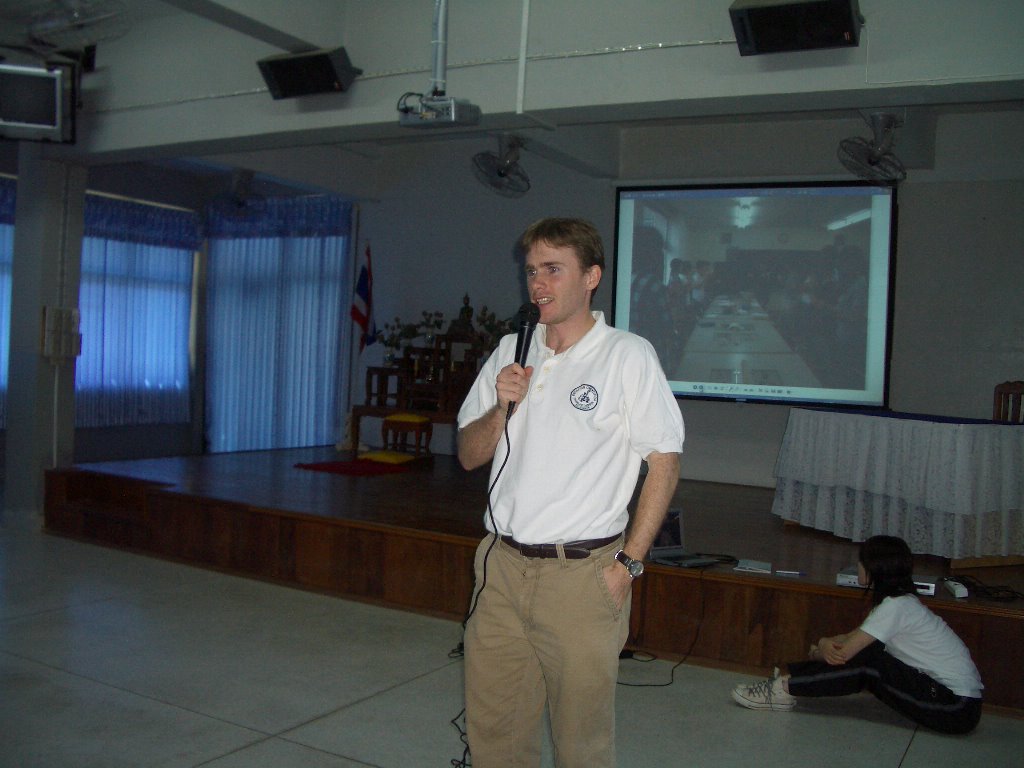
I also had the opportunity to teach two classes and it was a lot of fun! The first class (pictured above) was a presentation in which I talked about Iwate and our freezing cold winters while showing pictures of the university on the projector. I was nervous because I thought that me speaking in a foreign language for an extended period of time would bore the Thai adolescents to death. I was surprised that most of the students listened attentively and some actually asked questions.
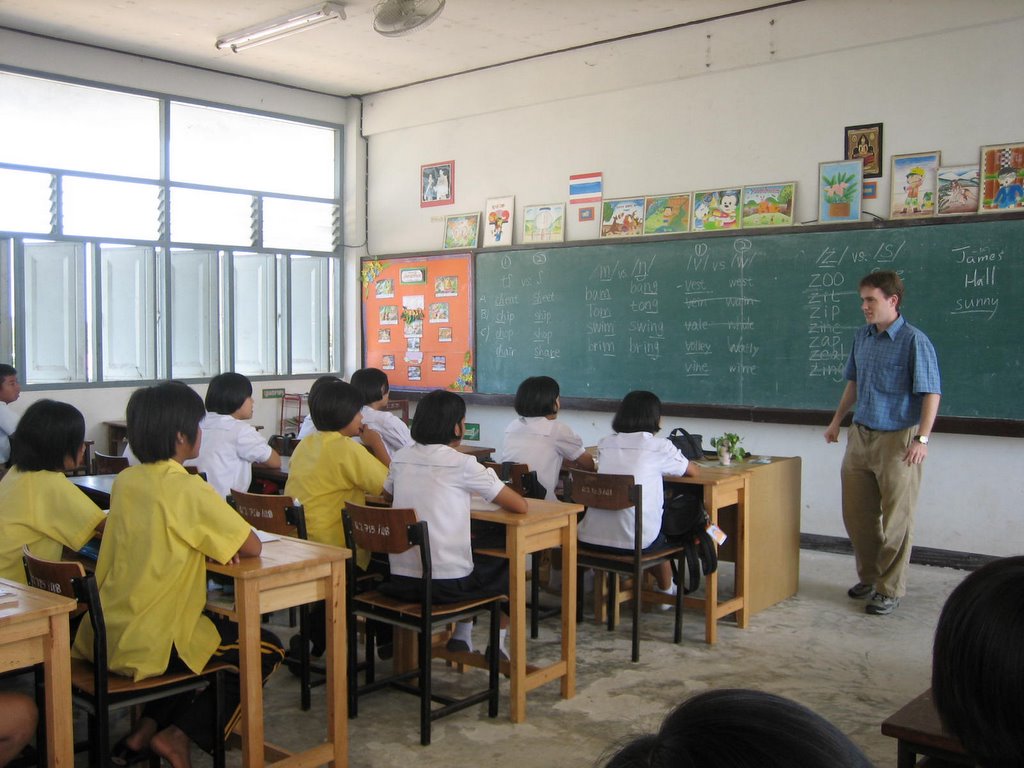
In the second class (pictured to the left) I taught pronunciation. The students were in their third year (9th grade US, chuugakkou 3 nensei Japan) and their energy and enthusiasm for practicing pronunciation was infectious.
In my experience teaching at Japanese Junior High Schools I had much more difficulty keeping the students' interests. The more the students lost interest, the more elaborate my lesson plans would become to win back their interest. These elaborate lesson plans had new activities and much more materials involved. This might have had a negative effect; overwhelming the students with the unfamiliar. In Ayutthaya, the themes of my classes were simple and the lesson plans were very basic. It was the chemistry between me and the students that made the class enjoyable. I should have worked on the chemistry more when I was teaching at a Japanese junior high school.
I have a lot more to write about my experience. I will do so later.