Showing posts with label cross-cultural understanding. Show all posts

Tuesday, October 17, 2006

Doing a Cross-cultural Understanding Class at a High School in Japanese


Two days ago, I went to a high school in a medium-sized city in Iwate. I gave a class to 40 high school students (from different homerooms) interested in my university. The high school requested that I give a "university lecture"for about an hour and then take questions from the students for a half-hour. I did a lesson about culture and talked in Japanese. This is what I did:
Ice Breaking: Students line up by birthday. They cannot speak nor use their hands. They can communicate by winking the months and blinking the days. After students made a line, I planned on putting them into groups of four with 2 boys and 2 girls in each group (this was essential for the main activity).
What actually happened: This activity proved to be difficult for the students. They felt embarrassed to wink and blink at each other and the line was never created. This activity is usally works well at the university, but high school students are a little more self-concious. After I put students in groups of 4, we had another problem: there was a lot of tension between the boys and girls in the groups.
Introduce the Topic: I said our goal today was to learn a little about what culture is and investigate some of the problems and understanding that might occur when people of different cultures meet. After defining "national culture" and "microculture", I talked about the different nationalities in Japan and the very high school I was visiting as examples of a microculture.
Examining our own culture: I gave the following scenario to students: "A group of aliens from Mars has just come to your high school. They are friendly people and have been across the universe researching the culture of other planets. They have come here to learn about the culture of your high school. Remember they know nothing about high schools on earth. Please brainstorm what you would tell them. For example, What do you eat?; What do you wear to school?, What do you do in school?, What do you do outside of school?". I gave the groups a few minutes to brainstorm some things they would tell the aliens and then called for volunteers to give some ideas. After some coaxing, 7 students gave ideas. The most frequent response to the aliens' inquiry was "we work hard", so I told the students that the aliens might consider the students of the school to be very busy.
I believe if I had done the following this mini-activity would have worked better:
Have each group choose a person to present before the activity started and tell each group that they have 5 minutes to come up with at least two ideas. I realized that brain storming is supposed to be a stream of ideas expressed freely, but students who are not used brain storming probably need to have it more structured at first.
The Anbura and Leba Activity:
Students formed two cultures; the Anbura and Leba. The Leba culture was very outgoing while the Anbura culture was much more reserved. Half the students received Anbura description sheets and the other half received Leba description sheets. I then asked students to read the sheets and gave them some questions to answer about their respective cultures with their groups. We then had an "Anbura, Leba Exchange Meeting" where students pretended to be the other cultures.
Students seemed to understand about their cultures. However, when the role play started most of the boys decided they were too cool to participate but many of the girls were really into their roles.
After the exchange, I asked the Anbura what they thought of the Leba and vice-versa. Some students answered in jest calling the other culture "sexy". Other students gave serious answers: one Leba called the Anbura "shy" while another Leba called the Anbura "cold". I then had the Anburas read their descriptions to the Lebas and vice-versa.
I told the students the point of this exercise was the following:
The descriptions of each culture written on the paper students read was objective and positive. However, a lot of students impressions of the other culture they met was negative. The Anbura were seen as cold by the Leba but the Leba did not know that the Anbura had a protocol for interacting with other cultures. Thus, we should not be hasty in making negative judgments about other cultures. I completed my "sermon" with some personal experiences I had in Japan where I made hasty judgements about people which I later regretted.
Conclusion of the class
The ending of this class should have had a period of reflection for the students but I had already used up an hour and ten minutes.

My Overall Impression of the Class:
Like my previous experience at the junior high school, it is not easy to go to a school and give a class to children only once. I need to be more conservative in my planning and compromise more of what I want to do to what the reality of the situation is. However, I do not want to compromise too much or I will be giving the students a typical lesson and there will have been no reason for me to come and visit the school.
It is exciting to do a class in Japanese, but I realized that the class is a little drier; it is easier for me to make jokes and be more of a performer when I do a class in English. When I speak Japanese, I sometimes have to devote most of my cognitive resources to producing the language and do not have enough left for spontaneous humor or entertaining performances.
Also, when I make a mistake in Japanese, students sometime laugh and lose their concentration.

Thursday, July 06, 2006

The Danger of Focusing too much on Cultural Differences

This time of year is always very stressful for me. Although it is a busy time of year as I have a full courseload, research to present in August right after the semester ends, university committees to serve on, a 21 month son at home, and a trip to the US to plan after my presentation is finished, this is not a source of my stress. The source of my stress lies in the two weeks I devote in my "Meeting of Multicultural Educators" class at university to studying the "national values" of other countries. Professor Geert Hofstede, classifies national values into five dimensions: power distance, individualism vs. collectivism, masuculinty vs. femininity, uncertainty avoidance, and long term orientation vs. short term orientation. Approximately 76 countries/ regions have been ranked on the degree to which they show characteristics of each dimension. For example Uncertainty Avoidance is defines as reflecting "the extent to which a society attempts to cope with anxiety by minimizing uncertainty. Cultures that scored high in uncertainty avoidance prefer rules (e.g. about religion and food) and structured circumstances, and employees tend to remain longer with their present employer."(from Wikipedia (2006). Geert Hofstede.)
Many of my students, who are of course Japanese, seem to prefer structured situations to unstructured situations and hesitate to ask open-ended questions. Conversely, when I was a student in the USA it seems that a majority of the questions I was asked were open-ended. Furthermore, when a teacher asked a question to the class I would raise my hand and try to guess the answer even if I was only 50% certain that I knew the answer. In terms of uncertainty avoidance, Japan scores much higher that the US. Although Hofstede's theory is not without its critics and problems, I find it a fascinating way to look at the national cultures of various countries and also helpful. If a teacher knows that the students he will teach are more likely to handle open-ended questions differently than the students from his home country, he will not put his students in uncomfortable situations as frequently nor will he feel frustration when a student does not answer his question.
Nevertheless, when I study Hofstede's national values I start feeling melancholic; I am ready to jump on the boat and cross the Pacific to the U.S. Why? I think the reason is that I start to think too much of the differences between the U.S. and Japan and start feeling culture shock. My surroundings become unfamiliar and I develop the urge to be back in my familiar environment where peoples' behavior makes sense to me. After the two weeks with Hofstede end, I seem to get reaccustomed to Japan and stop thinking about the differences between it and my home country.

Thursday, February 02, 2006

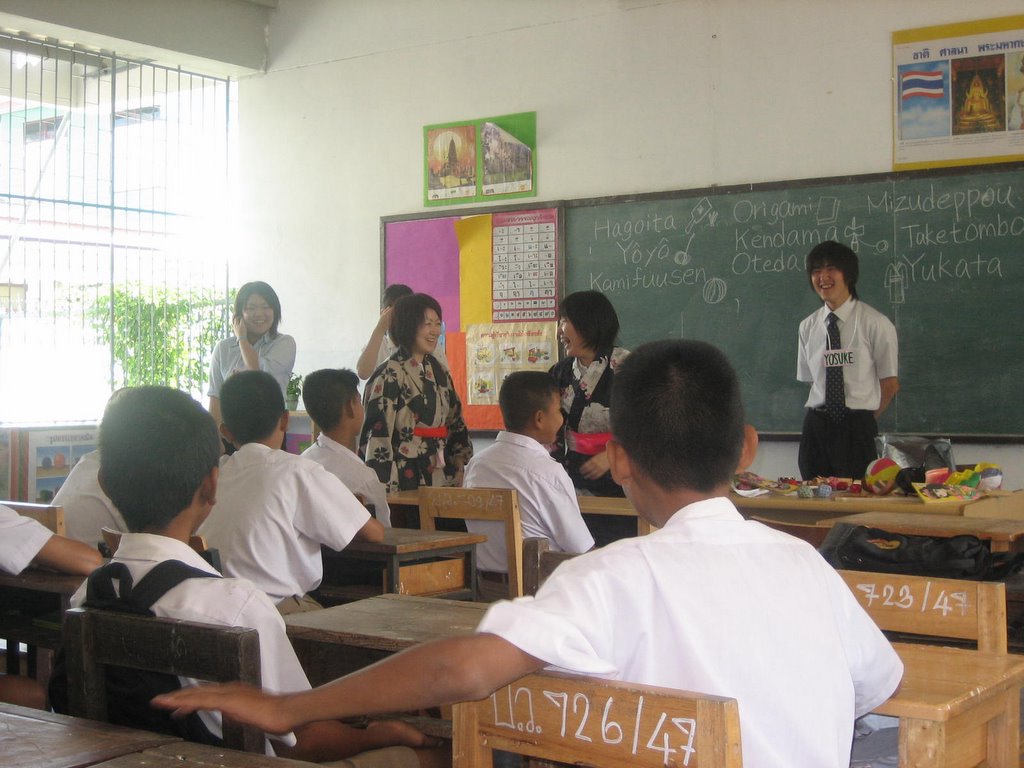
The Difference Between Thai and Japanese Middle/ High Schools

(To the left is an English class in Thailand taught by Japanese teachers.)
Today Eri, Ayu and I had an interesting talk about the differences we observed between the middle school/upper school we visited in Ayutthaya and the middle schools we have taught at or been students at in Japan. Cube, who will be going to the school this month, also participated in the discussion. As Eri mentioned in her blog, it is hard to tell for certain what the differences are because we were only in Thailand for a brief time and only saw one school. So this post will be about the differences we observed.

  1. Both Ayu and Eri mentioned that when they studied English in Japan, their teachers focused on vocabulary and grammar. Ayu said she felt the Thai students were a little more fluent because they spent their time in class practicing and learning phrases. Eri said that the school she observed tended to focus more on listening and speaking than in Japan.
  2. Eri mentioned that in the Thai classroom the teacher stood closer to the students. In the Japanese classroom the teacher stands on a podium and is farther away from the students.
  3. Another big difference was that at the school in Ayutthaya, the teachers made their own materials. In the Japanese classroom, teachers tend to use a textbook.
  4. Japanese students are required to have textbooks. In the school we visited students were not required to have textbooks and quite often the teachers provided the material.
  5. In the Japanese English classroom it is more difficult to call on a student. Let me give an example: I ask a student in class "How is the weather?". The student mumbles something I cannot understand. So, I ask "Excuse me, can you say that again?" The student looks embarrassed and freezes. He asks his friends what he should do. His friends tell him to say the phrase again. He hesitates to speak. His friends encourage him more and eventually he says the phrase again. Even if I still do not understand him, I will pretend that I do because I do not want to waste any more time. When I taught in Thailand, I asked a student a question. She answered, but I did not understand her. I asked her to repeat what she said in a louder voice. She repeated what she said without hesitation and I understood her.
  6. At the school in Thailand, all students in all classes had to do an independent project. In Japan, there tends to be less project work and more test-taking.
  7. In Japan classes usually start on time and there are very few changes to the schedule. In Thailand, the schedule seemed to change quite often. So classes quite often did not start on time. I actually found the unpredictability kind of exciting.
  8. In the Japanese classroom, the desks are usually aligned in (close to) perfect rows. In Thailand, the desks were not aligned in perfect rows.
  9. In Thailand, the students had to take off their shoes before entering their classroom. Teachers, though, did not have to take off their shoes. In Japan, students wear "indoor shoes" when they are in their classrooms and leave their "outdoor shoes" in a locker in the front hall of the school building.
  10. According to a Thai colleague of mine the goals of the national English curriculum are the following:

1) Communication: Students have to improve their four skills.
2) Connection: English should be connected with other subjects such as technology, history etc.
3) Community: students have to use English inside and outside the school
4) Culture: Students have to be able to understand about the culture of the other countries.

I believe that the national curriculum for English education in Japan has goals similar to 1) and 4) and perhaps 2) also. To my knowledge, they do not have a goal similar to 3). At the school in Ayutthaya, was that teachers had the freedom to design their own syllabus and create their own materials to accomplish these goals. In Japan, teachers do not have as much flexibility. Quite often a textbook will be chosen for a teacher by his department or school.

The above are the subjective observations of Ayu, Eri and myself and should not be taken as fact. If you would like to add something to the above or correct something, please write a comment!

Thursday, August 04, 2005

MMCE Facilitator's Handbook

Welcome to the English Teacher Discussion Forum. This is a blog I use for another class but it will now also be used for MMCE! This post is for the Facilitator's Portfolio I created for a "class" called the "Meeting of Multicultural Educators." The objective of the portfolio is for me to one 1) consider how a strong curriculum can be built for this learning experience and 2) serve as a resource of ideas for other practioners to try and improve on. If you have looked at the portfolio and have any thing you would like to say. Please write a comment to this post.