Monday, September 03, 2007

Cycling from Morioka City to Kuriyama, Hokkaido: Part 2

Day 1: Morioka City to Aomori City: 200 kilometers (August 10)

There isn't actually so much to write about this day. I rode 200 kilometers in 16.5 hours. It was brutal and I did not do anything very fun, I just rode and rested. I am writing about this so any novice cyclist can learn from my experience or any somewhat experienced cyclist can laugh at me.

As I mentioned in my previous post, I had originally planned to go from Morioka to Aomori City in 2 days leaving Morioka on August 10 and arriving on August 11. From Aomori I planned on taking a ferry to Hakodate. Because the ferries were going to be completely booked from August 11 and I would have a very difficult time getting my bicycle onto the ferry I decided to get to Aomori city on August 10.

I planned to leave my house at 3:30AM on that day and figured I could do 200 kilometers in about 12 hours averaging about 20 kilometers an hour and using 2 hours for rest. I imagined myself arriving in Aomori at about 4PM and being in Hakodate that night drinking beer and eating sushi with friends. Boy, was I wrong.

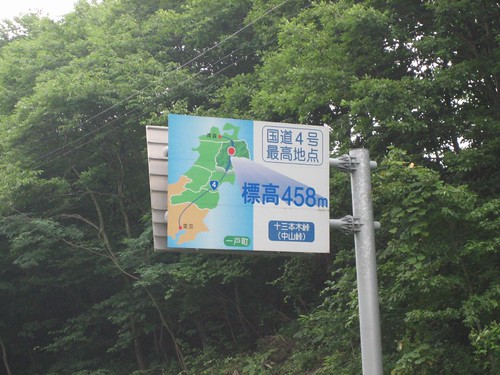
I got out of bed at 5 AM and it took me about an hour and half to get ready for the journey. I left my house at 6:30 without eating breakfast. My plan was to take route 4 all the way from Morioka to Aomori. In a little over an hour I had gone about 20 kilometers. I was not going as fast as I wanted but I was happy with my progress I stopped off at a Daily Yamazaki convenience store and ate breakfast and then was back on my way. In not so much time I was in Iwate-cho, 40 kilometers from Morioka. Soon after passing through Iwate-cho I experienced the 奥中山高原 or the Okunaka Mountain High Plains. The sign on the right marks the highest point on route 4, 458 meters above sea level. At this point I thought that I had overcome the hardest stretch of the trip. That was not to be the case.

After passing through Okunaka Kougen I arrived at 一戸 or ichinohe. "Ichi" means one and "he" means "door". Interestingly, there also exists a "2 no he" a "3 no he" a "5 no he" a "6 no he" a "7 no he", an "8 no he" and a "9 no he". I would have the honor of passing through all the "no hes" except for "8 no he" and "9 no he". Throughout the day, I wondered what the founding fathers of Iwate Prefecture and Aomori Prefecture were thinking when they were naming the towns. There must be some interesting history there.


At Ichinohe, the rain changed from drizzle to downpour. Because I was in a hurry to get to Aomori, I decided to go on in the pouring rain. As I was cycling up a hill I saw a cyclist standing under a tree waiting for the rain to stop. We made eye contact and he looked at me as if I was an idiot for cycling in the pouring rain. In this pouring rain, my feet and undergarments became soaked and would remain damp the rest of the 16 hours. When cycling, bring good water-resistant apparel as well as wear water resistant shoes or avoid cycling in a downpour.


After Ichinohe I passed through Ninohe (2 no he). As I was leaving Ninohe, I had gone about 80 kilometers and it was 11AM. I was feeling confident that I would be in Aomori city by 5PM. Unfortunately, 5 kilometers outside of central Ninohe I had a setback. As I was cycling up a hill, all of a sudden the back of the bicycle felt heavy. I looked down and realized that I had a flat tire. I got off my bicycle, tried to pump up the tire and realized that the hole in the tube was too big for any air to stay in the tire for a period of time. I took my spare tube out of my bag but soon realized that the valve of my spare tube was incompatible with my pump. According to the Japan Cycling website, most bicycles in Japan use a "Woods valve" (in Japanese the notation for this is 英) while the international standard is a "French" (仏)or "American valve" (米). The tube on my bike was an American valve so I had bought a pump compatible with that kind of valve. The lesson I learned is that when cycling in Japan bring a pump that can do Woods as well as French and American valves.


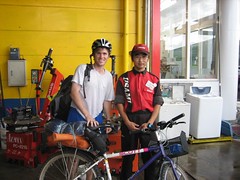
I was closer to Ninohe than Sannohe (3 no he), but did not want to walk in the oppostite direction so I decided to walk towards san no he and pray that I find a bicycle store along the way. After walking about a kilometer, I came across a gas station in the middle of no where. I explained to them my predicament and they told me that the nearest bicycle store was 10 kilometers away. Of course, they did not sell bicycle pumps. I asked them if they could pump up the tire and they said yes. I then asked them if they change the tube and they said yes. So I got to sit in the waiting room of the gas station and have a coke as the attendants fixed my bicycle tire. As I was sitting in the waiting room, I saw the cyclist I saw under a tree in Ichinohe pass the gas station. They also patched my tube for me and informed me that it had been punctured by a nail. Getting my tire fixed cost me 1050 Yen. It was money very well spent as I felt well rested and ready to cycle the remaining 118 kilometers. Later, when I recounted the story to a Japanese friend he said that the reason why the gas station helped me was because I was a foreigner and they might have blown off a normal Japanese. I don't know, though, these people acted like cyclists had come to them before when they were in trouble.
I left the gas station at close to 12PM. About 45 minutes later I was leaving sannohe (3 no he) when it started to pour. I was fortunate enough to see a michinoeki or "road station" which is similar to a highway rest stop. I stopped in the michinoeki, parked my bicycle and saw the cyclist who I had seen in under a tree in Ichinohe and pass me at the gas station between ninohe and sannohe, sitting under the porch of the rest area house sipping tea. I sat next to him and introduced myself. He lived near Morioka and was on his way to Hachinohe, a city about 30 kilometers from our present position. When I told him my destination and plan he called it 無謀 (mubou) which means foolhardy. A woman working at the rest area house overheard our conversation and gave me a cup of green tea. After about 10 minutes the rain stopped, and I felt good and ready to go the remaining 95 kilometers. It was about 1:30 PM.

After 10 minutes of riding the sun came out. I soon left sannohe and entered gonohe (5 no he). There is no 4 no he because the pronunciation for 4 sounds like the character for "death" and thus it is considered bad luck. At gonohe I encountered hills and mountains that went on for many kilometers. It was at about this time that I started to feel extremely fatigued. It seemed like everything was uphill and it never ended. I could have stopped in central gonohe but decided to continue. I thought that I could make it to Towada city which was about 20 kilometers away. The hills, though, became mountains, and my progress became agonizingly slow. At about 3PM I pulled into the Towada michi no eki barely able to stand. I ate a quick lunch and fell asleep for an hour. I woke up at 4:15 PM and left the michinoeki at 4:30 PM. I still had 80 kilomters to go to Aomori City. Between 6:30 AM and 11AM I had manage to cycle 80 kilometers. Between 12PM and 3PM, though, I had only managed 40 kilometers. My pace was slowing down and I was feeling tired even after my hour long nap. I had 80 kilometers to go, it was 4:30 PM and it would be dark before 7PM.

To make a long story short. The remaining 80 kilometers were hilly but not mountainous. I had to rest about 10 minutes for every hour I rode. Also, once it became dark my pace slowed even more. I made it into Aomori City at about 10:30 and then got lost. Route 4 approaching Aomori City is not bicycle friendly and I would recommend that cyclists try to find an alternative route into the city if possible. After asking for directions at a police box I was able to find the ferry terminal at about 11:30PM.

I had made a ferry reservation for early morning (5AM) for myself on August 11. They told me that I would be unable to take my bicycle so I had bought a bag (輪行 - rinkou)to put my bicycle in so that I could carry it on the ferry as luggage. When I got to the ticket booth at the ferry terminal I asked the agent if I could change my reservation and ride on the 1AM ferry. He looked at me as if I was crazy and informed me that the 1AM ferry was completely booked and that all the ferries leaving the next day and the day after were completely booked. He told me that if I wished they could put me on the wait list for the 1AM ferry and that I should go to the "waiting list" line. When I spoke to the agent at the waiting list line he told me that I could ride on the 1AM ferry with no problem. I asked him if I could also bring my bicycle on the ferry and he said no problem, I could put it together with the motorbikes. At that moment, I wondered why in the hell I had spent 12,000 yen for a bicycle bag. (The bag turned out to be very useful when I packed the bicycle in my car.)

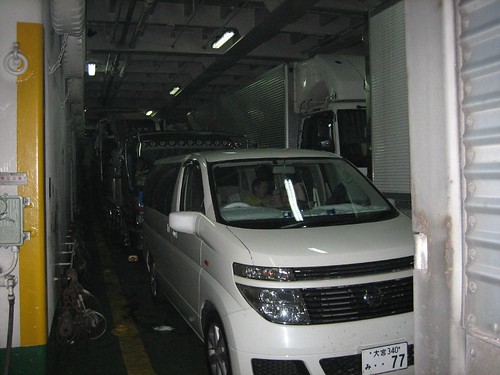
Boarding the ferry was pretty interesting. I boarded the ferry together with the motorcycles, pedaling my bicycle into the ferry while the other bikes motored in. My bicycle, Sheila, was tied to the wall of the garage as the picture to the right shows. Disembarking from the ferry was a little unpleasant. About 20 minutes before the ferry docked, all drivers, bikers and cyclists were instructed to go into the garage and wait in their cars or on their bikes. When I got into the garage, all the cars and trucks had their engines running and I felt like I would die from carbon monoxide poisoning. I took a picture of the scene and you can see it on the left. Eventually, the garage doors opened and I pedaled off the ferry between one big white truck and one dark one. I had made it to Hakodate. It was 5AM and my friend Bill was there to greet me. I decided the first thing I would do was go to Hakodate's Morning Market and eat sushi.
To be continued....

Tuesday, August 21, 2007

Cycling from Morioka City to Kuriyama, Hokkaido: Part 1

Ever since I moved to Morioka (Iwate Prefecture) from Hakodate, Hokkaido, I had wanted to bicycle from Morioka to my wife's hometown Kuriyama which is right in the center of the Island of Hokkaido. After 4 years of putting it off, this year I decided I was going to do it. My wife and son went to Kuriyama ahead of me and I was to meet them there. My plan was to bicycle from Morioka to Aomori City (200 kilometers) take the ferry from Aomori to Hakodate. Cycle from Hakodate to a town called Oshamanbe (93 kilometers) and then from Oshamanbe to a city called Muroran (about 90 Kilometers). Lastly I planned on cycling from Muroran to Kuriyama (about 100 kilomters). In Kuriyama, I would stay with my in-laws and then put my bicycle in our car and drive/ take the ferry back to Morioka with my wife and son.

I left Morioka on August 10 and had made it to Date, Hokkaido, a town 30 kilometers from Muroran city by August 13. In Date, I called it a trip and had my wife come pick me up. I was about 120 kilometers from Kuriyama. Although I did not make it to my final destination, it was a fantastic journey and I would recommend traveling around Japan by bicycle to anyone who is game for it. In the following posts I will talk about my journey and I hope that anyone interestecd in taking a cycling trip in Japan will be able to learn from my mistakes.

Preparing for the Trip

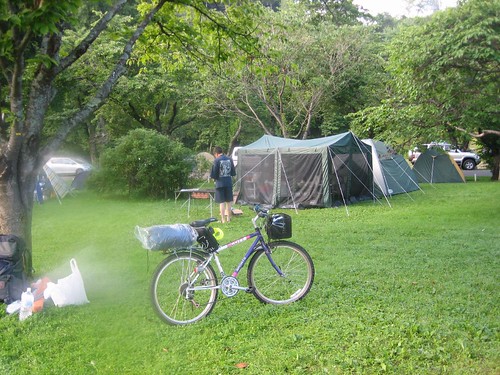
On August 1, I had asked a local cycle shop, Nakahata Cycle Shop (サイクルショップナカハタ), who I was friendly with whether or not they could find me a bicycle that I could use to go on a long road trip. At the shop they only had the prototypical Japanese urban basket bicycles (Mama chari) but the proprietor asked me what my budget was and said that he would make me a mountain bike out of a used frame he had in the scrap yard at his house. By August 5, I had a mountain bicycle complete with a bell/compass, rear blinking light, front light, front basket, a rear mount which I could tie a tent and sleeping bag onto, and a speedometer. I had originally told the repairman that my budget was 20,000 yen but when I saw the bicycle I assumed that it would be more because they had thrown all these accessories onto it. I was surprised when they only asked for 20,000 yen. Here is a picture of my bicycle resting at a campsite in Oshamanbe Hokkaido. As you might tell, I became quite attached to it. As it was originally a women's mountain bike, I think I will call her Sheila.

On August 8, I bought the Touring Mapple (ツーリングマップル) map of Hokkaido and Tohoku (Northeast Honshu). These maps also provide information about road conditions, restaurants, camp sites, youth hostels, rest areas and tourist sites for their regions. They proved to be immensely helpful.


On August 9, a day before I was to leave, I borrowed a tent from a colleague and intended to go shopping for gear that I would need for the trip. Here are two web pages that recommend what kind of gear to bring for a long cycling trip: Adventure Cycling Association: "How to pack and what to take"; REI: "Cycling Expert Advice".

Before I left my house to go shopping, I suffered my first setback: I learned that the ferries from Aomori city to Hakodate were completely booked on August 11! My original plan was to take two days and one night to go to Aomori city from Morioka. The people at the ferry terminal told me that I, myself, could ride the ferry but it would be impossible for me to take my bicycle. Bicycles are classified as motorbikes and must ride with the cars on the ferry. Although they are classified as motorbikes they only cost 900 yen to bring on the ferry which is considerably less than a motorbike. When I was told I could not take my bicycle on the ferry I panicked because my trip to Hokkaido was now in jeopardy. In the midst of my panic, I remembered that I had read something about a bicycle bag called a rinko (輪行) on the Cycling Japan website and immediately called the ferry company asking them if I could carry my bicycle on the ferry if it was put in a bag. Their answer was yes and my next challenge was to find out where I could find a rinko in Morioka.

I decided I would kill two birds with one stone and buy my camping goods and rinko together. A friend of mine recommended that I buy my camping gear at either Homac, Takeda Sports or Sunday. Homac and Sunday are big home amenity stores that sell everything from hardware to wood to bicycles to camping gear. I ended up buying a 1000 yen sleeping bag at Homac and a flashlight. At Takeda Sports I bought running shoes and something close to cycling shorts. Takeda Sports also had almost the exact same camping gear as Homac for the same prices. I learned that you can get a lot of cheap camping gear at big stores such as Homac or Takeda Sports. I was disappointed, though, to find that these stores had a very poor selection of bicycling gear and I worried that I would not be able to find a decent cycling helmet or the rinko. I asked the clerk at Takeda Sports what the biggest bicycle shop was in Morioka and he told me that it was Sasaso Cycle Shop (佐々宗輪店) on chuuou doori (chuuou road). When I went to the cycle shop, I was happy to find a rinko and a good helmet (Although combined they cost more than my bicycle!). With the rinko, sleeping bag, tent, and bicycle I was now ready to begin my trip!

Because the ferries were going to be so full on August 11, the beginning of Japan's Obon holiday, I decided I should make it to the ferry terminal in Aomori by August 10. There were 200 kilometers between me and Aomori city. I thought that if I left my house at about 3:30 AM, August 10, I should make it to Aomori city by dusk (about 7:00 PM). I had cycled 50 miles with my father with relative ease when I was in high school. I reckoned that 200 kilometers was about 125 miles and I thought that if I could cycle 50 miles with ease then adding another 75 miles would not be so bad. Of course, Japan is a heck of a lot more mountainous than my home state of Massachusetts, and I would soon learn that mountains are much more difficult to tackle than long distances.

The night before I was to leave I was awake until about 1AM trying to take care of some last second work and did not get out of bed until 5AM. Along with my tent and sleeping back which was tied to the back of my bicycle, I had originally planned to take a small backpack, place it in the front basket of my bicycle and tie it down with a cord. When I attempted to put my belongings (a change of clothes, rain gear, maps, spare tubes, a bicycle pump and tools for my bicycle) into my small backpack I soon realized that it would not all fit. So I abandoned the small backpack idea, took out my big camping rucksack, stuffed my belongings into it and strapped it on my back. I knew that it was not wise (very dumb) to carry such weight on my back for a 200 kilometer trip, but I was in a hurry to get out of the house and any more delays would prevent me from reaching Aomori city that day. Besides, the rucksack was designed for trekking and had all kinds of straps that kept most of the weight off my shoulders. To the right is a picture of me wearing the rucksack and standing by the bicycle with an empty basket in Yakumo, Hokkaido. It was a big mistake not buying side carriers for my bicycle but I did the best I could carrying the backpack.

At 6:30 AM I left Morioka for Aomori city. In my next post I will talk about my 200 kilometer adventure and what happened to me along the way. Stay tuned.

Friday, August 17, 2007

Getting Strict: Changing my teaching style

It has been a long time.

I got a little burned out from sitting in front of the computer and reduced my computer time. For the past couple of months, I have used the internet only to keep up with my beloved Red Sox. At work, of course, it seems like I spend the majority of my day writing e-mails and when I get home at night I prefer not to look at a computer screen.

Well, a couple of months ago I had a very shocking teaching experience which has affected my teaching and personality in the classroom. First, let me give you a little background. I teach full time at one institution, a teacher's college, and part-time at a liberal arts university and a nursing school. At the teacher's college and liberal arts university I am pretty much myself in the classroom: I don't get angry at my students for not doing homework or skipping class and sometimes will share things about my personal life such as news about my son, what I did over the weekend etc. I find that this approach works well and for the most part the students are very diligent. If I was a tougher teacher who got angry at students for falling asleep in class (I tease them instead), punished students for being late or missing homework, or did not flash a smile in class I do not think I would get any more effort out of these students.

I had tried this approach at the nursing school where I teach a class of 40 students. About 25 are girls and most students are either 18 or 19 years old. A couple are in their mid twenties and one or two are close to my age. The content of this class is English for nurses. We study some medical English and dialogues to use with English speaking patients. I started teaching this class in April of 2007 for 1 and a half hours a week and the first few months went well. The students seemed interested in the class and always participated enthusiastically. Their quiz scores were also decent which meant that they were studying outside of class. There was one student who openly rebelled and went out of her way to show me that she was not going to try but I was confident that she would eventually change because I knew that she was better at English than she was pretending to be.

Well, last July after a few bad weeks I had one terrible class with this group and it changed the way I conducted class with them. Because I had missed a previous week's class, the nursing school asked me to teach two consecutive periods (about 3 hours). I thought that this would be a great opportunity to focus on speaking because it seemed like our speaking activities were always rushed. I designed a slightly redundant speaking activity that was supposed to take about an hour where students would do a role play. One student would play a clerk at a registration desk in a hospital and the other a patient. The clerk had to ask the patient about her insurance policy, etc. and write the information on a form. For these students the grammar for asking questions in English is incredibly difficult. Most of the students can ask questions using the be-verb (ex. Are you sick?) but struggled to ask questions using the do-auxiliary (Do you have a fever?) or wh-questions (What is your temperature?). I had designed this task so students would be asking a lot of do-auxiliary and be-questions so that they could get used to the difference. I has planned the pair work so that each student would do the role play about 5 times with a different partner. I realized that 5 times to do the same role play was a lot but I thought that students really needed the practice and that changing partners constantly would make the activity more fun for the students. I planned on giving the students 5 minutes to do the 1st role play and then to reduce the time limit for each ensuing role play. I was hoping to build on students' fluency. Before the task we reviewed how to make questions in English and had done some exercises. Let me tell you what happened.

From the very beginning about half the students acted like doing such an activity was about as exhilarating as a colonic exam. Like after you have run 15 kilometers and every step is a burden, for these students every time they opened their mouth was a tremendous effort and every time they moved their pencil on the paper to write a piece of information required extraordinary strength. As I have to wake up at 5:30 AM every Monday morning to catch the train to go to the city where this gosh darned nursing school exists and I had not had much sleep the night before so I could plan the day's activity, I was ready to throw these miserable students out the window and relieve their suffering (I am just being literary). To make a long story short, most of the students did not do a damn thing. The class became more like a social hour and after 40 minutes I called on a couple of random pairs of students to perform the role play in front of the class. The students who were called on looked at me with an expression that said, "How dare you?!" Their effort and performances were pathetic. I called on a second pair who did an even worse job. I stopped the second pair and told everyone in the class to shut up. At this point I was very frustrated. I told the class that I could not bear to watch them any more. I added that I considered them adults and not children. I told them that I am a busy guy and did not want to waste my time being their baby sitter. I then said that I was very disappointed with them and if they were not going to give me any effort I would not give them any effort. Then, I left the class (there was 20 minutes remaining).

I departed the nursing school as fast as I could. The nursing school teachers asked me how class was and I lied and said fine. If I had told the teachers what had happened, I am sure that they would have disciplined the students severely but I wanted to keep this matter between me and the students. I returned to my full time place of employment and was surprised that day to receive a class from the homeroom teacher of the nursing school students. She apologized and told me it would never happen again. One of the students had told the teacher.

The next week I had a class at the nursing school which would then be followed by a month-long summer vacation. I went to the class and did not prepare anything. Usually I had students use name cards in the class and I would call them by the nicknames written on their name cards. For this class, I did not use the name cards. Rather I used the seating chart to identify students and called them by their last names. For boys, I added the suffix -kun onto their last names and for girls I added the suffix -san. I did not smile once. I entered the class and told them to open their textbooks. We did the textbook and a handout I had made for that chapter a year before. I did 95% of the class in Japanese. I only used English to read the textbook. I called on individual students to translate certain sentences from English to Japanese or from Japanese to English. The class was quiet and everyone worked hard. Even the perennially rebellious girl had brought her textbook and was actually writing in her notebook. In this class there was no pair work, it was a teacher-centered class and English was not used communicatively whatsoever. Also, there was a great distance between the student and teacher in this class. Instead of me being Mr. Hall, the father, husband, wanna-be sportsman and diehard Red Sox fan living in Morioka, I was Mr. Hall, the teacher. The students were also just the students I did not care about who they were individually; I just looked at them as names on the seating chart. At the end of the class I asked students to write what kind of class they liked better. Did they like the style of the previous classes or did they like the style of today's class?

15 students said they liked the style of that day's class. 10 students said they liked the old way better. 15 students said they wanted a combination of both lessons. I was very interested to read the reasons of the 15 students who like the strict class the best. One student wrote that she liked the strict class better because she did not have to worry about working with other students or fighting with other students. Another student wrote that she felt nervous in that day's class but she liked that feeling of nervousness. Yet another student wrote that she felt that day's class was best because all her classmates could pay attention. Even one of the more energetic students wrote (in English) "I am sorry. I like today's class the best."

What does this mean? I interpreted this to mean that most of these students preferred to have a stricter teacher. They want to be taught more and want everything explained to them in Japanese. Many of them don't care about me or my personal life so I should not talk about it. Also, I should probably not ask them questions about their personal life.

Before I end this post, let me just say that I had been already using a lot of Japanese in this class and this class already included a lot of metalinguistic explanations (grammar rules) in the students' native language. I also felt that interaction, listening to a lot of English, and experimenting with using what you have learned was important for learning English. So, I had tried to make a class that gave students 1) a lot of exposure to English, 2) the opportunity to use English and a comfortable environment to use it in, and 3) the support they need in Japanese to be able to use and understand English.

Well, I did not succeed in doing the above. From now on I have decided to be an all-powerful teacher when I step in the classroom and forget who I really am for an hour and a half. I will use more Japanese and provide more explanations. I will do mostly the textbook and make supplementary handouts but not spend so much time planning activities. Perhaps for 10 minutes in each class students will have some kind of very controlled pair work activity where they have to read a dialogue or translate something into English or Japanese. For this class, I think it will work the best. I do not think it is the best way for these students to learn language but it is better for them to learn something than nothing at all.

Wednesday, May 02, 2007

A Simple Lesson Idea for Showing Students the Living Conditions of our World Inhabitants

This is a lesson that can be done in small or large classes. I have done this lesson in the cross-cultural understanding class I have taught the past 2 years. The goal of this lesson is to get students to think about how their standard of living compares to other of people's standard of living and also to teach them vocabulary related to global studies. This is a rough outline of the lesson.

Time: 90 minutes

I Introduction
Today we are going to investigate the different levels of standard of living that we can find on this earth. >
II <span class="blsp-spelling-error" id="SPELLING_ERROR_0">Excercise 1: How much money do people have?
Using the following map for reference, students fill out the following worksheet (Answers are on the second page). In the worksheet, students guess how much money each region in the earth would have if there were only 100 dollar bills, how many people each region would have if there were only 100 people, the number of dollars per person in each region, and what the area of each region of the world would be if the total area of the earth was 100.
This is based on a lesson from a Japanese Global Education group.

III Exercise 2: What is the standard of living of people on this earth?

Part 1
Students fill out the following worksheet (html version) (pdf version). This worksheet is taken from the popular "If the World were 100 People" book. The work sheet looks something like this:
If the World were 100 PEOPLE:

There would be:
____________ Asians
____________Europeans
____________ from the West Hemisphere
____________Africans
____________ from North America
____________ from South America and the Caribbean ____________Africans
____________from Oceania
___________ non-white*
___________ white*
etc... There are a lot of items.
Depending on how much time you have, students can guess the number for each item or you can have students read the items in groups and confirm that they understand each item (there are some difficult ones). The teacher goes over the meaning or explains difficult words.

Part 2
Students watch a movie called Miniature Earth which presents the "If the World were 100 People" data. It can be viewed freely on the internet or you can download it onto your computer for $5. Students fill out the blanks in the worksheet. Some of the items in the worksheet are not in the movie. You can have students guess these items and then tell them the answers. The answers for the worksheet can be viewed here.

Part 3
For homework students write what about the movie surprised them and how representative their country is to the global village of 100 people.

Thursday, April 19, 2007

New English Teaching Methodologies Blogging Project


My English Teaching Methodologies Class and I have started a new blogging project.
The class consists of 30 students; some of them plan on being English teachers, others plan on being elementary school teachers, and others plan on entering the private sector. Above is a picture of some of them doing a practice elementary school English class last year.
We started this class on April 12 and we will finish the first week of August. AStudents will be blogging about their experience as language learners and teachers as well as be using these blogs as a means to exchange ideas and opinions about teaching English. Please check out the class blog for links to the students' individual blogs. We hope that you can join us.

Wednesday, April 18, 2007

My Advisee makes an Elementary School Teacher Blog

One of my advisees who graduated last March, Olive, was employed as an elementary school teacher this year and is currently writing about the challenges and rewards of teaching at elementary school on her blog. It is a good reference, please check it out!

The Importance of Being Organized and Singing the Burnt Out Blues

It has been a long time since I posted. The past month and a half have been perhaps the busiest of my up to now not so busy life and I had a difficult time keeping up.
There were some good things: Last month I was promoted from lecturer to asscociate professor(准教授). It was an overwhelmingly time consuming task to apply for promotion as I had to submit every single paper I ever wrote as well as write and abstract in Japanese for each paper. I also summarized each presentation I had ever done and provided evidence that I had done the presentation. In addition to this I had to submit 4 other documents. What made this task phenomenally time consuming was my complete lack of organization. I literally spent days going through all kinds of documents etc. that had been collecting dust in the corner of my office for a couple of years. I also spent quite a bit of time tracking down those journals and short articles I had wrote that I had misplaced. Thanks to some good friends who are highly organzied people, I was able to submit everything I had to. My advice to anyone interested in working in a Japanese university is to make a concious effort to hold onto every paper you write or any artifact of a presentation you made (not just to throw everything into a space in your bookshelf). Also, I recommend that you write an abstract of your paper in Japanese or presentation soon after you finish it. One of the reasons the application process took me so long was I had to write abstracts in Japanese for some papers that I had written years ago and whose content I had forgotten about. Also, writing a concise abstract in English is not easy for me so writing one in Japanese is extremely challenging and usually has to be proofread. Somehow I was able to get everything together by the deadline, but I hope that this encourages people not to follow in my haphazard footsteps.

I was also involved in a couple of fairly big projects in February and March which included helping to produce a textbook (I primarily managed the accounting side), redesigning the Faculty of Education's website, contributing a few short essays to a book and a non-academic publication, grading tests and reading papers and writing reports for a few trips I took (Thailand & China). I also try to devote a lot of time to my family. So, I was feeling a little overwhelmed in February and March. The end result was that I did not do as well as a job with my classes as I would have liked and was not able to finish two papers about using vocabulary notebooks. I have realized that I cannot be an administrator and an educator/researcher at the same time. Unfortunately, this year administrative work took too much time and I have been left feeling a little inadequate as an educator/researcher.
Classes started tow weeks ago and I still had a backlog of administrative work form the previous academic year that I just finished. I like to try new things in my classes but this was the first time I had not been able to plan anything new before classes began. The past week, I have not felt my normal amount of energy when getting ready for the new semester. However, I am not completely impervious to the excitement that comes with the beginning of a new academic year; new students, and a rested, refreshed and enthusiastic returning student body. Also, reading the Autono Blogger and the Japan Action Research in EFL today gave me some new ideas and rekindled my motivation a little. Once the weather warms up I think I will be more back to normal and back to feeling like an educator/researcher.

Wednesday, February 28, 2007

Seminar with Paul Nation


On February 27 and 28 I attended a two day seminar with one of the world’s foremost experts on vocabulary acquisition theory and pedagogy. The seminar was held at an Onsen(hot spring) outside Sendai and coordinated by Sendai JALT. I had felt absolutely overwhelmed by work and completely burnt out but the seminar managed to reinvigorate me. At the beginning of the seminar Paul talked about 4 essential strands that should compose a foreign language class syllabus. Teachers should devote 25% of class time to each of the following strands:

Strand 1 - Meaning focused input: There is overwhelming evidence that comprehensible input with a few unknown items to the learner is essential for language acquisition. Paul recommends that the learners understand 95% - 98% of the words in the input with 98% being preferable. Meaning focused input can be accessed through extensive reading, communicative activities or listening to stories.
Strand 2 – Language Focused Learning: This denotes a focus on grammar and vocabulary as well as training in vocabulary strategies and intensive reading (reading involving translation).
Strand 3 – Meaning Focused Output: This is output in which the learner is trying to relay a message and is not worried about accuracy. Learners should use some unfamiliar items (at least 95% of their speech should consist of familiar items) to help them learn them.
Strand 4 – Fluency Development: Learners should read, write, listen, speak language that they already know (they should understand 99% of all items). The purpose of this strand is for learners to learn to use the language that they already know. Many Japanese, for example, know a lot of language but do now know how to use it.

For me, these 4 strands offer a good framework to use to plan English language courses. These days my mind is so jumbled that getting back to the basics and looking at the big picture of course planning was just what I needed.

Paul, of course, talked about the 4 strands in much more detail and offered many concrete examples for activities in each strand. If you are interested in learning more, please go to his website.

In the seminar, Paul also talked about learning words from cards, ways of giving quick attention to words, good and bad language learning tasks, teaching vocabulary, and word frequencies. I am writing this post on the bullet train on my way back home. I have another few deadlines coming up next week. When or if things settle down, I would like to write about using vocabulary notebooks versus using word cards and what Paul revealed about the vocabulary size necessary to read a novel in English.

Saturday, February 24, 2007

How to Give a Speech in a Foreign Language

I was asked to write an essay for freshmen students about how to give presentations in English. The essay will appear in the university class guide book for freshmen. I tried to write it in as simple English as possible so that students might actually be able to understand it. Nevertheless, I doubt anyone will really read it so decided to copy and paste it into my blog. Would anyone out there give any different advice that what I have given?


How to Give a Speech in a Foreign Language

Giving a speech in a second language is not easy. When we speak in our native languages we can sometimes improvise while we are speaking and add information or reduce information. When we speak in a second language it is much more difficult to improvise because a lot of our attention is devoted to the language itself. Since it is more difficult to improvise, it is important to prepare thoroughly before giving a speech in a second language.


How should you prepare? First, write out what you will say in your speech or take notes of what you will say. When I first started giving speeches in Japanese, my second language, I would write out everything I planned to say. After the experience of a few speeches though, I started giving speeches from notes. I recommend that you do whatever makes you feel the most comfortable. If you do not have much time to prepare, I think that giving speeches from notes is the most efficient method.


When writing out the speech, remember that the speech should be in your own words. The worst speeches in English I have seen were when students wrote their speech in Japanese and then used a translating program to put it into English. When they gave their speech, they simply read the computer translation. In these cases, the audience and even the speakers themselves did not understand the speech! When you put your speech in your own words, your personality is revealed because you have ownership of what is being said. Regardless of whether or not you are advanced in the second language, your personality and interest in the subject will maintain the listener’s interest in your speech.


Also, when preparing your speech consider who your audience will be. Will your audience be familiar with the topic of your speech? If your audience is not familiar with part of the topic, for example the fall of Ayutthaya in a topic such as “The Effect of the Historical Fall of Ayutthaya on Present Day Thailand-Myanmar Relations” you will have to explain about the fall of Ayutthaya.


The second part of preparation is practicing the speech. Even though I am fairly experienced at speaking publicly in a second language, I would never speak without practicing and always find the time to practice. Do not feel embarrassed about speaking out loud when no one is in the room or when other people not related to your speech are in the room. I have practiced for speeches in such places as my car outside the speech venue, a bullet train, a plane, a hotel room, a hotel lobby, a park bench, my office, and, of course, my house. In all these cases, the speeches I gave were successful because I took the time to practice.


When you practice speaking remember that maintaining eye contact with the audience during a speech is essential. If the speaker is staring at his manuscript or notes the whole time he is speaking, it will be harder for the audience to concentrate on the speech. Thus, when preparing for your speech, stare at a wall pretending that it is your audience, and try to say as much as your speech as possible to the wall while occasionally taking quick glimpses at your notes or manuscript.


Another thing to keep in mind when practicing is time. Time limits for a speech can be from 5 to 30 minutes. Even 5 minutes can seem very long, but when you practice you will realize that you do not have enough time to finish your speech! Usually when I practice, I find that I have to remove a third of the content from my speech to finish in the allotted time. Finishing on time is extremely important. For example, when a speaker finishes his speech in 20 minutes when it was supposed to be 15 minutes, it is rude to the next speaker who is waiting and the listeners find it annoying too because it extends the time of the event they are attending.


Although finishing on time is important, your speech should not be hurried. Let’s say that you have to speak as fast as you can to give what should be an 18 minute speech in 15 minutes. If you do this, I can guarantee you that your audience will not understand what you said. If you have 15 minutes to speak, make sure that you can finish your speech within those 15 minutes speaking at a moderate pace that is not too fast or too slow for your audience.


Lastly, when you are preparing for a speech it is a good idea to have someone look at your manuscript/notes or listen to the speech. The person could be your teacher, a classmate or a friend. The feedback that you receive from this person will help you give a better speech.


In conclusion, to give an effective speech, prepare thoroughly and, regardless of your ability in the language, give the speech in your own words. Enjoy yourself while you speak and your audience will enjoy listening to you!

Wednesday, February 07, 2007

Demonstration Test


Dear English A Students,
Next week is our final test. Here is what you will need to do for next week:
Part I: I would like each pair from 2/7 to select three of the startling facts (see the list we made here.)we took from the United Nations Human Development Report that you think represent the biggest problems the world faces. You and your partner will then talk about the following with another pair:
a) Why do you think these problems are so big?
b) What can we do to solve these problems?
To successfully do this task, you should
1) be able to speak without reading from a piece of paper.
2) be able to pronounce the words correctly.
3) speak with passion.
4) give the listeners time to ask questions
5) be ready to explain the meaning of unknown words.
When you are listening to other people speak, I will expect you to ask questions.
Part II: There will be a written test containing reading, writing, and voacublary from the following chapters of the textbook: Synchronicity, Alternative Medicine, Nightmares, Bizarre Foods, and Startling Facts. The best way to study for this is to study the word entries in your vocabulary notebooks. To do well on the test it will be particularly important to know the derivations of the words we have learned, know how the words are used, and be able to use some of the words. You can view a test I gave in the past here. The written text next week will be a similar style.
Attention: Tomorrow's test will be in room G19 of the 学生センター and not in room 203 of the Faculty of Education.
JH

Wednesday, January 31, 2007

Studying about Education in Japan


Recently, I held a two-week seminar about education in Japan with 2 American students and 2 Japanese students. The first week, we learned about the school system in Japan: pre-war education, post-war education, compulsory education, laws governing elementary schools, junior high school and high schools. The second week we read an article about discipline in junior high schools and had a discussion (Fukuzawa, E. (1995). The path to adulthood according to Japanese middle schools. In T. Rohlen & LeTendre, G. (eds.) Teaching and Learning in Japan. Cambridge University Press.)
Some of the highlights of the discussion are below.
(Note to the Reader: As I started to write the highlights of the discussion, a lot of my opinions started to come out and are thus half of the content below are my personal rantings rather than highlights of the discussion).
The Difference between elementary school, junior high school and high school: In elementary school, learning is less teacher-centered and more learner centered. Students do projects and are encouraged to participate actively in class. In junior high school, learning is more teacher-centered and teachers are more authoritarian. One of the reasons is high school entrance exams and teachers must complete the curriculum in limited class time. The primary goal of elementary school and junior high school are to socialize children in to becoming good citizens of Japan. Education is compulsory up to high school. Although high school is optional 97% of all Japanese young adults attend some kind of high school. High schools, for the most part, are more focused on academics and less on character building. Students must study, study, study to get into the university of their choice.
Cram School: In junior high school and high school many students attend cram school after their normal school. In my opinion can be good. For example, if a child does not understand something in his class, he can get extra help at cram school . Considering that teachers have to move at a fast pace, cram school can be very helpful. However, perhaps one of the drawbacks of cram school is that a teacher can too a very mediocre job in his class but it will not matter because the students can learn what their teacher failed to teach effectively in cram school. Thus, there is no pressure on teachers to improve their teaching. Another drawback is that students can afford to sleep through class because they might study the content later at cram school. I think the overall drawback to cram school is that it minimizes the importance of the traditional school class.
The Difference in Workload Between High School and University: MM, sitting in the back left, said that in high school she studied from early morning to midnight but at university that was not the case. It is common knowledge that in Japan to get into an excellent university students must study incredibly hard for the entrance examinations. After getting into university, perhaps some students want to take a well-deserved rest. MM, though, happens to be a hard worker.
Writing Diaries: Many junior high school students write a "self discipline" diary (see Yoneyama, S. (1999) The Japanese High School: Silence and Resistance. Routledge.) called a 修養日誌(shuuyou nisshi) which they have to hand into their homeroom teachers. In their diary they report how much they studied, what they did in a day, and any problems that are bothering them (sometimes they must color-code particular routines). They receive comments from the teachers either praising them, encouraging them to use their time better, or anything else. These diaries serve as a means of private communication between the students and teachers (Yoneyama, 1999, p.62). MM and AK, front right, said that in their cases they wrote these kinds of diaries (my wife, who is Japanese, had never heard of them). The American students and teacher asked whether MM and AK felt that this was an invasion of privacy to which MM and AK answered no; it was just something that everyone did.
Junior high school students being punished for bring snacks to school: In the book we read, there is a story of a teacher hearing that his students were chewing gum in school and interrogating a student to find out exactly who were the offenders, calling all the students into the staff room using the school PR system, thoroughly scolding the students, and calling the parents in for a meeting. These students had broken the school rule of bring gum into school. MM told a story about when she was a JHS student. She and her friend ate snacks in the bathroom. Somehow,her homeroom teacher found out and called the offending students together for a meeting, the called a homeroom meeting, and lastly the issue was brought up in the all school meeting. To the American students (and teacher) this seemed a little severe. On the other had, compared to the U.S., it is probably safe to say that less students in Japan are smoking cigarettes, drinking alcohol, and doing drugs (I have no statistics and cannot support this and am making this assumption through my experience as a student in the US and my experience as a teacher in Japan). We wondered, could these kinds of severe enforcements of school rules steer children away from even worse temptations such as cigarettes or alcohol?
Homeroom Teachers visit the homes of their students: This is called 家庭訪問 (katei houmon) in Japanese. As students in some schools must write a journal, teachers in Japanese schools are interested in the students' lives outside of school because that has a big effect on the students' performance in school. For example, if a student is continually late for school, it could be the reason is that he is going to bed too late at night so a teacher might talk to the student's parents so that the student will go to be earlier. As a student in the USA, if I was late to school or class, I was just yelled at or punished. No teacher ever thought about why I was late and tried to work with me to fix the problem.
From visiting a student's home, a teacher can learn about the student's environment outside of school. This, of course, can be beneficial to the teacher and both J (front left) and AB (back right) appreciated that teachers in Japan work hard to try to instill in the children good habits. However, J mentioned that sometimes a teacher who worries about a student's habits can cross a line and actually be invading the student's privacy.
There was more that we discussed, but I am too lazy to keep on writing. I would like to add one more thing . As a teacher in Japan, I have been amazed at how good students can be at listening and following directions. Perhaps, I have their teachers to thank for that. On the other hand, students come to class with a very serious look on their face, never seem like they are enjoying themselves and are reluctant to participate. It is as if they are socialized to believe that learning is necessary but has to be boring and come to class with that mindset. Sometimes, I think I have their teachers to thank for that too.
--------------Resources-----------------
Below is some useful information I have found about the Education System in Japan on the Internet.

An Outline of the Education System of Japan in Japanese: (日本の学校制度の内容):私はこのドキュメントを筑波大学のウェブサイトからダゥンロードしました。このドキュメントはとても、分かりやすく日本の学校制度を紹介します。

National Clearing House for United States - Japan Studies: An excellent site with an abundance of resources for teaching about Japan.

Educational Statistics from Japan

Worldwide Comparative International Education Statistics (In Japanese) 教育指標の国際比較: 日本,アメリカ合衆国,イギリス,フランス,ドイツ,ロシア連邦,中国,韓国等における教育の普及,教育諸条件,教育費等の状況を統計数字によって示したものである。
A Pages with Lots of Links about Education in Japan: I was too busy to click on any of the links and investigate, but this site looked like it could be promising.
Here are some books I have read about education in Japan:

Our Earth is in Trouble


The picture with snow was taken outside of the Faculty of Education last year. The picture without the snow was taken at about the same time this year. Climate change is starting to really scare me, and I hope that we will be able to make the changes necessary in our daily lives to avert a humanitarian catastrophe.
This January, I went to Bangkok, Thailand to see how schools and universities are practicing Education for Sustainable Development (ESD). You might not know this, but we are currently in the Decade of Education for Sustainable Development (DESD)which was declared by the United Nations. The objective of the DESD "is to integrate the principles, values, and practices of sustainable development into all aspects of education and learning." (I will blog about this later). For those of you unfamiliar with the term sustainable development, I would define it as national development that does not overuse natural resources or do irreparable damage to the earth.
In my university, I teach a class of 40 engineering and agricultural students. Maybe many of these students will be pioneers in creating new sustainable technologies in their fields! Since these students might be called upon to help solve some of the world's problems, I decided that we should learn what some of the world's problems are. I have asked students to go to the United Nations Human Development Report home page, find a world development statistic they find most startling, and report it as a comment to this post.
I have written the first comment to serve as an example.

Sunday, December 31, 2006

About Ferries in Northern Japan


Every New Years my wife, son and I go to Hokkaido from Iwate. Usually this entails driving from Morioka to Hachinohe (about 2 hours) and then taking a 6 hour ferry from Hachinohe in Aomori to a city called Tomakomai. We then drive from Tomakomai to my wife’s hometown, Kuriyama. We always take our car to Hokkaido.
This year, because of bad weather our ferry from Hachinohe on December 28 was cancelled. So we decided to take the ferry from Aomori City (about 2 and a half hours by car) to Hakodate (about 3 and a half hours) and then drive from Hakodate to Kuriyama (4 hours). We made a reservation for December 28 and it seemed as if the ferries were running. On December 27 we received a phone call saying that the days ferries for that day had been cancelled because of bad weather so they were canceling all reservations for December 28. Instead, we could show up to the ferry terminal on December 28 and take a number. When our number was called we could go on the ferry. They predicted that there would be a bout 100 cars ahead of us ( a ferry could take about 50 cars). Because the weather was scheduled to get worse we decided to leave on the 28th before the weather got really bad. We got to the ferry terminal at about 6:40 AM on December 28 leaving our house at 4:00 AM. We were told that there were 110 cars ahead of us and that we would not be able to board the ferry until after noon. My wife and I estimated that we would be able to board a ferry between 3 – 5PM. The ferry parking lot was full and there were trucks parked on the street. There were also a lot of people sleeping in their cars as they had probably been waiting for a ferry from the previous day. Most passengers on the ferry our truck drivers carrying goods from the main Island to Hokkaido and vice versa. The ferry terminal reeked of cigarette smoke as many of the truck drivers were drinking and smoking. Everywhere we went there seemed to be cigarette ashes and ash trays. Outside, most of the hundreds of cars and trucks had their engines running so the people inside could keep warm. So the air outside the ferry terminal wreaked of automobile emissions while the inside of the terminal smelled like a bar. This was no place for a 2 year old to hand out so my wife and I went sightseeing around Aomori city.
We went to a beautiful hot spring (onsen) at a hotel called Jogakura (城ヶ倉) in Hakkouda Mountain (八甲田山). My son and I went into the bath together. The hot spring had an outdoor batch and my son and I sat in the bath with me staring at the snow covered trees and falling snow and my son playing in the bath. It was one of the most serene and peaceful moments I had experienced in years. Unfortunately, the clock was ticking and we decided to go back to the terminal to check on the ferry. We arrived at the terminal at about 1PM. There were no fewer cars, people were still partying in the ferry terminal, and it seemed that few numbers had been called since we departed for the mountains. So, we decided to go into Aomori City and eat lunch. For lunch we went to a big shopping mall. In the restaurant, the waitresses were very impolite, my son was crying and refusing to eat, and everyone around us was smoking. It seems like there are a lot of smokers in Aomori city. We saw a grandmother and a mother with her infant daughter enter the restaurant. They sat down and then the grandmother and mother lit their cigarettes up. The food was not so good either. It was a pretty lousy lunch but my son cheered up and ate so the lunch ended well. The shopping center also had a children’s play space where my son could entertain himself.
We got back to the ferry terminal at about 3:30 PM. Few numbers had been called and some of the truck drivers were starting to get a little restless. In the span of 20 minutes there were two outbursts directed towards the ferry ticket clerks. While the truck drivers insulted them, the ticket clerks bowed their heads and said “moushiwake arimasen” which translates roughly to “How can you ever forgive us.”
I took my son on a 30 minute walk and we observed to boats and the trucks. I put him on my shoulders and ran along the edge of the dock. My lungs started to burn a little and realized that it probably was the result of the exhaust coming from all the trucks (please see the picture). My son saw a ferry docked and insisted that we go on. I had to explain to him that it was not our turn. I do not think he understood the specific reason but he accepted the fact that we could not go on the ferry for a while.
We spent the next two hours hanging out in our car and going into the ferry terminal to see if their were any other developments. At about 5:30 PM we drive to a super market to buy dinner. When we got back to the ferry terminal at 6PM I realized that out number had been called and our ferry was boarding. I drove the car to the ferry as fast as I could and we were the second to last car to board. Once we were on the ferry, the voyage was fairly pleasant. We were in the economy cabin which consists of a carpeted floor and some pillows. Every passenger stakes their own territory and then tries to sleep. We staked our own territory, my wife and son slept, and I read in peace. It was very nice. The ferry arrived at Hakodate at about 10PM and then we arrived at Kuriyama at about 3AM. Altogether, it was a 23 hour trip. That is about as long as it takes us to go to Boston. The moral of the trip was that if you can avoid waiting at a ferry terminal do so.

Tuesday, December 26, 2006

Learning Styles of Japanese JHS and SHS according to the Teachers

Today, I held a two day workshop on Task Based Language Teaching with 2 junior high school English teachers and 5 senior high school English teachers. For one of our activities we read an article by Jerry Call called "Expanding the Learning Styles of Japanese Analytic Learners" in the book Understanding Learning Styles in the Second Language Classroom by Joy M. Reid. As a task, we made a list of the characteristics of learning styles Call had given for Japanese learners and then discussed whether we agreed or disagreed. We ended up discussing about not only the characteristics that Call gave but also many other characteristics the teachers themselves gave. It was an interesting discussion. The main reason why was that each teacher worked with learners of differing learning characteristics. This reinforced my belief that it is difficult to make generalizations about a society of learners; even one as homogeneous as Japan. Below, I have written some of the characteristics Call and the teachers gave as well as the teachers' opinions.

Characteristic 1: Japanese learners are quiet

Opinion: The teachers were not sure about this characterization. Teacher M, a junior high school teacher, said that her students were not quiet and were especially enthusiastic about speaking English with foreign teachers (ALTs). She added that girls at her school tend to be good at writing but they cannot speak well while boys tended to be stronger at speaking.
Teacher C, a high school teacher, said that her students were quieter but it depended on the situation. In interview test students are very quiet but in class they are very noisy and like to imitate the ALT’s or Ms. C's English.
Teacher Min, a high school teacher, thought that Japanese learners, especially young learners, are very energetic to learn English. However, she said that in Japanese settings, students are supposed to be quiet and listen to the teacher. So, she believes tha that Japanese think that they are supposed to be quiet in class always.

Characteristic 2: Japanese learners are reflective, not impulsive (They tend to think things through carefully before they speak.
Opinion: Teacher K, a high school teacher, reported that an Canadian ALT at his school understood the phrase “The noisy whale gets the oil” but not "The peg sticking out gets hammered"(出るくいが打たれる). He added though, it is hard to know whether Japanese students are really quieter than western students because he has never been to the west to compare.
Teacher R, a high school teacher. said that her school divides their English classes by student ability. In the higher level classes, students are more reflective but in the lower level they tend to be more impulsive.
Teacher Min concluded that Japanese people try to avoid risks, especially in public. They do not want to be embarrassed.

Characteristic 3: Group work tendencies - boys and girls in JHS and SHS do not work well together (Thought of by us)
Opinion: When Teacher E, a junior high school teacher, makes pairs she makes either boy/boy or girl/girl pairs. She said that to communicate fluently, boys cannot talk to girls and girls cannot talk to boys. I, JH, added that I have had similar experiences. Teacher MI, a high school teacher, said that she is very careful when making groups because the wrong combination of learners can have bed consequences for the class.
Teacher K said that in his school he has not seen such problems between boys and girls (except for one class). Teacher Min said that there was not so much tension between boys and girls at her school. She said that one reason could be is that when teachers read classlists or take attendance in some schools, they call boys names and girls names together. In many schools, boys are called first and then girls are called (or vice versa) when attendance is taken.
Teacher C said that she teachers a class where there is only one girl. She commented that the boys behaved differently when the girl was present compared to when she was absent. When the girl was present, the boys tended to be more reserved.

Characteristic 4: Japanese learners are Reticent
Teacher M (JHS) said that she does not think so, because students at her school like to speak English. In JHS, the like to play games. They speak English naturally when ALT comes to the classroom. But, in writing they don’t try to write. I don’t think they are good at making sentences.
Teacher C (SHS) said that her students like to read English or repeat after her but when she gives them activities where they have to write about themselves they do not want to do it. She concluded that students can write about other things but not about themselves. She added that maybe JHS students are not reticent but as they become older they become reticent.

Wednesday, December 13, 2006

Teaching Debate to Adults

At the beginning of this month I was asked to teach a class at a "correspondence university". This is a university in which most of the classes are done through viewing lectures on-line or reading books and sending reports via the mail. Students also have occasional "intensive lectures" which last for about 10 hours over the span of 2 days. I was asked to give one of these intensive lectures and decided to do a class on debating. Of course, I was planning to create my own mini-curriculum and eventually do a debating class at the university. Unfortunately, I was so busy that I had very little time to actually prepare for the 2 day class. I found a great article on debtate by Daniel Krieger and it really saved me. The article proposes gives a six-class unit plan for debate. I used Krieger's curriculum as the outline for the course and then filled it in with my own activities. I recommend that all those interested in teaching debate read the article.
About the class, there were only 6 students. To my surprise a few of the students could not really read or write English so the first hour I was very worried that the class would be a total flop. I then reminded myself that the focus of the class was learning about debate rather than learning English. We would be doing debate in English but I thought that with a little translation here and there and support from the learners who were very skilled at English all the students could learn a little about debate and experience it. In the end, everyone participated, worked hard and had fun. These learners were all adults ranging in age from 25 to about 70. They had little inhibitions and the difficulty of the task did not deter them from trying. I think that is one of the differences between teaching adults and adolescents. In my experience, adolescents tend to give up a little faster when they think a task they have to do is too difficult or requires too much effort.
By the way, we ended up debating about the following resolution:
"Japan is not a good place for foreigners to live."
A summary of the argument can be seen here.

Saturday, November 18, 2006

Problems Encountered When Reviewing Vocabulary

Last Wednseday, I had my English class consisting of 40 agriculture and engineering unversity freshmen majors. The title of the course, "English A", peaks the students interest and curiosity (I am being sarcastic). The class meets once a week for an hour and a half. Last week, I had a class that did not go so well and I would like to write why:

First, for warm-up I displayed some questions using key vocabulary from previous classes using powerpoint (the file can be viewed on-line here). Students made pairs (every week, students are put into pairs randomly) and one student faced the screen and asked his partner the questions displayed. The partner was not allowede to see the questions. They then switched roles.

The previous week we had read about nigthmares so last week we reviewed the key words from the reading. Students' homework was to write the words in their vocabulary notebooks and do a vocabulary exercise.

To review the key words I wrote the base words and their derivations on the blackboard. For example, I wrote the word terror (the reading was about nightmares) on the blackboard. Students in the vocabulary section of their textbook had two sentences with blanks where they would have to write the correct derivation of terror (answers in parentheses):
Terror
1. Jemilia was _______ of being alone in her large house at night. (terrified)
2. The most __________ experience I've ever had was in an airplane. (terrifying)

Next to terror, I wrote terrified, terrifying.

The other base words were decribe, recur, fortune, analyze, neglect and imagine so the blackboard looked something like this:

Terror: terrifiying, terrified
Describe: descriptive, description
Recur: Recurrent, recurring
Fortune: Unfortunate, fortunately
etc...

After we finished the vocabulary review, to review the pronunication of the words, I would point to a base word and have the students repeat the derivation. After we practiced the derivations for the seven words, I erase the middle parts of each derivation (e.g. desrcibe: d____ve, de______ ion) and had the students repeat the derivations. Lastly, I erased all the derivations and had the students repeat the derviations for a base word after I reported it.

In the next activity, I used powerpoint again. Students were shown 5 slides for about 15 seconds each (Please see sheets 1 - 5 here). Each slide consisted of the day's base words/ derivations and base words/ derivations that they had studied previously. Also, the words were displayed in various styles. Students were asked to write down as many words as they could remember and then share their list with their partner. (The idea came from Morgan, J & Rinvolucri, M. (2004). Vocabulary. Oxford, p.93)

After making a new list with their partner, students were asked to write as many sentences for as many words as possible in 10 minutes. I told them they could not use a dictionary. I thought that this would be difficult but possible because students had
1) been exposed to the different ways of using words through the vocabulary exericises and reading
2) had studied the words before and should have understood what they mean.

Before this actitivity, I envisioned that the students would work together actively in pairs to write as many sentences as possible in 10 minutes. However, of the 34 students who came to the class that day, the majority of them struggled monumentally with this activity. Many students just stared blankly at their notebooks, other students wrote but completely ignored their partners. After students had written as many sentences as they could, I would say a word and asked if anyone had written a sentence for the word. I decided to pose the question to the entire class because I did not want to call on a pair and embarrass them if they had not written a sentence. None of the students volunteered to give a sentence. After about 3 minutes of uncomfortable silence which seemed like an eternity, a student volunteered to give a sentence. (In retrospect, I have taught in Japan in 8 years and know that most students will hesitate to volunteer answers, but I am stubborn and cantankerous.)

So, the activity did not go well. After the activity ended, I commended the students on their fantastic listening ability and also how impressed I was with their reading ability. I then told them that to learn how to use words, you actually have to try to use them. Making mistakes is important and part of the learning process. That is why I has tried to do the activitiy. I asked students before they left the class to write me some advice on how this activity could be done better. These are the answers I got (They have not been edited but some have been translated into English). I have categorized the answers into Advice, I don't Know, Overall Reflection of the Activity, and Postive Responses:

Advice (20 students)
practice reading, writing and talking
Make sentences in homework. And next time, speak sentences. The time to make sentences need.
To write sentences is difficult. Call on one person. Don't call on all of person.
Take more time memorize words.
I think we me talk more naturally. I think you should increase talking in groups.
Everyone read aloud textbook and homework
It's difficult for me to write sentence. I think better that teacher show us example sentence.
I think that we feel nervous still now. So, it is important to be friendly with each other.
You should call on people once at a time.
I think for one word, I want to know more about derivative and how to use. I enjoyed this class.
Choice and ask to a person. I can't understand how to use a word.
Difficult to remember the mean of words. I want to use dictionary.
How about make group? Not pair.
I think something like game contain in class.
I think more understanding lots of words meaning a person.
I think if we see some example. We can make some sentence. Ex) prevent + O + from doing = I prevented hom from going to school.
Because Japanese people are shy, we give paper that we write sentence.
Almost pair partner have never met before. So we don't get along well with each other.
I think we should understand the used of the words well.
Nominate (= call on somebody)

I don't know (5 students)
I'm sorry I don't know
I don't know good idea.
I'm very difficult problem.
I'm sorry, I don't know.
I can't think of good way.

Overall Reflection of the Activity (4 students)
Today's lecture is difficult for me. But I want to study fun English .
I don't good thinking sentence in short time. So today's class is hard.
It's difficult to make sentence.
Word review is difficult for me.


Positive Responses (5 students)
I think we should write English sentence more. And we will understand English more.
Today's class was good.
I want to do this type of activitiy again.
Today's word review was not difficult for me. Because I understood words.
English game or CD listening or use PC? The class is fine like it is.

What I learned:
  • I thought I had given the students plenty of exposure to the use of the words, but many disagreed with me. Perhaps when we do vocabulary exericises I should tell them don't just fill in the blanks but pay attention to how the word is used and write your observations in your vocabulary notebooks.
  • Students think that they have to write a perfect sentence. I just want them to write something. I have a 2 year old son who knows a lot of English and Japanese. He uses a lot of words incorrectly, but the more he uses certain words and phrases, his usage evolves and becomes more and more standard (meaning grammatically and pragmatically accurate). When students tell me their sentence, I want the sentence to be incorrect because the feedback will help them realize how the word is used and their classmates will benefit from the feedback. Nevertheless, this is a source of great anxiety for students and I have to be more considerate to this.
  • Here is an idea on how I could do the activity without causing so much anxiety. A lot of students wanted to work in groups. Maybe is I had the students work in groups and gave each group a more concrete goal it would have worked better. For example, "Each group has 10 minutes to write the most sentences they can. The group that writes the most correct sentences will have to be sung to by the rest of the class next week." Then, I would collect the sentences, read them and announce the winner the next week. The next week, I could also highlight some gramattically incorrect or semantically/ pragmatically awkward sentences and ask students how they would correct them. I could also highlight some well-written sentences and congratulate the group.
  • Questions directed to the whole class do not work. Learners prefer being put on the spot (being called on) to volunteering an answer. The problem is I prefer the latter and not the former.

Tuesday, November 07, 2006

Using Jeopardy to Teach Relative Pronouns


Last week I went to the same junior high school I went to last month for a demonstration lesson in front of 30 English teachers and officials of the city I was visiting. I was asked to teach page 60(?) of the New Horizon Textbook. My students were 35 third graders (9th grade). I was supposed to teach the nominative use of that relative clauses (The word being modified is the subject of the that clause, in Japanese this is 主格のthat). For example,


  • This is the dog that ate the cat.
  • The country that hosted the world cup was Germany.

I was not supposed to teach the objective use of that relative clauses (The word being modified is the object of the that relative clause, 目的格のthat).

The above explanation makes the class sound more difficult than it actually was. This class went better than the last one because I decided to flood students with input and encourage them to learn the new grammatical pattern that way rather than force them to speak a grammatical pattern that they did not need to use so much. I also had a graduate student, John Wang, and an undergraduate student, Monchichi, come and help me by joining the various students groups during the activity and providing support. Here is what we did:

---------------------------------------------------

Goal:

  • Use jeopardy to help students learn how to use "nominative that relative pronoun clauses" through input flooding
  • Do 95% of the class in English
  • The students experience group work and speak English within the group

Class:
Warm up (Materials: computer, projector)

Plan: Students make pairs. Using MS powerpoint, I display 10 questions. One member of a pair is looking at the screen and asking questions to the other member who is turned away from the screen and cannot see the questions. Then, the members switch.
What happened: Students were nervous at first but did this activity.

Introduce the Key Sentence: (Materials: sentence cards (made by some nice graduate students) to put on the blackboard)

What I did and how the students reacted:
I put the following two sentences in the blackboard:
1. Mr Hall is an Iwate University teacher.
2. He is nice.
I asked students to make the two sentences into one sentence. Most of the students knew how to do this but no one volunteered an answer as I had anticipated so I simply reminded students that the sentence would be:
Mr Hall is an Iwate University teacher who is nice.

I asked students, "Why do we use 'who'?" Of course I had no answer so I asked a student, "Is Mr. Hall an animal?" The student, after an initial period of uncomfortable silence said "no." I then asked is "Mr. Hall a thing?" and asked a student for an answer. Unfortunately the student answer, "yes". I then said that I was not a "thing" but a "human" and that we use "who" to add information about humans. (The students had studied "who".)

Next, I then put the following two sentence cards on the board:
1. Kobe is a city.
2. It has great beef.

I then combined these two sentences to make
Kobe is a city that has great beef.

I asked students if Kobe was a human to which they replied "no." I then told them that we used "that" to add information about "things" or "non-humans" and asked them to make a sentence out of the following two sentences:

1. The Nile is a river.
2. It is in Africa.

As a class, students made the sentence
The Nile is a river that is in Africa.

I did not call on a student because I knew that no students would answer in such an atmosphere where they were being taight by someone they did not know and were being watched by 30 or so other strangers. Nevertheless, students seemed to understand so we went to the next activity.

Jeopardy (Trivia) (Materials: computer, projector, name tags)

Preparation:Before we started jeopardy, students made groups. The groups were pre-determined by the homeroom teacher. Each group had 6 people and each person in the group was assigned a letter from A - F.
(Side note: ALTs who teach the same students only once a month, if you are going to do group work (more than 2 members per team) I recommend that you have the HRT determine the groups in advance and tell the students before the class they will do group work. The homeroom teachers knows best which students work best together and how to make the groups about even in ability.)
Students also wore nametags. Before class, students wrote the name they wanted to be called, their group number, and their letter(A-F). The nametag looked something like this:


Group 4
Letter E
Jimbo


The Game

How it was played: I explained that "that" and "who" sentences could be used for trivia and then demonstrated (not explained) how to play jeopardy by practicing a few questions. I told students that jeopardy meant 質問コーナー in Japanese. The rules were that each group would have one leader and that only the leader could answer the question. Of course, the other group members could tell the leader the answer but only the leader could raise his hand. However, the leader would change after every question. For the first question, the leader was student A from each group. After the question, the leader changed. I used powerpoint to display the jeopardy game and questions. The jeopardy template came from EFL Geek and I added the questions. The file that we used to play jeopardy can be downloaded here.

Each question and answer had a nominative "who" or "that" relative clause sentence. When a group answers a question correctly, they were able to rest. The other groups would have to repeat the answer which had the target structure. After they repeated the answer, I would remove the target structure and students would have to repeat the sentence without the target structure.

Ex.
Question: This is a man from Iwate who played on the Japanese Soccer Team.
Answer: The man who played on the Japanese Soccer Team is Mitsuo Ogasawara. (All the groups except the group that answered correctly repeats.)
Answer without target structure: The man is ^^^^ Mitsu Ogasawara. (Students say the sentence adding the omitted target structure).

How the students reacted: On their evaluation forms, most students said that they understood the "that" construction and they enjoyed the class. Many also said that they had made the effort to speak English in their groups. I owe that to John and Monchichi who worked with each group and helped motivate them to speak English.
During the game, students struggled to repeat the sentence without the target structure.


Overall Reflection


I have learned a lot from my last 3 experiences teaching at a junior high school and senior high school. I am finally understanding the students and what they will or will not do in the classroom. This is good because the next time I teach jr high students I can have a class with activities I know that they can do so that the students remain confident and feel secure but also mix these secure activities with more demanding ones that will force students to challenge themselves without overwhelming them.

I also understand what kind of groundwork has to be done in advance for the students to be able to do group work (This is only if you are a visiting teacher and will only teach the students a few times a year.).