Thursday, December 18, 2014
My Labor of Love
I attended the JALT (Japan Association of Language Teaching) between November 21 - 23 in Tsukuba city and on the way back home on the bullet train tears started to fill my eyes. I reflected on the thousands of hours I have spent correcting and commenting on my students' writing and asked myself why. I have read plenty of good student work but also plenty of awful writing by students who are likely more unmotivated to do their assignment than I am to read it. I also reflected on the thousands of hours I have spent reading and commenting on the response cards students write at the end of my classes. I have my own research, my family, my own hobbies, my PhD, university projects, and the classes themselves to prepare for. Why do I spend so much time on something that I do not really get any reward for? I realized that it is because I care about the people in my classes and I want them ALL to get something out of my classes. Giving assignments, commenting on assignments, and the students writing response cards at the ending of class gives me a chance to help the students one on one and show them that I care about their learning. Often, I am so busy commenting on assignments that I cannot prepare as well as I should for class (I cannot make snazzy powerpoint, eye-catching handouts, conduct an engaging introduction of the material, etc.). However, I feel it is my duty for students to get something out of my classes. The best way to do this is to encourage them to delve into the material themselves and encourage them through commenting on their work, opinions, thoughts, etc. I have to show them that I care and will ALWAYS take whatever they produce seriously. This brought tears to my eyes as I felt like a complete ass crying on a full bullet train back to Morioka.


Friday, August 02, 2013
Researching what constitutes real and meaningful learning in the Japanese EFL Classroom
Recently, I watched an online lecture by Rod Ellis titled "Micro-evaluation of Tasks," basically he was teaching methods that teachers can use to see whether or not their tasks actually work. You might have noticed that the title of this post does not have the work task in it. My understanding of Communicative Language Teaching or CLT and
Task-Based Language Teaching (TBLT) has changed this past year. CLT is a range of
principles about language learning and tasks are a way in which teachers
can try enact these principles (Kumaravadivelu, 2009). Therefore, I am applying Ellis's principles for evaluating tasks to a "communicative lesson." In the lecture, he discussed three perspectives from which a task can be evaluated:
Dick Allwright's (2003) theory of exploratory practice is very close to what has been in my mind but up to now I have been unable to articulate. Allwright says that rather than instructional efficiency, we should be concerned with the quality of life in the classroom which I interpret to mean that teachers and learners find classroom practices rewarding and meaningful. Therefore, instead of doing research which tries to develop improved teaching techniques, we need to develop our understanding of the quality of classroom life. There is no cause and effect relationship between quality of classroom life and teaching technique, but teachers and learners understanding what quality of classroom life is will benefit them.
This is kind of deep stuff! The past four months, I have recorded 5 classes at the junior high school affiliated with my university. Four of the classes were taught by my students and one by the head English teacher. I used three video cameras in each class. One camera was focused on the teacher and two were focused on a learner each. The learners wore wireless microphones so we could hear their interaction. The point of doing this was basically to investigate "2" or learners' behavior during the communicative activities. The fundamental principle of CLT is that classroom practice be real and meaningful to the learners (Hiep, 2007). Therefore, I wanted to analyze learner interaction to determine the extent to which the communication was real and meaningful to them. This involves transcribing their interaction which is a lengthy process I am still involved in. I also looked at the nature of the activities the students were engaged in using principles from Csikszentmihalyi's (1994) flow psychology. Flow psychology is the study of the mentality of people when they completely devote themselves to a particular activity and even lose track of time. This state of mind is called "flow." I first learned about it in van Lier (1996) and read more about it in Csikszentmihalyi (1994), which, by the way, is a good read. Basically people are most likely to experience flow when the activity in which they are engaged has
clarity: concrete goals and manageable rules
flexibility: it is possible to adjust opportunities for action to our capacities or abilities
feedback: we know how we are doing in the particular activity while we are doing it
concentration: we are able to screen out all distractions and focus on the particular activity
In addition to recording student interaction, at the ending of the class, students answered a questionnaire about their experience to help me ascertain the extent to which they felt there was activity had clarity, flexibility, feedback, and concentration. In my opinion, students do not necessarily experience flow because a teacher employs a superior activity. Rather, students experience flow when they perceive that the activity facilitates clarity, flexibility, feedback, and concentration.
At two conferences in August, JASELE and JACET, I will make presentations related to these classes. My goals in the presentation will not be prescribe superior teaching techniques to produce fluent speakers of English but rather to consider 1) What constitutes real and meaningful L2 communication in the EFL classroom in Japan and 2) What is quality classroom life in my particular context. I think these questions are the most important ones to answer. Looking at learner behavior can tell us the extent to which students find the class meaningful as well as provide feedback to the teacher as to whether or not their expectations are unreasonable.
- whether students enjoyed doing the task and found it useful
- the extent to which the task results in the type of learner behavior that the teacher had in mind when selecting or designing the task
- whether the task contributes to the students' acquisition of the L2
Dick Allwright's (2003) theory of exploratory practice is very close to what has been in my mind but up to now I have been unable to articulate. Allwright says that rather than instructional efficiency, we should be concerned with the quality of life in the classroom which I interpret to mean that teachers and learners find classroom practices rewarding and meaningful. Therefore, instead of doing research which tries to develop improved teaching techniques, we need to develop our understanding of the quality of classroom life. There is no cause and effect relationship between quality of classroom life and teaching technique, but teachers and learners understanding what quality of classroom life is will benefit them.
This is kind of deep stuff! The past four months, I have recorded 5 classes at the junior high school affiliated with my university. Four of the classes were taught by my students and one by the head English teacher. I used three video cameras in each class. One camera was focused on the teacher and two were focused on a learner each. The learners wore wireless microphones so we could hear their interaction. The point of doing this was basically to investigate "2" or learners' behavior during the communicative activities. The fundamental principle of CLT is that classroom practice be real and meaningful to the learners (Hiep, 2007). Therefore, I wanted to analyze learner interaction to determine the extent to which the communication was real and meaningful to them. This involves transcribing their interaction which is a lengthy process I am still involved in. I also looked at the nature of the activities the students were engaged in using principles from Csikszentmihalyi's (1994) flow psychology. Flow psychology is the study of the mentality of people when they completely devote themselves to a particular activity and even lose track of time. This state of mind is called "flow." I first learned about it in van Lier (1996) and read more about it in Csikszentmihalyi (1994), which, by the way, is a good read. Basically people are most likely to experience flow when the activity in which they are engaged has
clarity: concrete goals and manageable rules
flexibility: it is possible to adjust opportunities for action to our capacities or abilities
feedback: we know how we are doing in the particular activity while we are doing it
concentration: we are able to screen out all distractions and focus on the particular activity
In addition to recording student interaction, at the ending of the class, students answered a questionnaire about their experience to help me ascertain the extent to which they felt there was activity had clarity, flexibility, feedback, and concentration. In my opinion, students do not necessarily experience flow because a teacher employs a superior activity. Rather, students experience flow when they perceive that the activity facilitates clarity, flexibility, feedback, and concentration.
At two conferences in August, JASELE and JACET, I will make presentations related to these classes. My goals in the presentation will not be prescribe superior teaching techniques to produce fluent speakers of English but rather to consider 1) What constitutes real and meaningful L2 communication in the EFL classroom in Japan and 2) What is quality classroom life in my particular context. I think these questions are the most important ones to answer. Looking at learner behavior can tell us the extent to which students find the class meaningful as well as provide feedback to the teacher as to whether or not their expectations are unreasonable.
- Allwright, D. (2003). Exploratory Practice: rethinking practitioner research in language teaching. Language Teaching Research, 7(2), 113-141. doi: 10.1191/1362168803lr118oa
- Csikszentmihalyi, M. (1994). The Evolving Self: A Psychology for the Third Millennium. New York: Harper Perennial.
- Hiep, P. H. (2007). Communicative language teaching: unity within diversity. ELT Journal, 61(3), 193-201. doi: 10.1093/elt/ccm026
- Kumaravadivelu, B. (2009). Understanding Language Teaching. London: Routledge.
- van Lier, L. (1996). Interaction in the Language Curriculum. London: Pearson Education.
Monday, July 15, 2013
The Collapse of English Education in Japan
Today, I went to a symposium by Kumiko Torikae, Haruo Erikawa, Yukio Otsu, and Yoshifumi Saito. The title was 英語教育、迫り来る破綻ーーみんなで考え、行動しようーー or "The Coming Collapse of English Education: Let's think and act together [to prevent it]." They recently wrote a book with the same title and the symposium was sponsored by the publishing company. The speakers discussed the following topics which were based on what they wrote in the book:
The criticism I have of this symposium was that the title was to think and act together but we were not really able to do this. The speakers spoke for 25 minutes each and after that the participants wrote questions for them to answer on paper. Many participants wrote questions and I can understand that this enabled the speakers to get a general feeling for what the audience wanted to discuss. We had 90 minutes for question and answer in which the speakers gave their insights into the questions and problems written by the participants. At the very ending, the speakers opened the floor for further questions and comments. Five people spoke and the second to last person, quoting the Japanese teacher's union (Nikkyousou), said that he felt that the most important role for English education in Japan was to improve students' ability in Japanese. First, I will say that this is definitely one of the benefits of studying a foreign language: learning to look at your own language more objectively. At least two of the speakers answered and said that they agreed that this was very important. This actually really disappointed me because I feel that if this goal is made a priority then learners' English abilities will not be developed at all and classes will be primarily focused on translation. The speakers have all criticized "communicative English," and I think a lot of their criticisms are valid. However, I also worry that at the ending of the symposium they were encouraging teachers to maintain the status quo instead of really improving English education.
Postscript: After writing this I stumbled upon a blog post by Prof. Yosuke Yanase which raises the same point I do (although much more convincingly) and also summarizes the main issues of the symposium very well. If you can read Japanese, check it out!
- Prof. Haruo Erikawa: Protecting children from the reckless demands global corporations are making on English education 「グローバル企業の無謀な英語教育要求から子どもを守るために」
- Prof. Yoshifumi Saito: The Puppet Show of Confusion in English Education 「英語教育混乱のカラクリ」
- Prof. Yukio Otsu: Three reasons why I am against Elementary School English Education 「わたくしが小学校英語教科化に反対する3つの理由」
- Prof. Kumiko Torikae; The Chronic Reformatory Sickness and Global Syndrome that Plagues English Education
The criticism I have of this symposium was that the title was to think and act together but we were not really able to do this. The speakers spoke for 25 minutes each and after that the participants wrote questions for them to answer on paper. Many participants wrote questions and I can understand that this enabled the speakers to get a general feeling for what the audience wanted to discuss. We had 90 minutes for question and answer in which the speakers gave their insights into the questions and problems written by the participants. At the very ending, the speakers opened the floor for further questions and comments. Five people spoke and the second to last person, quoting the Japanese teacher's union (Nikkyousou), said that he felt that the most important role for English education in Japan was to improve students' ability in Japanese. First, I will say that this is definitely one of the benefits of studying a foreign language: learning to look at your own language more objectively. At least two of the speakers answered and said that they agreed that this was very important. This actually really disappointed me because I feel that if this goal is made a priority then learners' English abilities will not be developed at all and classes will be primarily focused on translation. The speakers have all criticized "communicative English," and I think a lot of their criticisms are valid. However, I also worry that at the ending of the symposium they were encouraging teachers to maintain the status quo instead of really improving English education.
Postscript: After writing this I stumbled upon a blog post by Prof. Yosuke Yanase which raises the same point I do (although much more convincingly) and also summarizes the main issues of the symposium very well. If you can read Japanese, check it out!
Saturday, February 09, 2013
Practice Lessons for Pre-service English Teachers
Today was our last day of classes at the university. In my English teaching methodology class I have been experimenting with different ways for students to do practice teaching in the class. It is extremely important for students to experience teaching because that is the only way they can link such theories as learning strategies, communicative competence, etc. to English teaching. However, practice teaching is not easy because I have 43 students in the class. This means that it is not feasible to have one or two students do their practice teaching in class and have the others pretend to be students. If we did this, then maybe each student would teach no more than one 10-minute lesson a semester. Therefore, I have decided to have students do their demonstration lessons in small groups. Here is what I did for our practice teaching day:
First, I chose four activities from the Internet TESL Journal:
Lesson 1: The Bragging Game
Then I divided the class into 5 groups of 8 students. Each group had 4 teaching pairs.
Then, each student was given the following blogging assignment (taken from our class blog):
First, I chose four activities from the Internet TESL Journal:
Lesson 1: The Bragging Game
Lesson 2: Verb Review Game
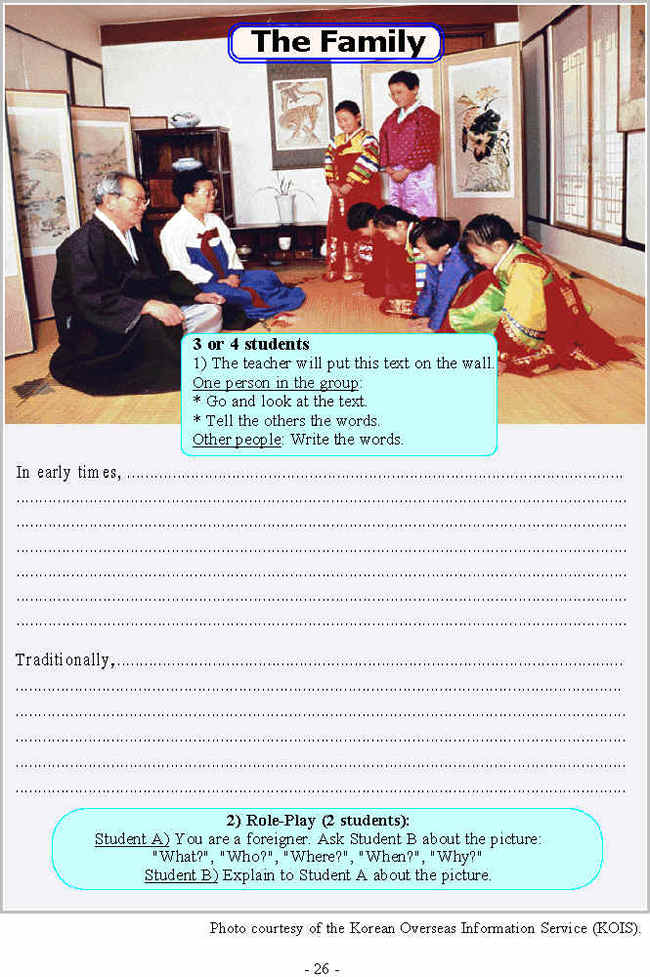
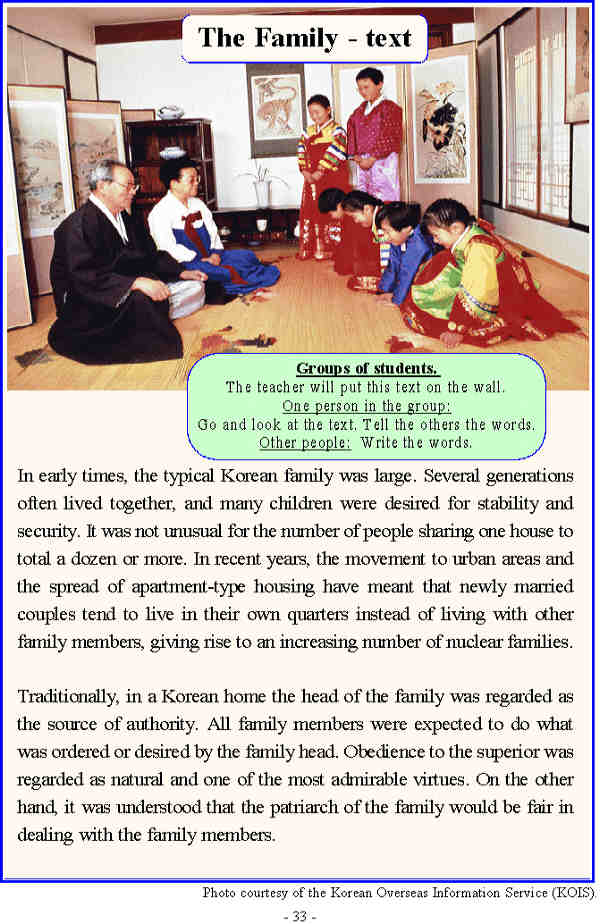
Lesson 3: (a) The Family (Worksheet) (b) The Family (Text) (c) The Family (Teacher's Notes)
Lesson 3: (a) The Family (Worksheet) (b) The Family (Text) (c) The Family (Teacher's Notes)
Lesson 4: The Syllable Game
Then I divided the class into 5 groups of 8 students. Each group had 4 teaching pairs.
| Lesson 1 | Lesson 2 | Lesson 3 | Lesson 4 | |
| Group A | Kota and Airi | May and Yui | Haruka and Emi | Miki and Saki |
| Group B | Mai and Chika | Kotaro and Shohei | Hiroki and Makoto | Hamaya and Matsun |
| Group C | Shunsuke and Hikaru | Masato and Tatsuki | Shunta and Satoru | Takumi and Eiki |
| Group D | Takahiro and Ai | Flowers and Machiko | Marin and Yurika | Yoshi and Ryouhei |
| Group E | Satoshi and Wataru | Ayu and Moe | Shiho and Kanako | Yui U and Takayuki |
Then, each student was given the following blogging assignment (taken from our class blog):
I would like you to write the lesson plan in your blog specifying the following. Next week, you and your partner will conduct a 10 minute lesson based on your plan.
Activity: What kind of activity is it? Adjust the activity so that it encourages acquisition, interaction, or focus on form. Your activity can cover more than one of these.Strategies: What kind of learning strategies does it encourage?Learning styles: What kind of learning style is most appropriate for your activity?Communicative competence: What kind of communicative ability does it encourage and why?Procedures: Write the steps you will take to carry out the activity. At the ending of your activity, there should be some kind of reflection to help students realize the skill/strategy you wanted them to practice.
See my sample lesson for an example
The text books we use are the TKT Course and 新しい時代の英語科教育法と実践 . The items that I asked students to specify(Activities, strategies, learning styles and communicative competence) were concepts that we studied in the textbooks. When we did the actual practice lessons, all groups did Lessons 1, 2, 3, 4 in that order. We were able to finish on time easily. What impressed me was that each pair of students taught their lessons differently depending on their goal. This meant that they were thinking very deeply about their teaching which I think is great. The problem areas were first, with five groups teaching at once it is hard to understand what each group is doing. I had two other teachers come to class that day to help me but I will not always have these kinds of resources. Second, I was not able to look at all the blogs before the class and give feedback on the lesson plans. I was just too busy. I was fortunate in that one of the other teachers volunteered to read the students' blogs. Third, sometimes when you are so busy orchestrating students' group work, keeping time, etc. it is hard to give students good comments on their lessons. Despite the problems, I am going to continue to use this format next semester. Although I need to think of ways that I can follow the students' lessons better, the most important thing is that the students, themselves, learn from this experience and determine themselves how they should improve.Although you will be team-teaching, you should write the lesson plan in your own blog. It is ok to write the same thing as your partner.
Wednesday, February 06, 2013
Using Vocabulary Notebooks: Tips For Organization
Between April and August, I wrote tons about using vocabulary notebooks (hereafter VNs) and then abruptly stopped. (You can see the posts here). VNs were basically "vocabulary sheets" that could be put into a two-ringed binder (See a sample below).

Although I continued to use them from October (when the second semester for university starts in Japan), I was too busy with other things to devote as much time to experimenting with them. This semester I did not really expand on VN activities, but I did improve in incorporating them more smoothly into the curriculum. This semester, of 22 students, I would say that 20 routinely entered words into their VNs. The key to this success was 1) making VNs an essential part of the class evaluation while trying to encourage independent learning and 2) being more organized. I will explain both below:
1. Making VNs an essential part of class evaluation but encouraging some independent learning:
We routinely had quizzes about words that students wrote in their VNs and I routinely collected students' vocabulary sheets. Although it would be great if students would autonomously update their own VNs to satisfy their need for learning English words, without any kind of external measures from the teacher, students will not update their VNs.
However, when we had readings outside of the textbook, students would choose the words that they wanted to learn. Also, when we had quizzes, I let students choose which words to write on the quiz. For example, if students wrote 4 vocabulary sheets from a unit, they would choose about 3 words per page. For the quiz, I would give students a blank vocabulary sheet and they would fill it in. Also, they did not have to write the phonetic symbols for each word but they would have to write where the accent was. Lastly, they would only have to write the "derivations" and "important information" for about two thirds of the words. The reasons for this is that in can be too tedious to write all the lexical information for words you want to learn and for a lot of words receptive knowledge will suffice. Here is an actual quiz:

In addition to the quiz, I would collect students' vocabulary sheets after their quizzes and give them marks of ✓+, ✓1/2, ✓, ✓-, depending on how much effort they put into their sheets. Last semester I realized that students wrote a lot of incorrect information into their sheets and would actually correct this information. This semester, though, I did not do that. However, I believe there was less erroneous information in students' VNs this semester. The reason was, I think, is that they chose the words to write productive information (derivations, "important information," example sentences) for and did not have to write this information for words that they did not intend to learn. Additionally, they had a semester's worth of experience using VNs and they were more used to the practice of finding the word information. Nevertheless, I think that frequently students did write incorrect information. However, I could not spare the time to check the sheets, this is an issue.
At the ending of the semester, students had a self-evaluation sheet which contained their grades for each assignment and quiz. Students had to calculate their numerical grade in the last class and then tell me whether they deserved an A+, A, B, C or D. (At many Japanese universities, they do not use numerical grades). Of course, students' VN marks were also on the evaluation sheet (see below). Actually, I accidentally forgot to record some of the grades for students VN sheets (especially if they turned them in late), so with the self-evaluation sheets students were able to confirm to me that they had filled out their sheet even if there was no mark. A real evaluation sheet is shown below:
2. Organization

Although I continued to use them from October (when the second semester for university starts in Japan), I was too busy with other things to devote as much time to experimenting with them. This semester I did not really expand on VN activities, but I did improve in incorporating them more smoothly into the curriculum. This semester, of 22 students, I would say that 20 routinely entered words into their VNs. The key to this success was 1) making VNs an essential part of the class evaluation while trying to encourage independent learning and 2) being more organized. I will explain both below:
1. Making VNs an essential part of class evaluation but encouraging some independent learning:
We routinely had quizzes about words that students wrote in their VNs and I routinely collected students' vocabulary sheets. Although it would be great if students would autonomously update their own VNs to satisfy their need for learning English words, without any kind of external measures from the teacher, students will not update their VNs.
However, when we had readings outside of the textbook, students would choose the words that they wanted to learn. Also, when we had quizzes, I let students choose which words to write on the quiz. For example, if students wrote 4 vocabulary sheets from a unit, they would choose about 3 words per page. For the quiz, I would give students a blank vocabulary sheet and they would fill it in. Also, they did not have to write the phonetic symbols for each word but they would have to write where the accent was. Lastly, they would only have to write the "derivations" and "important information" for about two thirds of the words. The reasons for this is that in can be too tedious to write all the lexical information for words you want to learn and for a lot of words receptive knowledge will suffice. Here is an actual quiz:

In addition to the quiz, I would collect students' vocabulary sheets after their quizzes and give them marks of ✓+, ✓1/2, ✓, ✓-, depending on how much effort they put into their sheets. Last semester I realized that students wrote a lot of incorrect information into their sheets and would actually correct this information. This semester, though, I did not do that. However, I believe there was less erroneous information in students' VNs this semester. The reason was, I think, is that they chose the words to write productive information (derivations, "important information," example sentences) for and did not have to write this information for words that they did not intend to learn. Additionally, they had a semester's worth of experience using VNs and they were more used to the practice of finding the word information. Nevertheless, I think that frequently students did write incorrect information. However, I could not spare the time to check the sheets, this is an issue.
At the ending of the semester, students had a self-evaluation sheet which contained their grades for each assignment and quiz. Students had to calculate their numerical grade in the last class and then tell me whether they deserved an A+, A, B, C or D. (At many Japanese universities, they do not use numerical grades). Of course, students' VN marks were also on the evaluation sheet (see below). Actually, I accidentally forgot to record some of the grades for students VN sheets (especially if they turned them in late), so with the self-evaluation sheets students were able to confirm to me that they had filled out their sheet even if there was no mark. A real evaluation sheet is shown below:

2. Organization
One of the things I struggled with last semester was that I had a difficult time keeping track of the number of vocabulary sheets I asked them to write and students were also confused about how many they should have. This semester, on the course vocabulary resource page I recorded each time I asked students to record words in their vocabulary sheet from readings we did, songs we listened to, or discussions that we had. I also recorded when they had a quiz based on a particular sheet or when I collected the sheets to see that they had been writing in the VNs (see below)

 Also, students wrote their names and the topic for the words on each vocabulary sheet. I used a new system to have students turn is assignments including VN sheets. Each student at the beginning of class would be given a clear file with their number on the outside (students were given a number from 1 - 23 at the beginning of the semester. They were numbered this way on the class list I received from the university). When students turned in a VN sheet, they would put it in their clear file. This made it MUCH easier for me to keep track of the sheets. If I had students hand them in with no files and received a big stack of VN sheets, I know that I would have lost many of the sheets.


Thursday, January 24, 2013
What I Learned About Teacher Education in Thailand
For 13 days I rotated around three unique schools and saw three unique groups of student-teachers teach at each school. In my post before I left for Thailand, I wrote:
At the Thai schools we had three groups of people working together on planning the ideal English class. These groups had different life experiences and views on teaching, they were Japanese college professors (who were American!), Thai and non-Thai English teachers working in Bangkok or Ayutthaya, and Japanese pre-service teachers. We had different ways in how we perceived good topics, appropriate activities, our ideal image of teachers, how to interact with students, and how to use materials.
I think that for the classes that were most successful, the pre-service teachers, the Thai teachers, and the American teachers were able to exchange dialogue about the classes, understand each other, and negotiate changes that everyone could be happy with. For the classes that were not as successful (all the classes were actually good, I think), the pre-service teachers, Thai teachers, and American teachers were not quite able to reach a common ground. Nevertheless, the opportunity to collaborate on planning these classes was an incredible experience which taught me about myself, my students, and the Thai teachers; it also brought us all closer together. This trip taught me about how difficult and exhausting communication can it made me a more open and honest communicator and made me feel more alive.

in Thailand I want to see how students will fix their own lessons and how this experience will change their view of what effective teaching and their image of themselves as teachers.In the blog, I try hard not to write about people or schools in such a way that would reveal information they would not want shared. I am a little worried that what I would write might reveal certain details that schools and or the student teachers would prefer not to be shared. However, I do think that I can share what fascinated me the most about this whole experience.
At the Thai schools we had three groups of people working together on planning the ideal English class. These groups had different life experiences and views on teaching, they were Japanese college professors (who were American!), Thai and non-Thai English teachers working in Bangkok or Ayutthaya, and Japanese pre-service teachers. We had different ways in how we perceived good topics, appropriate activities, our ideal image of teachers, how to interact with students, and how to use materials.
I think that for the classes that were most successful, the pre-service teachers, the Thai teachers, and the American teachers were able to exchange dialogue about the classes, understand each other, and negotiate changes that everyone could be happy with. For the classes that were not as successful (all the classes were actually good, I think), the pre-service teachers, Thai teachers, and American teachers were not quite able to reach a common ground. Nevertheless, the opportunity to collaborate on planning these classes was an incredible experience which taught me about myself, my students, and the Thai teachers; it also brought us all closer together. This trip taught me about how difficult and exhausting communication can it made me a more open and honest communicator and made me feel more alive.

Wednesday, January 16, 2013
Using the Japanese Portfolio for Student Teachers of Languages in a Class Discussion
I am in Thailand right now but need to get my mind off it. So, I am going to write about using the J-Postl. The J-POSTL or the Japanese Porfolio for Student Teachers of Languages is adapted from E-POSTL or the European Portfolio for Student Teachers of other Languages. The J-POSTL consists of 100 descriptors that students can use to assess their teaching ability. The descriptors help students assess their knowledge or ability related to their context, teaching methodologies, using resources, planning lessons, conducting lessons, etc. The descriptors are useful in that they can raise students' awareness of the techniques, skills, and knowledge that very good teachers have. For example, look at the following descriptors for conducting lessons:
The problem with J-POSTL is the sheer number of descriptors can make it a little overwhelming. However, the developers of the portfolio recommend that students only do a few descriptors at a time. I tried to do just this last month. My students in my teaching methodologies class did a one day teaching practice at an elementary school where they conducted a foreign language activity (English activity) using the standard elementary school English textbook, "Hi, Friends"After their practice lesson, we had a class discussion using part of the J-POSTL. For the discussion our goal was to Determine the essential skills necessary for conducting foreign language activities in elementary school, this is what I did:
In steps 4 and 5, I told students that they could add their own items if they so wished. The final list of the most important items consisted of the students' original items rather than those of J-POSTL.
I thought that this was VERY interesting. I think it means that it is difficult to tell students to look at their classes from a perspective that is different from their own. The J-POSTL makes A LOT of sense to me because I am an experienced teacher. Student-teachers, however, are new to teaching and they might perhaps focus more on the very basics such as "enjoy the class" rather than the detailed techniques, knowledge, and skills written in J-POSTL. Also, it could have been the nature of the task itself that influenced students' answers. Nevertheless, I was surprised that every item that students voted as most important were their own original ones.
I should be writing about my students' teaching in Thailand right now, but actually being able to think about my orderly and predictable life in Japan has been a little therapeutic for me.
-
73 I can start a lesson in an engaging way.
-
74 I can be flexible when working from a lesson plan and respond to student interests as the lesson progresses.
75 I can adjust my time schedule when unforeseen situations occur.
76 I can time and change classroom activities to reflect individual students’ attention spans.
- I gave students a list of descriptors from J-POSTL about using resources, lesson planning, and conducting a lesson (using a lesson plan, content, interaction with students, classroom management, classroom language). I have written the list of descriptors I used at the bottom of this page.
- I asked students to write a circle next to they thought they were able to do in the lesson, a cross next to what you were not able to do, and write a triangle next to what they thought was not relevant. (5 minutes)
- Each teaching group of students (7 groups of students each conducted a class) watched a video of their class. If their thinking changed, they could change their answers they wrote in 2. (15 minutes)
- Each teaching group comes to a consensus about the 5 items they thought they were most successful in accomplishing in their classes and the 5 items they were least successful in accomplishing. (20 minutes)
- Next, students made seven new groups so that each new group consisted of a member from each of the original groups (like a jigsaw task). They shared the results of 4. with their new group members. After that, as a group, they chose what they thought were the four most important items for conducting foreign language activities in elementary school and gave reasons why. (20 minutes)
- Lastly, each group presented their top four items. I wrote them on the computer (using a projector of course) and as a class we chose the top 5 items.
In steps 4 and 5, I told students that they could add their own items if they so wished. The final list of the most important items consisted of the students' original items rather than those of J-POSTL.
| Number of Votes | Item |
| 40 | Enjoy the class |
| 23 | Use English as much as you can. |
| 20 | Don’t use Japanese too much |
| 16 | Try to speak easy English |
| 12 | Prepare for the class perfectly |
| 12 | Prepare for many activities |
I thought that this was VERY interesting. I think it means that it is difficult to tell students to look at their classes from a perspective that is different from their own. The J-POSTL makes A LOT of sense to me because I am an experienced teacher. Student-teachers, however, are new to teaching and they might perhaps focus more on the very basics such as "enjoy the class" rather than the detailed techniques, knowledge, and skills written in J-POSTL. Also, it could have been the nature of the task itself that influenced students' answers. Nevertheless, I was surprised that every item that students voted as most important were their own original ones.
I should be writing about my students' teaching in Thailand right now, but actually being able to think about my orderly and predictable life in Japan has been a little therapeutic for me.
Appendix: Items from J-POSTL used in the class discussion
RESOURCES
47 I can identify and evaluate a range of coursebooks/materials appropriate for the age, interests and the language level of the students.
48 I can select texts and language activities from coursebooks appropriate for my students.
49 I can locate and select listening and reading materials appropriate for the needs of my students from a variety of sources, such as literature, mass media and the Internet.
50 I can make use of ideas, lesson plans and materials included in teachers’ handbooks and resource books.
51 I can design learning materials and activities appropriate for my students.
52 I can recommend dictionaries and other reference books useful for my students.
53 I can guide students to use the Internet for information retrieval.
LESSON PLANNING
A. Identification of Learning Objectives
54 I can identify the Course of Study requirements and set learning aims and objectives suited to my students’ needs and interests.
55 I can plan specific learning objectives for individual lessons and/or for a period of teaching.
56 I can set objectives which challenge students to reach their full potential.
57 I can set objectives which take into account the differing levels of ability and
special educational needs of the students.
58 I can set objectives for four main skills of listening, speaking, reading and writing
respectively, according to the focus of individual lessons and/or period of teaching. 59 I can set objectives which encourage students to reflect on their learning.
59. I can set objectives which encourage students to reflect on their learning.
47 I can identify and evaluate a range of coursebooks/materials appropriate for the age, interests and the language level of the students.
48 I can select texts and language activities from coursebooks appropriate for my students.
49 I can locate and select listening and reading materials appropriate for the needs of my students from a variety of sources, such as literature, mass media and the Internet.
50 I can make use of ideas, lesson plans and materials included in teachers’ handbooks and resource books.
51 I can design learning materials and activities appropriate for my students.
52 I can recommend dictionaries and other reference books useful for my students.
53 I can guide students to use the Internet for information retrieval.
LESSON PLANNING
A. Identification of Learning Objectives
54 I can identify the Course of Study requirements and set learning aims and objectives suited to my students’ needs and interests.
55 I can plan specific learning objectives for individual lessons and/or for a period of teaching.
56 I can set objectives which challenge students to reach their full potential.
57 I can set objectives which take into account the differing levels of ability and
special educational needs of the students.
58 I can set objectives for four main skills of listening, speaking, reading and writing
respectively, according to the focus of individual lessons and/or period of teaching. 59 I can set objectives which encourage students to reflect on their learning.
59. I can set objectives which encourage students to reflect on their learning.
CONDUCTING A LESSON
A. Using Lesson Plans
73 I can start a lesson in an engaging way.
74 I can be flexible when working from a lesson plan and respond to student interests as the lesson progresses.
75 I can adjust my time schedule when unforeseen situations occur.
76 I can time and change classroom activities to reflect individual students’ attention
spans.
A. Using Lesson Plans
73 I can start a lesson in an engaging way.
74 I can be flexible when working from a lesson plan and respond to student interests as the lesson progresses.
75 I can adjust my time schedule when unforeseen situations occur.
76 I can time and change classroom activities to reflect individual students’ attention
spans.
B. Content
77 I can relate what I teach to students’ knowledge, current events in local context, and the culture of those who speak it.
C. Interaction with Students
78 I can keep and maximize the attention of students during a lesson.
79 I can encourage student participation and student interaction whenever possible.
80 I can cater for a range of learning styles.
81 I can help students to develop appropriate learning strategies.
D. Classroom Management
82 I can create opportunities for and manage individual, partner, group and whole class work.
83 I can manage and use instructional media (flashcards, charts, pictures, audio-visual aids, etc.) effectively
E. Classroom Language
84 I can conduct a lesson in the target language, and if necessary use Japanese effectively.
85 I can encourage students to use the target language in their activities.
77 I can relate what I teach to students’ knowledge, current events in local context, and the culture of those who speak it.
C. Interaction with Students
78 I can keep and maximize the attention of students during a lesson.
79 I can encourage student participation and student interaction whenever possible.
80 I can cater for a range of learning styles.
81 I can help students to develop appropriate learning strategies.
D. Classroom Management
82 I can create opportunities for and manage individual, partner, group and whole class work.
83 I can manage and use instructional media (flashcards, charts, pictures, audio-visual aids, etc.) effectively
E. Classroom Language
84 I can conduct a lesson in the target language, and if necessary use Japanese effectively.
85 I can encourage students to use the target language in their activities.
Friday, January 04, 2013
Off to Thailand
I am writing from a hotel in Narita and am off to Thailand for almost two weeks. Another colleague and myself will be accompanying 10 students to Bangkok and Ayutthaya where they will be teaching English at high schools. I think that the students have been preparing hard for their teaching but I still don't think that they are quite ready. Last year, students went to Thailand with an almost perfect lesson plan. However, I took great pride in watching their lesson but then wondered whether students were actually teaching their own lesson or actually teaching my lesson. This year, students have chosen their own topics, activities, etc. Students are divided into 3 groups. Each group has made lesson plans and conducted demonstration lessons. Here are the topics of each group.
Group 1 (Three female students teaching at an All-Girl's High School in Bangkok): Valentine's Day in Japan, Traveling in Japan
Group 2 (Three female students teaching at a coed school in Ayutthaya): Origami, New Years in Japan
Group 3 (Three female students and one male student teaching at a coed school in Bangkok): Seasonal events in Japan, Japanese food stalls
One regret I have is that during the demonstration lessons I tend to talk A LOT and the students do not have much of a chance to give each other feedback after the lesson. If I see something during the lesson that I know would not work well in Thailand I become filled with an uncontrollable urge to point it out and give students my own ideas about how to remedy the problem. I do not have the patience to let students resolve the problem themselves. However, I also think that because the students have not gone to Thailand, they CANNOT understand why some thing might not work. I have been accompanying students to Thailand for a couple of years and feel the overwhelming urge to impart what I have learned before students have had a chance to try to work out the problem themselves. I need to learn to speak less.
No matter what I tell them though, they won't really be able to understand why or why not their lesson will work until they actually teach in the Thai schools. Therefore, in Thailand I want to see how students will fix their own lessons and how this experience will change their view of what effective teaching and their image of themselves as teachers. Well, I have to get ready to go.
Group 1 (Three female students teaching at an All-Girl's High School in Bangkok): Valentine's Day in Japan, Traveling in Japan
Group 2 (Three female students teaching at a coed school in Ayutthaya): Origami, New Years in Japan
Group 3 (Three female students and one male student teaching at a coed school in Bangkok): Seasonal events in Japan, Japanese food stalls
One regret I have is that during the demonstration lessons I tend to talk A LOT and the students do not have much of a chance to give each other feedback after the lesson. If I see something during the lesson that I know would not work well in Thailand I become filled with an uncontrollable urge to point it out and give students my own ideas about how to remedy the problem. I do not have the patience to let students resolve the problem themselves. However, I also think that because the students have not gone to Thailand, they CANNOT understand why some thing might not work. I have been accompanying students to Thailand for a couple of years and feel the overwhelming urge to impart what I have learned before students have had a chance to try to work out the problem themselves. I need to learn to speak less.
No matter what I tell them though, they won't really be able to understand why or why not their lesson will work until they actually teach in the Thai schools. Therefore, in Thailand I want to see how students will fix their own lessons and how this experience will change their view of what effective teaching and their image of themselves as teachers. Well, I have to get ready to go.
Thursday, December 13, 2012
Impromptu Advising in "Class Conferences" and "Speech Contests"
The past few years I have been frequently asked to be a judge at a speech contest or an "advisor" for an "open class conference". A speech contest is fairly self-explanatory. Judges will evaluate the contestants and before announcing the winners, one judge will speak for 5 to 10 minutes offering advice to the contestants about how they can improve their speeches. Occasionally, I am nominated to be this judge.


An open-class conference, on the other hand, might not be so clear to some of you. Schools in Japan will periodically conduct conferences for which they publish some kind of journal about their overall educational mission as well as the specific objectives and research agendas of each subject. In the conference they conduct one open class per subject and this open class is then followed by a meeting between the class instructor and those who came to see this class. The meeting can last from 60 to 90 minutes. The instructors will present their overall objectives for their subject and then talk about their class specifically. This is followed by questions and opinions from the audience. Lastly, a university professor and/or a teacher supervisor from the Board of Education will speak for 10 to 20 minutes each offering their advice to the instructors. They are fulfilling the role of an "advisor."Advisors' roles are usually to meet with the instructors a few weeks before the class to give them feedback on the lesson as well as speak at the conference. I am not a big fan of "the open class conference" because the advisors are treated as an authority and their opinions are never questioned (Of course, if people do not agree with the advisors, they can just ignore them). Nevertheless, if you work at a university or high school, at some point you might find yourself being asked to speak for 10 to 20 minutes in English or Japanese about English teaching or students' speeches. So, I thought I would write about my tricks of the trade.
First, my presentations are actually not impromptu. For open class conferences, I have seen the lesson plan and talked to the teachers beforehand so I already have an idea about the topics I can discuss: for example, teaching reading, writing, conducting group work, a specific grammar point, task based language teaching, etc. I also might think about the jokes I might tell or the analogies I might make before the conference starts. Before the conference, I will sometimes put information I have on these topics onto my IPad which I bring to the conference to use for recording field notes. With speech contests, usually I do not have this kind of luxury to predict what kind of topics I might discuss.
Second, when I am watching the speeches or classes, I am not only concentrating on what I am observing, but in the back of my head, I am also thinking about possible talking points for my impromptu presentation. If I think of a talking point, I will immediately write it down. I try to write various talking points throughout the class or the speech. For example, the awful handwriting below shows the talking points that I wrote while watching an elementary school English class. I ended up discussing the HRT/JTE/ALT role, how to encourage more authentic communication in the class, and pronunciation tips.
Third, after the class, I will try to speak to the other advisor to find out what he/she plans to discuss. The reason for me doing this is that one, I do not want to talk about the same thing and two, if my opinion is different, I want to consider how to present my perspective in a way that contrasts with that of the other advisor but does not put us in an awkward situation. In a speech contest, after the judges have decided the winners, I will ask the other judges what they want me to say in my feedback to the contestants. I will either add the other judge's advice to my talking points, make new talking points, or not include the judge's advice.
Fourth, in a speech contest, I speak soon after talking to the other judges. In an open class conference, I have more time to consider what I will say. I am usually adding smaller details to my main talking points while listening to the discussion in the meeting following the open class. If I hear a teacher speak his or her opinion and find it interesting, I might try to incorporate it into one of my talking points.
Lastly, when I speak, I sometimes tell the audience how many talking points I have. It makes it easier for the audience to take notes, of they so wish. I might say something like, "I want to talk about four conditions necessary to conduct group work smoothly" or "I want to discuss 4 areas of pronunciation that are difficult for Japanese students" etc.
I should add that when I speak at elementary schools I usually do my presentation in Japanese and at junior high schools or speech contests I give my presentations in English. If I am to speak in Japanese, I find that I have to prepare more. When I speak in English, I find that I can make more rudimentary notes and get away with ad-libbing. When I first started doing this I was REALLY awful at it. I still do not consider myself that good, but I have found that I can, for the most part, give acceptable presentations. Maybe the most important thing is to smile, look like you are happy to be there, be in good spirits, and try your best to say something that will hopefully be useful to the people who have the unenviable task of listening to you.

Wednesday, December 05, 2012
Taking Japanese Student Teachers to Thailand to Teach English
Building a lesson from scratch includes choosing the content, thinking about how to present the content to the students in a way that is comprehensible and interesting, conceiving of communicative activities related to the content for students, and determining which language points and vocabulary to highlight to the students. I believe that this is what the best English language teachers in Japan can do. I have written about this many times, but at my university, we have a teaching internship in a few secondary schools in Thailand where our students try to do exactly this. We tell the student-teachers that they are not teaching English but rather teaching about the Japanese culture in English. This year, a colleague and I will accompany the student-teachers to Thailand for two weeks in January. We have been helping the students prepare since October and we have done up to meeting 5 so far:
Meeting 1: Write profiles to send to host families and schools. Overview of the participating schools.
Meeting 2: History of Thailand
Meeting 3: Culture and customs of Thailand
Meeting 4: Classroom English practice and students receive a description of the kind of lesson plan we want them to conduct.
Meeting 5: Student-teachers present proposals for lessons and receive feedback
Meeting 6: Student-teachers give demonstration classes. More meetings: Student-teachers make appointments to consult with the internship supervisors about their classes.
I wish that we could meet more, but considering all the other work both the student-teachers and my university teachers have, even the above schedule is very hard. In meeting 4, I introduce many different ideas for ways to present material and tasks that encourage the use of all four skills. However, student-teachers probably did not learn anything from this. I have found that student teachers grow when they try demonstration lessons, receive feedback, and fix their lesson. It is only by actually teaching that student-teachers develop the know-how to teach. As I said before, this program enables the student-teachers to do some thing that would be more difficult for them to do as teachers in a school of Japan: design and develop their own teaching materials and activities to accomplish the English learning goals they have for the children. It is my hope that this experience will inspire the program participants to develop their own materials when they become teachers.
Meeting 1: Write profiles to send to host families and schools. Overview of the participating schools.
Meeting 2: History of Thailand
Meeting 3: Culture and customs of Thailand
Meeting 4: Classroom English practice and students receive a description of the kind of lesson plan we want them to conduct.
Meeting 5: Student-teachers present proposals for lessons and receive feedback
Meeting 6: Student-teachers give demonstration classes. More meetings: Student-teachers make appointments to consult with the internship supervisors about their classes.
I wish that we could meet more, but considering all the other work both the student-teachers and my university teachers have, even the above schedule is very hard. In meeting 4, I introduce many different ideas for ways to present material and tasks that encourage the use of all four skills. However, student-teachers probably did not learn anything from this. I have found that student teachers grow when they try demonstration lessons, receive feedback, and fix their lesson. It is only by actually teaching that student-teachers develop the know-how to teach. As I said before, this program enables the student-teachers to do some thing that would be more difficult for them to do as teachers in a school of Japan: design and develop their own teaching materials and activities to accomplish the English learning goals they have for the children. It is my hope that this experience will inspire the program participants to develop their own materials when they become teachers.
In a few weeks, I will blog about the themes and lessons of the student teachers.
Wednesday, November 28, 2012
Doing a Task at an Elementary School
On October 31, my universities affiliated elementary school had an "Open Class Conference" (公開授業研究会). As a "collaborative researcher" I teamed up with teachers in the "English study group" (英語班) to plan two classes. The first class was a picture book class with the third grade and the second class was a class using "tasks" with the fifth grade. With all modesty possible, I have to say that both classes were much more successful than I anticipated. In this post, I will talk about the task based class and (hopefully) in a future post discuss the picture book class.
Last June, I went to Sendai with the head of the English study group (Hereafter T Sensei) at the elementary school and a graduate student. We attended a lecture by Dr. Natsuko Shintani about TBLT (Task Based Language Teaching) for young learners. This was a great opportunity for both me and T-Sensei to get on the same page about what TBLT is and understand the types of tasks used with young learners. We left the workshop with a common understanding about the principles of TBLT. However, the tasks that were shown in the workshop were designed for a small group of children at an English school. We had to think how we could design a task for a large group of children (+30 students) with limited command of English and lower motivation to study English.
The four features of tasks introduced in the workshop are below and based on the features we designed two tasks.
The modest success of this lesson was a result of the collaboration between me, the elementary school, and my graduate students. We met two times for about 90 minutes each time (to plan the task and picture book class, not just the task class). By sharing ideas with each other and combining our strengths, we were able to think of original lessons that we could not have done by ourselves. It made me realize how important collaboration is. I will talk about the two tasks we ended up doing:
Task 1: The Locker Task
The words for the unit of Hi, Friends were
These are fairly dull words and our challenge was to think of a situation where children could use these words meaningfully.
The first task we designed was called the "locker task". It was a kind of "find the differences task."Students were in pairs, and each had a different picture of a locker. The goal of the task was to find the number of differences in two minutes. The words were words from the unit of high friends (I acknowledge that there was a BIG spelling mistake on the first set of cards). For the first two sets of cards, the teacher performed the task together with the students (the teacher had the card for Locker 1A and the students had the card for Locker 1B). After this, the students did the task twice using the next two sets of cards. It is important to note that the students were familiar with these words.
35 of 36 students report that they were able to communicate the contents of their locker. When asked what helped them, 31 of 36 students wrote that the teacher's demonstration helped them. What was interesting was that the teacher demonstrated how to do the activity but did not explicitly teach which language to use.
Task 2: The Magic Bag
First, I will say that task 2 was the far more innovative task and was the original idea of the elementary school teachers.
 This is a little more complicated. The teacher said that all the students had a "magic bag" like Doraemon and they could put anything inside of it. The children had the above worksheet which featured a daily class schedule. The children then had to choose a day, and then based on the class schedule for the day, put objects in their bag. For example, if the day was Friday, the classes were Japanese, social studies, science and music. A student who chose Friday would then have to put a Japanese textbook, globe, beaker, and piano in their bag. After the students had chosen the days and the corresponding contents of their bag, they made pairs again. They would ask each other, "What do you have in your bag" and write down their partners answers. After writing down what their partner said, they would try to guess the day. The goal of the task was to guess the day of the week their partner had prepared for. As in the first task, 35 of 36 students wrote that they were able to express the contents of their bag and ask their partner the contents of their bag. Twenty-seven of 36 students wrote that their teacher's demonstration was helpful although the teacher did not explicitly teach language.
Both Tasks
Again, tasks are supposed to have the following characteristics:
Both tasks featured a focus on the message, there was a clear gap in information between the pair of students, the teacher did not explicitly teach language and students were expected to use their own language, and each task had a clear goal.
We did give questionnaires to the students to find out the techniques they used to accomplish the tasks but I have no idea when I can get around to actually analyzing them so I thought I would write about this experience before I completely forgot about it. If you would like to use these ideas for your own contexts, please feel free to do so. If possible, I would also appreciate it if you contacted me to tell me how it went.
Last June, I went to Sendai with the head of the English study group (Hereafter T Sensei) at the elementary school and a graduate student. We attended a lecture by Dr. Natsuko Shintani about TBLT (Task Based Language Teaching) for young learners. This was a great opportunity for both me and T-Sensei to get on the same page about what TBLT is and understand the types of tasks used with young learners. We left the workshop with a common understanding about the principles of TBLT. However, the tasks that were shown in the workshop were designed for a small group of children at an English school. We had to think how we could design a task for a large group of children (+30 students) with limited command of English and lower motivation to study English.
The four features of tasks introduced in the workshop are below and based on the features we designed two tasks.
- A task involves a primary focus on message.
- A task has some kind of 'gap"
- The learners choose the linguistic and non-linguistic resources needed to complete the task.
- A task has a clearly defined outcome.
The modest success of this lesson was a result of the collaboration between me, the elementary school, and my graduate students. We met two times for about 90 minutes each time (to plan the task and picture book class, not just the task class). By sharing ideas with each other and combining our strengths, we were able to think of original lessons that we could not have done by ourselves. It made me realize how important collaboration is. I will talk about the two tasks we ended up doing:
Task 1: The Locker Task
The words for the unit of Hi, Friends were
Apple, cap, shoe, bat, glove, flower, fish, eggplant, mat, bird, frying pan, cup, tomato, triangle, recorder, piano, microscope, beaker, brush, map, globe, triangle, ruler, notebook, Japanese/science/history/English textbook, eraser, pen, pencil, marker, water bottle.
These are fairly dull words and our challenge was to think of a situation where children could use these words meaningfully.
The first task we designed was called the "locker task". It was a kind of "find the differences task."Students were in pairs, and each had a different picture of a locker. The goal of the task was to find the number of differences in two minutes. The words were words from the unit of high friends (I acknowledge that there was a BIG spelling mistake on the first set of cards). For the first two sets of cards, the teacher performed the task together with the students (the teacher had the card for Locker 1A and the students had the card for Locker 1B). After this, the students did the task twice using the next two sets of cards. It is important to note that the students were familiar with these words.
 |
| Locker 1A |
 |
| Locker 1B |
 |
| Locker 2A |
 |
| Locker 2B |
 |
| Locker 3A |
 |
| Locker 3B |
Task 2: The Magic Bag
First, I will say that task 2 was the far more innovative task and was the original idea of the elementary school teachers.

Both Tasks
Again, tasks are supposed to have the following characteristics:
- A task involves a primary focus on message.
- A task has some kind of 'gap"
- The learners choose the linguistic and non-linguistic resources needed to complete the task.
- A task has a clearly defined outcome.
Both tasks featured a focus on the message, there was a clear gap in information between the pair of students, the teacher did not explicitly teach language and students were expected to use their own language, and each task had a clear goal.
We did give questionnaires to the students to find out the techniques they used to accomplish the tasks but I have no idea when I can get around to actually analyzing them so I thought I would write about this experience before I completely forgot about it. If you would like to use these ideas for your own contexts, please feel free to do so. If possible, I would also appreciate it if you contacted me to tell me how it went.
Sunday, November 18, 2012
Issues with textbooks and reading/writing assignments for pre-service teachers
I am in charge of a teaching methodology class for second year students university students. Most of them are English majors and about half of them aspire to be English teachers. This year I have 43 students in the class; this means giving them any kind of assignment also gives me a lot of work. Checking 40 + long writing assignments adequately can take over 7 hours easily, and really make it hard for me to prepare the week's lesson. Because the class is conducted mainly in English and the content, theories and practices in TESOL/TEFL, is new to students, it is essential that they read the textbook and do the writing assignments every week.
The textbook that we use is titled 英語科教育の基礎と実践 (An approximate translation is "Basic theory and practice of English Education"), the book is a good introduction to basic theories in TESOL/TEFL, teaching techniques, and teaching English in junior and senior high schools in Japan. Of course, the book cannot go into very much depth, but I think it points students into the right direction for learning more about their field.
Anyway, back to the reading and writing assignments. As you can tell, the book is written in Japanese, but I have the students answer questions about the reading in English. I think that it is important for the students to be able to explain concepts about English education in English. I hope that they will be able to build off this experience to one day be able to explain their pedagogical choices to ALTs or be able to discuss English teaching with other educators throughout the world.
We have a class blog and students make their own blogs which link to the class blogs. Students put their assignments and reflections of their practice teaching on their personal blogs. These blogs are supposed to serve as portfolios of students' work. I am actually not sure if I have chosen the appropriate technological tool for students' portfolios, but that is a story for another post. Students evaluation is based on whether or not students can explain the concepts written in the textbook in English. I grade them by giving them one of the following marks:
A couple of weeks ago, I encountered an unexpected problem with these writing assignments. In the first assignment there were many sloppy mistakes. Sloppy mistakes are spelling mistakes, mistakes in plural/singular, mistakes in with subject-verb agreement, etc. Basically, sloppy mistakes are mistakes that students should be able to catch by themselves. To my surprise, well over 50% of the assignments were littered with these sloppy mistakes. For example, some students spelled the word learn as "lean" throughout their whole assignment. This gave me a sense of deja vu as something similar happened to me last year in the same class. On top of that, many of the assignments were full of global errors or awkward English, I was not sure what the students were trying to say. Becoming an English teacher at a public school is very competitive and these days one needs strong English skills to pass the teacher's examination and interview test. For the sake of the students, I cannot accept mediocrity. They have to all work hard to improve their English if are serious about becoming English teachers.
I underlined all the mistakes they made (this took well over 10 hours), and told students that they had to fix their mistakes as an assignment. I also transformed myself to the stern Jimbo and told students that they made too many careless mistakes and this was intolerable (Of course making mistakes because you are experimenting with new and difficult language is a good thing. Also, I should not that I make spelling mistakes all the time and a few mistakes in an assignment will not bother me. In fact, for me to get mad at a few mistakes would be very hypocritical).
As I said before, in addition to the careless mistakes, there was a high amount of unintelligible prose written by the students. Therefore, after the stern Jimbo had said his peace, I decided to give the students about 40 minutes to start the next assignment in pairs and I walked around to observe how there were doing the assignment. One of the most typical strategies was this: they would find the answer to the question of the textbook in Japanese and try to understand it. After grasping the meaning, they would write the answer in Japanese. Lastly, they would translate the answer into English. I realized that the textbook in Japanese was not necessarily clear-cut for them. When I read and summarize parts of the textbook, I understand the concepts already and can use my background knowledge when the language of the book is unambiguous or clear to me. The students, however, do not have the background knowledge that I have. It seems like that when students are unsure what the Japanese is actually saying, they tend to just directly translate it into English. The result of their effort is unintelligible English.
On this day, we ended up working on writing the answers into English the whole time and after the class had ended, I felt that I had just conducted my first grammar-translation class ever. I would not call it a waste of time, students worked very hard and I think they understood better what I expected from them and I understood better the demands that the assignments placed on them. Nevertheless, I did not think this was an ideal way for us to spend the precious little time we have to learn the basics of English teaching. I am now starting to question whether these kinds of assignments are appropriate (Reading in Japanese and answering questions in English). There are textbooks written in fairly simple English such as the TKT Course Module 1,2,3 which I think does a good job of explaining all the basics about English language teaching and learning that teachers need to know. The TKT is a teaching knowledge test for teachers of adult learners made by Cambridge University Press. I would prefer to use a book that also specifically discusses teaching at schools in Japan. In other words, I want a book that will contextualize the knowledge better.
I will say that most of the students in the class are working hard. I hope that this experience will push the students to become better self-monitors of their writing and also help them realize how hard they have to work to improve their English. I hope that I can choose the right kind of textbook and the right way of using the textbook that will help the students learn the basics of English teaching and improve their teaching. I really want to help them realize their dreams. For the next few weeks, we will be preparing for a teaching practice at a local elementary school. Hopefully during this time, I will be able to think of a better way of using the current textbook.
The textbook that we use is titled 英語科教育の基礎と実践 (An approximate translation is "Basic theory and practice of English Education"), the book is a good introduction to basic theories in TESOL/TEFL, teaching techniques, and teaching English in junior and senior high schools in Japan. Of course, the book cannot go into very much depth, but I think it points students into the right direction for learning more about their field.
Anyway, back to the reading and writing assignments. As you can tell, the book is written in Japanese, but I have the students answer questions about the reading in English. I think that it is important for the students to be able to explain concepts about English education in English. I hope that they will be able to build off this experience to one day be able to explain their pedagogical choices to ALTs or be able to discuss English teaching with other educators throughout the world.
We have a class blog and students make their own blogs which link to the class blogs. Students put their assignments and reflections of their practice teaching on their personal blogs. These blogs are supposed to serve as portfolios of students' work. I am actually not sure if I have chosen the appropriate technological tool for students' portfolios, but that is a story for another post. Students evaluation is based on whether or not students can explain the concepts written in the textbook in English. I grade them by giving them one of the following marks:
✓- means that a student was not able to explain the concepts in English.
✓ means that students were mostly able to express the concepts but there were some mistakes which made the writing difficult to understand.
✓1/2 means that they were able to express the concepts well with perhaps a few minor areas where the meaning was not completely clear
✓+ means that they were able to express the concepts very well
A couple of weeks ago, I encountered an unexpected problem with these writing assignments. In the first assignment there were many sloppy mistakes. Sloppy mistakes are spelling mistakes, mistakes in plural/singular, mistakes in with subject-verb agreement, etc. Basically, sloppy mistakes are mistakes that students should be able to catch by themselves. To my surprise, well over 50% of the assignments were littered with these sloppy mistakes. For example, some students spelled the word learn as "lean" throughout their whole assignment. This gave me a sense of deja vu as something similar happened to me last year in the same class. On top of that, many of the assignments were full of global errors or awkward English, I was not sure what the students were trying to say. Becoming an English teacher at a public school is very competitive and these days one needs strong English skills to pass the teacher's examination and interview test. For the sake of the students, I cannot accept mediocrity. They have to all work hard to improve their English if are serious about becoming English teachers.
I underlined all the mistakes they made (this took well over 10 hours), and told students that they had to fix their mistakes as an assignment. I also transformed myself to the stern Jimbo and told students that they made too many careless mistakes and this was intolerable (Of course making mistakes because you are experimenting with new and difficult language is a good thing. Also, I should not that I make spelling mistakes all the time and a few mistakes in an assignment will not bother me. In fact, for me to get mad at a few mistakes would be very hypocritical).
As I said before, in addition to the careless mistakes, there was a high amount of unintelligible prose written by the students. Therefore, after the stern Jimbo had said his peace, I decided to give the students about 40 minutes to start the next assignment in pairs and I walked around to observe how there were doing the assignment. One of the most typical strategies was this: they would find the answer to the question of the textbook in Japanese and try to understand it. After grasping the meaning, they would write the answer in Japanese. Lastly, they would translate the answer into English. I realized that the textbook in Japanese was not necessarily clear-cut for them. When I read and summarize parts of the textbook, I understand the concepts already and can use my background knowledge when the language of the book is unambiguous or clear to me. The students, however, do not have the background knowledge that I have. It seems like that when students are unsure what the Japanese is actually saying, they tend to just directly translate it into English. The result of their effort is unintelligible English.
On this day, we ended up working on writing the answers into English the whole time and after the class had ended, I felt that I had just conducted my first grammar-translation class ever. I would not call it a waste of time, students worked very hard and I think they understood better what I expected from them and I understood better the demands that the assignments placed on them. Nevertheless, I did not think this was an ideal way for us to spend the precious little time we have to learn the basics of English teaching. I am now starting to question whether these kinds of assignments are appropriate (Reading in Japanese and answering questions in English). There are textbooks written in fairly simple English such as the TKT Course Module 1,2,3 which I think does a good job of explaining all the basics about English language teaching and learning that teachers need to know. The TKT is a teaching knowledge test for teachers of adult learners made by Cambridge University Press. I would prefer to use a book that also specifically discusses teaching at schools in Japan. In other words, I want a book that will contextualize the knowledge better.
I will say that most of the students in the class are working hard. I hope that this experience will push the students to become better self-monitors of their writing and also help them realize how hard they have to work to improve their English. I hope that I can choose the right kind of textbook and the right way of using the textbook that will help the students learn the basics of English teaching and improve their teaching. I really want to help them realize their dreams. For the next few weeks, we will be preparing for a teaching practice at a local elementary school. Hopefully during this time, I will be able to think of a better way of using the current textbook.
Subscribe to:
Posts (Atom)