I am involved in English Teacher Education in Japan. I started this blog in 2005 and abandoned and returned to it a couple of times. Here, I write about things I have tried in class, my experience in teacher education in Japan and other places, and deep thoughts about the origin of the universe. This blog used to be anonymous but no longer. I try not to write anything that will get me fired.
Tuesday, June 04, 2019
My Take on the JALT CALL Conference (June 1, 2019)
I presented at the JALT CALL Conference on June 1, 2019 with 4 teacher-colleagues from Bangkok. I presented how we customized Wordpress to serve as a Lesson Study App and its positive and negative aspects. The APP is used to facilitate student-teacher development and knowledge generation of teaching methodology. My colleagues presented about their experiences using the APP. We use this APP for a teaching internship done by my university in Thailand.
A grand total of two people 😞 attended our presentation. This was disappointing, but I understood the reason why. The majority of the presentations at JALT CALL seemed to be about online apps or activities that people could immediately make use of. I think that what I am doing is original, but only a wordpress expert would leave my presentation with something they could soon use. Perhaps, my presentation is best for the WordPress conferences.
Despite this, the conference itself and even the presentation were worthwhile. The presentation was a chance for me to consolidate everything my colleague (Simon) and I have done to convert Wordpress to a Lesson Study App. It was also a good chance for me to get on the same page with my colleagues from Thailand. I realize that it is now time to write up what we have done, I am hopeful that it will be useful to somebody and somewhere.
The conference exposed me to tons and tons of online tools for research and learning which I will summarize below. It was so exciting to know about all the options out there but overwhelming. Through experience, I have learned that adopting online education tools is a gradual process. First, you need to figure out what it can do, then you need to figure out whether the tools' features can help you accomplish your classroom learning objectives, lastly, you need to implement it. During the implementation stage, as my understanding of what the technology improves, both my teaching procedures and the way I use the tool change so that they begin to match each other. this process can last up to a year or more for me.
Having said all that, here are the exciting new tools I learned about at the conference.
Research tools
Youtube studio can be used for free to transcribe interviews. I do not think it could be used for classroom interactions which has too much background noise, but the accuracy rate (which I cannot remember) seems to be equivalent to the software which costs money. If I had know about this when doing my PhD research, I probably could have saved a lot of time.
Learning Management Systems (LMS)
Before, I had primarily been familiar with Moodle, which is free, but an institution has to install it on their server, which requires time and money. Google classroom
and Schoolology are free and all the data is stored on their cloud so one does not have to worry about server management. However, to use Google classroom your institution has to register its domain with them, which could be challenging bureaucratically. It seems that with Schoolology, individual teachers can use it easily. Also, it seems to be designed for students to use on their phones, which means you do not need a computer room. Supposedly, Moodle now offers a cloud service. I think these cloud services could potentially save time and money, but is it safe to entrust all your data to a third party?
Online Language Learning Tools
The keynote speech by Dr. Evgeny Chukharev-Hudilainen was very entertaining. He introduced his own language learning program, Linguatorium, which he says is supported by psycholinguistic research and empirically proven to work. However, it costs students a little bit of money. He had some interesting things to say about Duolinguo, which my son uses to study Chinese. I am also waiting for Duolingo to come out with the Thai or Burmese language. However, he said that Duolingo, to his knowledge, is neither based on the science of language learning nor has it been empirically tested. However, it remains very popular.
Dr. Hiroaki Ogata gave a plenary on Learning analytics, discussing how software can be used to analyze and inform the teacher about a students' informal and formal classroom learning. The presentation was a little over my head, but the appeal of using technology to understand how each student is grasping with classroom learning is appealing.
Lastly, I saw Ms. Lorna Layantes Beduya present about using Metaverse in language classes. Metaverse is hard to describe but it looks to me to be kind of like an interactive trivia application that students can make to teach each other about a topic. For example, in my international understanding class, I could probably use Metaverse for students' country presentations.
Tuesday, April 30, 2019
The Danger of Groupwork without Feedback
I was reading John Hattie's Visible Learning for Teachers, which is a readable summary of a meta-analysis on thousands of studies investigating effective teaching practices. I was struck by on thing in particular:
“Most of the feedback that students receive about their classroom work is from other students – and much of that feedback is wrong.”
One of the reasons I do groupwork in my classes is so that students will support eachother. Usually, students work in pairs or groups of four. In my teacher education classes, the class sizes range from 24 to 30 students. It is difficult to monitor 12 to 15 pairs or 6 to 8 groups but I always assumed that students would be able to support each other. After reading Hattie, though, I thought that I needed to do a better job of monitoring groups.
In my "English Teaching Methodology 3" (ETM 3) class, we were reading about "Practice Activities and Tasks" in the TKT Course Module 1,2,3. I gave three questions to the class about the main ideas of the chapter and had them answer these questions in pairs. This time, though, in our Wordpress class blog, using WPDiscuz, I posted each question as a comment on the lesson page for that day. The groups then had to post their answers as replies to the comments (See below).
To my surprise, most of the pairs answered the below question incorrectly.
“Most of the feedback that students receive about their classroom work is from other students – and much of that feedback is wrong.”
One of the reasons I do groupwork in my classes is so that students will support eachother. Usually, students work in pairs or groups of four. In my teacher education classes, the class sizes range from 24 to 30 students. It is difficult to monitor 12 to 15 pairs or 6 to 8 groups but I always assumed that students would be able to support each other. After reading Hattie, though, I thought that I needed to do a better job of monitoring groups.
In my "English Teaching Methodology 3" (ETM 3) class, we were reading about "Practice Activities and Tasks" in the TKT Course Module 1,2,3. I gave three questions to the class about the main ideas of the chapter and had them answer these questions in pairs. This time, though, in our Wordpress class blog, using WPDiscuz, I posted each question as a comment on the lesson page for that day. The groups then had to post their answers as replies to the comments (See below).
To my surprise, most of the pairs answered the below question incorrectly.
2.What is the difference between skill-based and language based activities? Can you provide and example from the New Crown or Sunshine textbook?
I actually thought the concept of skill and language focused lessons would be easy for students to grasp. Because I could see students' comments, we could discuss the issue deeper: I could understand what many of the students were thinking and they could understand what I wanted the to learn. I saw one way that technology could be used as a means for the teacher to understand the extent to which students are grasping comments and make the appropriate intervention.
Saturday, April 20, 2019
Wordpress Multisite for Education, Server Requirements, GoDaddy
The past few years, I have been using ePortfolios in my English Teaching Methodology classes. I experienced one incredibly significant problem for almost three years but because of my own stubbornness continued to use wordpress multisites. Wordpress multisites are a network of blogs; there is a main site and then under that, a “subsites.” Each student had their own site for which to create and publish an ePortfolio detailing their development over the span of two years of taking English Teaching Methodology courses (I am an English teacher trainer).
After this two year odyssey, I wonder why it took so long to get this answer from goDaddy. Multisites should be hosted on Virtual Private Servers or Private Servers. Luckily, my university has provided a Virtual Private Server for me and I have moved the site from goDaddy to there using a plugin called All-in-one-WP-Migration . In fact, this plugin did a much better migration than the technician at goDaddy did when they had moved the site previously.
The morals of this story are
To teach students how to write in their ePortfolios, I would hold a class in the computer room. What happened was after 8 students logged in, the remaining students would receive a “cannot connect to server error.” This error is shown in the first picture below in Japanese. In order for students to be able to properly write into their ePortfolios, they need a good hour to work independently and receive help from friends or their instructor when they are in trouble. If they have this chance, they will understand how to use wordpress. However, when I experienced this “cannot connect to server” problem, I would have to ask students to write into their ePortfolios by themselves at home. Of course, some students just cannot figure it out by themselves, so a lot of students would have to meet with me individually, which took 10 times more of the time it would have taken if all the students would have been able to log in and edit their ePortfolios at once. Also, there were always some students who did not seek me out for help so they never learned to write into their ePortfolios
correctly. If I could have conducted one class where everyone could edit their own site at once, I would not have had these problems.
The server provider, Godaddy, said that it was a university network problem. I pestered the university network technicians for a couple of years. At first, they were incredulous that it was a problem with the university network. At the same time, Godaddy seemed to be equally incredulous that is was a problem on their end. This is an important point: for IT, we rely on different service providers and when there is a problem, they are likely to point their fingers at one another. It becomes the client’s job to provide enough evidence to one of the providers that the issue is likely with them.
I was able to confirm that the ePortfolio URLs were not being blocked by the university firewall. Additionally, the network administrator asked our network provider to come to the university and conduct tests. They confirmed that a signal was actually leaving the university network but not returning as it should. With this information, I called goDaddy support. The first time, the person on the phone said that he believed me but could not give me an answer why this problem was occurring. I called goDaddy support again about a week later, and the person on the phone said that I was on a shared server plan and the server cannot provide enough resources to have 30 people log in at once. BINGO. That was the issue we had been experiencing for over two years! Why did it take so long? Afterwards, I read “Wordpress for dummies” and it said that Wordpress Multisites will not work well on a shared server.
After this two year odyssey, I wonder why it took so long to get this answer from goDaddy. Multisites should be hosted on Virtual Private Servers or Private Servers. Luckily, my university has provided a Virtual Private Server for me and I have moved the site from goDaddy to there using a plugin called All-in-one-WP-Migration . In fact, this plugin did a much better migration than the technician at goDaddy did when they had moved the site previously.
The morals of this story are
- If you want to do a wordpress multisite, for heavens sake, use a virtual private server!
- GoDaddy in my opinion is not knowledgeable of WordPress multisites. In fact, there were other instances of terrible or downright incorrect advice they gave me about multisites that I did not write in this entry. My colleague was able to resolve the problems that they would have charged me a lot of money to handle. Some of these problems were caused by them when they migrated sites (This is another blog entry). I do not want anyone else to suffer like I did. If you want to do multisites, GoDaddy is, in my brutally honest opinion, close to useless.
Wednesday, April 03, 2019
I am alive
Gosh darn it has been a long time since my last post. The past four years I have finished my PhD, been continuing to work on various projects, and have been raising a family. I thought that writing a blog would take away from other things, but I am starting to realize that writing is a better way to learn something than just reading.
I have a new and improved home page here: https://logos.edu.iwate-u.ac.jp/jhoffice/james-m-halls-homepage/
That is all for now.
I have a new and improved home page here: https://logos.edu.iwate-u.ac.jp/jhoffice/james-m-halls-homepage/
That is all for now.
Sunday, January 03, 2016
Taking a walk in Yangon on October 18, 2015
I meant to write this in my blog a long time ago. First, it took hours for me to figure out how to trace my path on google maps. After that, I weas so burned out that I did not think about this for a couple of months!
Anyway, on a Sunday in mid-October I took a 6 hour walk in Yangon and thought people could learn from my experience. When I am in Yangon on non-working days, I am usually by myself and can only go so long without other human contact. Invariably I am approached by people in Yangon and end up striking up a conversation with them. When I am visiting a famous attraction, a polite and usually articulate person will approach me with the intention of extracting money from me in some manner. In countries like Thailand, I successfully avoid these people; I have read about the scams in Lonely Planet, 地球の歩き方, or the internet, and I am confident in identifying scammers.
Myanmar, though, is different. It is harder for me to understand the extent of people's sincerety. I really have no references in the guide books about what to do when people approach you at famous attractions so I basically go with my instinct.
So, let me talk about my walk. I started near Boyoge Market at the Point A at the bottom of the map and walked to Shwedagon Pagoda. It took a little over 30 minutes. Basically, I spent 90 minutes walking around extensive grounds surrounding the pagoda and absorbing the atmosphere. The central stupa has altars (fountains and a stand for burning incense) representing days of the week placed arounds its perimeter. People will go to the altar for the day of the week they were born and pray. I used the available wifi to look up the day of the week which I was born, Friday. I was too shy to pray though because I did not know how. As I was about to leave, an elderly man with an official tour guide badge caught me at the exit. After some small talk, he offered to show me how to make a prayer at the "Friday corner" (See below). My tour guide walked very slowly and I wondered how he could take someone on a tour of the whole premises.
Since nearly three months have passed, I have forgotten the exact order of procedures but I will recount what I remember. First, we prayed for my health and poured a cup of water over the head of the Buddha. After that we prayed for my success, love life, family, and something else followed by pouring water over the statue. The man was very erudite, and elderly. He guided me in a very gentle manner and he seemed to be very sincere and genuinely interested in teaching me something as well as looking out for my welfare. He said that he was a former history professor but that the government had denied his pension. He was making a living by acting as a tourguide. He told me he needed about 10,000 kyat (about 10 US dollars) to pay off work-permission fee to the pagoda. I gave it to him and said good bye. The man stayed behind at the Friday corner to pray some more.
Next, I walked from Shwedagon Pagoda towards Boyoge Park. Below is a picture of the street near the rotary on the map. The way to cross the street is to run to the median strip when you can and wait there for an opportunity to cross the other side of the street. I usually run when crossing the street in these situations because it is difficult for me to judge how fast the cars are going and they don't really slow down or brake for pedestrians.
My goal was to walk to the reclining Buddha by taking some back roads. I had my iPad with me which seemed to show a way to take the backroads. However, I ended up getting lost on Ngar Ptit Gyi Pagoda Street. Below is a picture of the street.
To my interest, I ended up walking by a monastic school for disadvantaged youths. Little did I know that I would actually be visiting the school later in the day.
After walking for another 5 minutes, I realized that I was INCREDIBLY thirsty to the extent that I felt too weak to walk. Fortunately, I found a eating establishment on the side of the road and was able to get a glass bottle of pepsi. There is nothing like drinking cold soda out of a glass bottle in a tropical climate to wet a parched throat. After leaving the restaurant, some gentlemen on the side of the road told me I was going the wrong way. He said something and then pointed to a pathway. I wanted to go to Chauk Htat Gyi or the reclining Buddha. However, I realized that I had absolutely know idea how to pronounce Chauk That Gyi so I hadn't the faintest clue what the man was directing me to. I decided that it must be the reclining Buddha so I took the small path. The picture below is the small path and is represented by the small black line on the map (To the right of the hospital).
The path seemed to zigzag quite a bit and I really had no idea where I was. Eventually, I ended up on what seemed to be Shwegadon Pagoda Road. The Reclining Buddha was supposed to be off this road so I was close. However, my iPad was no longer able to show me my location and I could not get my bearings. Also, by this time, I was really starting to feel hot and tired. I am not a tropical person. My brain stopped working and I ended up walking in the opposite direction of the reclining Buddha. Eventually, I realized the error of my ways, turned around, and located the hospital so I knew I was close. However, the entrance to the reclining Buddha was not very clear to me, and I walked passed it. I decided to give up on the reclining Buddha and instead went to the Five Story Buddha or Nga That Gyi Pagoda (the namesake of the street I have been traversing earlier). My path there is represented by the shorter black line on the map.
The five story Buddha was actually stunning. Not only the Buddha but the ornately carved wooden screen behind it had me captivated. I say on a bench for about three minutes in a kind of trance until another elderly gentleman sat next to me and tried to make small talk. I was exhausted and really wanted to be left alone to admire the Buddha. The man said he lived on the premises and invited me to visit the monastery where he lived. I thought eventually I would be required to make some kind of donation and I was not up to it. I politely refused but the man sat next to me looking kind of sad. I took out my iPad and pretended to read my guidebook. He sat next to me for a few minutes and then said it looked like I was busy so he would leave. With a sad look on his face he said to me, "Have a nice life," which made me feel kind of like a modernist jerk.
After a few more minutes of admiring the Buddha I stood up only to hear a voice behind me ask, "Where are you from?" The voice came from a fairly well-dressed man with almost impeccable English. He told me that he was an English teacher from a school and showed me the picture. It was actually the school I had walked by. He asked me if I would like to see the school and I said yes. I was wary that I would likely be asked for money, but because I am designing teaching materials for Myanmar elementary schools, I could not refuse the offer. As I walked out of the temple with the "teacher," the modest monk who I had been talking to before gave me a look like I had made the wrong choice. I had a brief tour of the school and was able to talk to some of the students, see a classroom, and learn about the kind of textbooks that they used. To be honest, I was not entirely convinced my guide was a teacher but he did have full access to the school, answered my questions, and introduced me to students. After my little tour, he asked for a donation. I gave him what I thought was a respectable sum for a mini-tour and to my surprise he asked me for more (This led me to doubt his credentials).
By this time, I had lost just about all my energy. I walked to the Clover Hotel near Boyoge Park and took a taxi to my hotel in downtown Yangon. It was around 2PM and I had left my hotel at 8AM. When I got back to the hotel, I went right to a restaurant which had western food and thus catered to a mostly foreign clientele. When I left the restaurant it was pouring rain and a girl who was about 10 was sitting on the sidewalk with nothing to cover her and begging for money. I went back to the hotel feeling depressed. Might my "generosity" (For example with the "school teacher" or see my March post) be misguided and doing more harm than good? Hopefully in the end I can say that I did some good in Myanmar.
Friday, August 21, 2015
Foreign Language Education and Technology Conference at Harvard University
A lot of these tools are pretty exciting so I have decided to make a record of the ones I can remember on my blog. I am doing this so I do not completely forget every thing I learned last week. I also hope this might be useful to anyone who might be interested.
Online multimedia creation tools
These all come from Keah Cunningham's presentation. If you click on her link, you can get directions on how to use the below programs:
Keep vid: You can download youtube videos on this website.
VLC Media Player: This application can be downloaded and used to extract media from a film on DVD. It's free.
Pic Monkey: You can edit images for free online
TwistedWave: Online audio editing.
JumpShare: An easy way to share files if you do not want to deal with Dropbox
Zamzar: Enables you to convert video, audio, document files to a variety of formats. Very good.
Online courses
Duolingo: According to the dean of eLearning at Harvard this site is the future of online language learning. You can study foreign languages for free.
Shaping the way we teach English: A free online course for teaching English as a foreign language. It is run by professors at the University of Oregon but funded by the US government. Anyone can join.
American English: Tons of online resources for learning US English as well as culture.
Really cool online tools which probably require a little time to learn and might cost a little money
Thinglink: It allows you to make interactive images. For example, you can show a map of your neighborhood and mark your favourite restaurants. When the users click on one of the restaurants, they can see a description, a picture you took of the food, a video of you eating there etc. I definitely want to use this someday. It would be good for project work.
Voicethread: This allows you to make voiced over slide shows using multiple narrators. It looks cool but it also seems like it would take a while to learn.
Padlet: This allows you to create an online bulletin board, interactive image, or wall. When I saw the demonstration at FLEAT it seemed really cool but I cannot quite remember it now.
ePortfolios
I got some good ideas for other programs I can use for ePortfolios such as Wordpress or Weebly. I currently use Mahara but the new version runs incredibly slowly on my university server and I am considering switching to a more reliable and simpler program. Anyway, I will save that for another post.
Monday, May 25, 2015
Reading 日本人に相応しい英語教育 (Suitable English Education for Japanese)
I bought this book nearly two years ago and it had been sitting on my book shelf since. I decided that it was time for me to read it and I assigned it as reading for a graduate school seminar (for non-English majors) after we had read the book "英語教師のための第二言語習得論入門" (An Introduction to Second Language Acquisition for English Instructors) which advocated a communicative approach to teaching English in Japan.
日本人に相応しい英語教育 (Suitable English Education for Japanese) by Hajime Narita strongly advocates translation and explicit grammar instruction as an appropriate teaching methodology to use with Japanese students.
Admittedly, I am more in the CLT (Communicative language teaching) camp, but I thought some of the arguments in this book were compelling. Professor Narita emphasises that a communicative approach might be appropriate for students whose L1 is closer to English because their grammar systems (verb tense, article usage, word order) are similar. The "linguistic distance" between English and Japanese is significantly greater and thus learners will need more explicit instruction because they will be unable to pick up rules through just input or communication. This made me reflect on how challenging it has been for me to learn to speak acceptable Japanese. Language learning is not just fun, it is hard and sometimes tedious work. In my teacher education classes I advocate a "communicative approach" but I worry that I could be misleading student-teachers into thinking that learning English comes from carefree communication. I have written about this before but it seems that so many teachers teach classes with either too much incredibly boring instruction and monotonous drilling or too many poorly conducted "communicative activities" rather than a pragmatic balance of both. Classes need to have a balance with concise and clear instruction, active and challenging drills, and engaging communicative activities.
Next up on my reading list will be "Effective English Instruction Appropriate for Japanese Learners" written by three of my buddies. Maybe they can point me in a better direction.
日本人に相応しい英語教育 (Suitable English Education for Japanese) by Hajime Narita strongly advocates translation and explicit grammar instruction as an appropriate teaching methodology to use with Japanese students.
Admittedly, I am more in the CLT (Communicative language teaching) camp, but I thought some of the arguments in this book were compelling. Professor Narita emphasises that a communicative approach might be appropriate for students whose L1 is closer to English because their grammar systems (verb tense, article usage, word order) are similar. The "linguistic distance" between English and Japanese is significantly greater and thus learners will need more explicit instruction because they will be unable to pick up rules through just input or communication. This made me reflect on how challenging it has been for me to learn to speak acceptable Japanese. Language learning is not just fun, it is hard and sometimes tedious work. In my teacher education classes I advocate a "communicative approach" but I worry that I could be misleading student-teachers into thinking that learning English comes from carefree communication. I have written about this before but it seems that so many teachers teach classes with either too much incredibly boring instruction and monotonous drilling or too many poorly conducted "communicative activities" rather than a pragmatic balance of both. Classes need to have a balance with concise and clear instruction, active and challenging drills, and engaging communicative activities.
Next up on my reading list will be "Effective English Instruction Appropriate for Japanese Learners" written by three of my buddies. Maybe they can point me in a better direction.
Monday, March 30, 2015
Love being a "foreigner" in Myanmar, hate being one in Japan
![]() |
| Friends I made at Mahabandoola Garden in Yangon |
After talking to these wonderful young people, I started to think about similar experiences I have had in Japan: Japanese people I do not know or barely know approaching me to practice their English. I know that their intentions are the same as the Myanmar people I met in Mahabandoola Garden. I am always polite and cordial but not very friendly to people who do this. To be completely honest, I absolutely detest when people I do not know in Japan or acquaintances I do not know very well approach me to practice their English. Why? I know why now. In Myanmar, I am a foreigner, I do not understand any Burmese and will probably never know more than a few words or phrases. I don't mind that people approach me and tell me directly state that they want to practice English with a foreigner because I do not live here and even the most routine tasks such as ordering a bowl of noodles is a challenge for me. On the other hand, I have lived in Japan for 16 years and have made a fairly substantial effort to learn the language. I live apart from my family and friends in the US and it is not for the sake of being a "foreigner" in a "foreign land." I dislike being called a foreigner because Japan is my second home. I want to be accepted as a functioning member of society and not as a conversation partner. I know I am not "Japanese" but I do not feel like a foreigner either. What should I be called? I don't know, but in Japan, I am not the person who I was in Mahabandoola Park.
I will end by saying that if I were in the shoes of the Japanese people who try to speak English to me, I would probably do the same thing as an enthusiastic language learner. I also understand there are (American/European) non-Japanese in Japan who have lived there longer than me who chose not to learn the language. I think that people who want to practice their English or other foreign language in Japan have to judge on a case by case basis whether or not it is appropriate.
Sunday, March 22, 2015
Day trip from Yangon to Dala, Myanmar
I am in Yangon, Myanmar for the next couple of weeks working on a textbook project. On the weekdays I am at work but on the weekends I am completely by myself in my hotel in downtown Yangon. Yesterday, when I was walking near the Pansodan Jetty I met a 13 year old boy named Jeim. From the Jetty, there was a ferry which crossed the other side of the Yangon river to Dalah.
He was selling postcards. He said that he used to live in Dala but his dad died in the tsunami (referring to the super typhoon of 2008 which everyone calls "a tsunami") and he quit school to support his family. He said that he had a brother and sister who lived with their grandmother in a rural area. He and his mother were squatting in Yangoon and living off his income. He asked if he could be my guide because he does not make much money from selling postcards. I was very surprised at how good a communicator this boy was. In fact, to be articulate as he was, I thought that he likely had a talent for learning languages that most people do not have. A couple of hours before meeting Jeim, I had talked with a university graduate for about 30 minutes who could not communicate as well as the thirteen-year-old postcard seller.
To make a long story short, I agreed to go on a tour of Dala with him leaving at 9:00 AM the next day. Dala is a collection of villages and offers a glimpse of the traditional stilt houses that the Burmese live in outside Yangon. He told me that he would show me how Myanmar people really lived.
When I showed up at our meeting point a little past 9AM Jeim was not to be seen. As I started to cross the bridge over Strand st. Jeim appeared out of no where. We took the ferry across the river and Jeim told me we would need to hire Trishaws (bicycle taxis) to see the village (he was right). We ended up hiring two trishaws, one for him, one for me, and spend 90 minutes riding around the village. He was right, I could see how the poorer rural people lived and it was fascinating. The trishaw driver and Jeim also did a good job explaining to me every thing we drove by. I saw one pristine looking pond and Jeim said that was where everyone got their drinking water. Free water and food were also supplied to people by the local temples. There were a couple of things about this experience that bothered me.
First, when we stopped in one of the villages, Jeim asked me if I would like to buy biscuits for the children. The children were poor and hungry. I said yes but felt a little strange because it felt kind of like someone asking the dumb tourist if they wanted to by animal feed to give to the wild animals. We arrived at a stall and about 20 adorable children made a line. Jim told me that one back of biscuits (15 packs inside) would cost 4000 kyat (about 4 dollars) and I knew that this was an exorbitant price. He asked me how much I wanted to buy and I said two. The children wanted to eat, I wanted to give them food, but I also felt I was being had and they were using the cute children as a means to make a big profit off me. The day before, I had eaten a bowl of noodles and two pepsis for 1500 kyat (about $1.50). I ended up buying two bags of biscuits for 7000 kyat and giving them to the kids. The trishaw drivers and Jeim made sure that each child only received one pack. Jeim told me that the kids parents were working in Yangon and they would not eat until they came back home.
Second, the Trishaw drivers tried to charge me an incredibly exorbitant sum which I negotiated down to just an exorbitant one. I should have negotiated beforehand but I had thought Jeim would be looking out for my interest. The trishaw drivers were basically older kids (late teens or early twenties) and obviously had some kind of prearrangement with Jeim. I had a feeling as a little thirteen year old kid he did not have much leverage over them.
After settling with the Trishaw drivers, we went back to Yangon and had a pleasant talk on the ferry. Jeim thanked me repeatedly for hiring him as a guide. We settled to price in a secluded place on the Yangon side of the river. He said that he did not want others to see because they would talk and it would be bad for him. Jeim seemed to know all the ferry officials, the children peddling random merchandise on the ferry, and the young mothers, some begging for money, on the other side of the river. I could understand why he did not want them to see our transaction.
Jeim had asked me to pay what I thought he deserved. I told him how about 20000 khat ($20) which I thought was VERY generous but he then begged me for 30000 kyat or $30. I thought that Jeim had been ridiculously overcharging me the whole day, but the reason why I paid because in a lot of cases, from the trishaw drivers to the woman in the food stall to his mother, it really seemed like he was trying to spread the wealth around to people who desperately needed it. The day before, when I met Jeim, I tried to give him 5000 kyat and he refused it. As a father of three kids, I did not have the heart to bargain down an enterprising 13 year old who was forced to be the man of his family (I do believe he has told the truth). I do not think he is always able to find guide work and his next big payday might not be for a while.
Anyway, I wondered if I was doing more harm than good by overpaying. Will this encourage people to pray on sucker tourists like me rather than perhaps engaging in more honest endeavors? Or, am I just being cheap? These people are poor, do not have the opportunities that I have, and did provide me a bonafide service.
Today, the Jeim and the Trishaw drivers seems to take a sincere interest in learning about the USA and Japan from me as well as learning some English and Japanese. They also taught me some Burmese language. The children and adults in Dalah all went out of their way to say either "hello" or "Mingalaba" to me. Thanks to that, I learned my first Burmese word. Every time we passed a school, Jeim or the Trishaw driver Sam would point it out to me. For someone who is helping to develop English textbooks for Myanmar children, it was an incredibly valuable experience to see this side of Myanmar and imagine how an English class might occur in this kind of situation. Overall, I am glad that I did this. Next time, though, I'll make sure that I pay a good price but not a ludicrous one.
Here is a picture of me and Jeim, I really liked the kid and hope things work out for him.
Monday, February 16, 2015
Who am I to criticize my students' English when my Japanese stinks?
Yesterday, I had to write a letter to a junior high school principal requesting that he permit a teacher at his school to present at a conference with me. I wrote the letter in what I thought was fluent and persuasive Japanese. I asked my wife to take a look at it just to make sure there were no typos. Immediately she took out a red pen and started to correct. When she got to what I thought was the most compelling part of the letter, she asked if I has used a translating program. I, the teacher who curses the invention of translating programs often when he reads his students' written work, was being accused of using what I despise the most. Although she did not mean to insult me, my wife's appraisal of my Japanese felt, for a moment, absolutely devastating. It was like working your whole life to become a Picasso and being told that you can't even finger paint.
The past few years, in my teaching methodology courses, I have been very strict in correcting students' English. In my evaluation of their writing, I have designed rubrics that frankly tell them if their English has shortcomings. I thought that even if the criticism was a little tough, it would be good for them. To be hired as English teachers, to be superior English teachers, they must possess a superior level of English. However, being on the receiving end of the tough love has made me reexamine this notion. The semester has just ended but next semester I would like to talk to my students about this.
Thursday, December 18, 2014
My Labor of Love
I attended the JALT (Japan Association of Language Teaching) between November 21 - 23 in Tsukuba city and on the way back home on the bullet train tears started to fill my eyes. I reflected on the thousands of hours I have spent correcting and commenting on my students' writing and asked myself why. I have read plenty of good student work but also plenty of awful writing by students who are likely more unmotivated to do their assignment than I am to read it. I also reflected on the thousands of hours I have spent reading and commenting on the response cards students write at the end of my classes. I have my own research, my family, my own hobbies, my PhD, university projects, and the classes themselves to prepare for. Why do I spend so much time on something that I do not really get any reward for? I realized that it is because I care about the people in my classes and I want them ALL to get something out of my classes. Giving assignments, commenting on assignments, and the students writing response cards at the ending of class gives me a chance to help the students one on one and show them that I care about their learning. Often, I am so busy commenting on assignments that I cannot prepare as well as I should for class (I cannot make snazzy powerpoint, eye-catching handouts, conduct an engaging introduction of the material, etc.). However, I feel it is my duty for students to get something out of my classes. The best way to do this is to encourage them to delve into the material themselves and encourage them through commenting on their work, opinions, thoughts, etc. I have to show them that I care and will ALWAYS take whatever they produce seriously. This brought tears to my eyes as I felt like a complete ass crying on a full bullet train back to Morioka.
Friday, August 02, 2013
Researching what constitutes real and meaningful learning in the Japanese EFL Classroom
Recently, I watched an online lecture by Rod Ellis titled "Micro-evaluation of Tasks," basically he was teaching methods that teachers can use to see whether or not their tasks actually work. You might have noticed that the title of this post does not have the work task in it. My understanding of Communicative Language Teaching or CLT and
Task-Based Language Teaching (TBLT) has changed this past year. CLT is a range of
principles about language learning and tasks are a way in which teachers
can try enact these principles (Kumaravadivelu, 2009). Therefore, I am applying Ellis's principles for evaluating tasks to a "communicative lesson." In the lecture, he discussed three perspectives from which a task can be evaluated:
Dick Allwright's (2003) theory of exploratory practice is very close to what has been in my mind but up to now I have been unable to articulate. Allwright says that rather than instructional efficiency, we should be concerned with the quality of life in the classroom which I interpret to mean that teachers and learners find classroom practices rewarding and meaningful. Therefore, instead of doing research which tries to develop improved teaching techniques, we need to develop our understanding of the quality of classroom life. There is no cause and effect relationship between quality of classroom life and teaching technique, but teachers and learners understanding what quality of classroom life is will benefit them.
This is kind of deep stuff! The past four months, I have recorded 5 classes at the junior high school affiliated with my university. Four of the classes were taught by my students and one by the head English teacher. I used three video cameras in each class. One camera was focused on the teacher and two were focused on a learner each. The learners wore wireless microphones so we could hear their interaction. The point of doing this was basically to investigate "2" or learners' behavior during the communicative activities. The fundamental principle of CLT is that classroom practice be real and meaningful to the learners (Hiep, 2007). Therefore, I wanted to analyze learner interaction to determine the extent to which the communication was real and meaningful to them. This involves transcribing their interaction which is a lengthy process I am still involved in. I also looked at the nature of the activities the students were engaged in using principles from Csikszentmihalyi's (1994) flow psychology. Flow psychology is the study of the mentality of people when they completely devote themselves to a particular activity and even lose track of time. This state of mind is called "flow." I first learned about it in van Lier (1996) and read more about it in Csikszentmihalyi (1994), which, by the way, is a good read. Basically people are most likely to experience flow when the activity in which they are engaged has
clarity: concrete goals and manageable rules
flexibility: it is possible to adjust opportunities for action to our capacities or abilities
feedback: we know how we are doing in the particular activity while we are doing it
concentration: we are able to screen out all distractions and focus on the particular activity
In addition to recording student interaction, at the ending of the class, students answered a questionnaire about their experience to help me ascertain the extent to which they felt there was activity had clarity, flexibility, feedback, and concentration. In my opinion, students do not necessarily experience flow because a teacher employs a superior activity. Rather, students experience flow when they perceive that the activity facilitates clarity, flexibility, feedback, and concentration.
At two conferences in August, JASELE and JACET, I will make presentations related to these classes. My goals in the presentation will not be prescribe superior teaching techniques to produce fluent speakers of English but rather to consider 1) What constitutes real and meaningful L2 communication in the EFL classroom in Japan and 2) What is quality classroom life in my particular context. I think these questions are the most important ones to answer. Looking at learner behavior can tell us the extent to which students find the class meaningful as well as provide feedback to the teacher as to whether or not their expectations are unreasonable.
- whether students enjoyed doing the task and found it useful
- the extent to which the task results in the type of learner behavior that the teacher had in mind when selecting or designing the task
- whether the task contributes to the students' acquisition of the L2
Dick Allwright's (2003) theory of exploratory practice is very close to what has been in my mind but up to now I have been unable to articulate. Allwright says that rather than instructional efficiency, we should be concerned with the quality of life in the classroom which I interpret to mean that teachers and learners find classroom practices rewarding and meaningful. Therefore, instead of doing research which tries to develop improved teaching techniques, we need to develop our understanding of the quality of classroom life. There is no cause and effect relationship between quality of classroom life and teaching technique, but teachers and learners understanding what quality of classroom life is will benefit them.
This is kind of deep stuff! The past four months, I have recorded 5 classes at the junior high school affiliated with my university. Four of the classes were taught by my students and one by the head English teacher. I used three video cameras in each class. One camera was focused on the teacher and two were focused on a learner each. The learners wore wireless microphones so we could hear their interaction. The point of doing this was basically to investigate "2" or learners' behavior during the communicative activities. The fundamental principle of CLT is that classroom practice be real and meaningful to the learners (Hiep, 2007). Therefore, I wanted to analyze learner interaction to determine the extent to which the communication was real and meaningful to them. This involves transcribing their interaction which is a lengthy process I am still involved in. I also looked at the nature of the activities the students were engaged in using principles from Csikszentmihalyi's (1994) flow psychology. Flow psychology is the study of the mentality of people when they completely devote themselves to a particular activity and even lose track of time. This state of mind is called "flow." I first learned about it in van Lier (1996) and read more about it in Csikszentmihalyi (1994), which, by the way, is a good read. Basically people are most likely to experience flow when the activity in which they are engaged has
clarity: concrete goals and manageable rules
flexibility: it is possible to adjust opportunities for action to our capacities or abilities
feedback: we know how we are doing in the particular activity while we are doing it
concentration: we are able to screen out all distractions and focus on the particular activity
In addition to recording student interaction, at the ending of the class, students answered a questionnaire about their experience to help me ascertain the extent to which they felt there was activity had clarity, flexibility, feedback, and concentration. In my opinion, students do not necessarily experience flow because a teacher employs a superior activity. Rather, students experience flow when they perceive that the activity facilitates clarity, flexibility, feedback, and concentration.
At two conferences in August, JASELE and JACET, I will make presentations related to these classes. My goals in the presentation will not be prescribe superior teaching techniques to produce fluent speakers of English but rather to consider 1) What constitutes real and meaningful L2 communication in the EFL classroom in Japan and 2) What is quality classroom life in my particular context. I think these questions are the most important ones to answer. Looking at learner behavior can tell us the extent to which students find the class meaningful as well as provide feedback to the teacher as to whether or not their expectations are unreasonable.
- Allwright, D. (2003). Exploratory Practice: rethinking practitioner research in language teaching. Language Teaching Research, 7(2), 113-141. doi: 10.1191/1362168803lr118oa
- Csikszentmihalyi, M. (1994). The Evolving Self: A Psychology for the Third Millennium. New York: Harper Perennial.
- Hiep, P. H. (2007). Communicative language teaching: unity within diversity. ELT Journal, 61(3), 193-201. doi: 10.1093/elt/ccm026
- Kumaravadivelu, B. (2009). Understanding Language Teaching. London: Routledge.
- van Lier, L. (1996). Interaction in the Language Curriculum. London: Pearson Education.
Monday, July 15, 2013
The Collapse of English Education in Japan
Today, I went to a symposium by Kumiko Torikae, Haruo Erikawa, Yukio Otsu, and Yoshifumi Saito. The title was 英語教育、迫り来る破綻ーーみんなで考え、行動しようーー or "The Coming Collapse of English Education: Let's think and act together [to prevent it]." They recently wrote a book with the same title and the symposium was sponsored by the publishing company. The speakers discussed the following topics which were based on what they wrote in the book:
The criticism I have of this symposium was that the title was to think and act together but we were not really able to do this. The speakers spoke for 25 minutes each and after that the participants wrote questions for them to answer on paper. Many participants wrote questions and I can understand that this enabled the speakers to get a general feeling for what the audience wanted to discuss. We had 90 minutes for question and answer in which the speakers gave their insights into the questions and problems written by the participants. At the very ending, the speakers opened the floor for further questions and comments. Five people spoke and the second to last person, quoting the Japanese teacher's union (Nikkyousou), said that he felt that the most important role for English education in Japan was to improve students' ability in Japanese. First, I will say that this is definitely one of the benefits of studying a foreign language: learning to look at your own language more objectively. At least two of the speakers answered and said that they agreed that this was very important. This actually really disappointed me because I feel that if this goal is made a priority then learners' English abilities will not be developed at all and classes will be primarily focused on translation. The speakers have all criticized "communicative English," and I think a lot of their criticisms are valid. However, I also worry that at the ending of the symposium they were encouraging teachers to maintain the status quo instead of really improving English education.
Postscript: After writing this I stumbled upon a blog post by Prof. Yosuke Yanase which raises the same point I do (although much more convincingly) and also summarizes the main issues of the symposium very well. If you can read Japanese, check it out!
- Prof. Haruo Erikawa: Protecting children from the reckless demands global corporations are making on English education 「グローバル企業の無謀な英語教育要求から子どもを守るために」
- Prof. Yoshifumi Saito: The Puppet Show of Confusion in English Education 「英語教育混乱のカラクリ」
- Prof. Yukio Otsu: Three reasons why I am against Elementary School English Education 「わたくしが小学校英語教科化に反対する3つの理由」
- Prof. Kumiko Torikae; The Chronic Reformatory Sickness and Global Syndrome that Plagues English Education
The criticism I have of this symposium was that the title was to think and act together but we were not really able to do this. The speakers spoke for 25 minutes each and after that the participants wrote questions for them to answer on paper. Many participants wrote questions and I can understand that this enabled the speakers to get a general feeling for what the audience wanted to discuss. We had 90 minutes for question and answer in which the speakers gave their insights into the questions and problems written by the participants. At the very ending, the speakers opened the floor for further questions and comments. Five people spoke and the second to last person, quoting the Japanese teacher's union (Nikkyousou), said that he felt that the most important role for English education in Japan was to improve students' ability in Japanese. First, I will say that this is definitely one of the benefits of studying a foreign language: learning to look at your own language more objectively. At least two of the speakers answered and said that they agreed that this was very important. This actually really disappointed me because I feel that if this goal is made a priority then learners' English abilities will not be developed at all and classes will be primarily focused on translation. The speakers have all criticized "communicative English," and I think a lot of their criticisms are valid. However, I also worry that at the ending of the symposium they were encouraging teachers to maintain the status quo instead of really improving English education.
Postscript: After writing this I stumbled upon a blog post by Prof. Yosuke Yanase which raises the same point I do (although much more convincingly) and also summarizes the main issues of the symposium very well. If you can read Japanese, check it out!
Saturday, February 09, 2013
Practice Lessons for Pre-service English Teachers
Today was our last day of classes at the university. In my English teaching methodology class I have been experimenting with different ways for students to do practice teaching in the class. It is extremely important for students to experience teaching because that is the only way they can link such theories as learning strategies, communicative competence, etc. to English teaching. However, practice teaching is not easy because I have 43 students in the class. This means that it is not feasible to have one or two students do their practice teaching in class and have the others pretend to be students. If we did this, then maybe each student would teach no more than one 10-minute lesson a semester. Therefore, I have decided to have students do their demonstration lessons in small groups. Here is what I did for our practice teaching day:
First, I chose four activities from the Internet TESL Journal:
Lesson 1: The Bragging Game
Then I divided the class into 5 groups of 8 students. Each group had 4 teaching pairs.
Then, each student was given the following blogging assignment (taken from our class blog):
First, I chose four activities from the Internet TESL Journal:
Lesson 1: The Bragging Game
Lesson 2: Verb Review Game
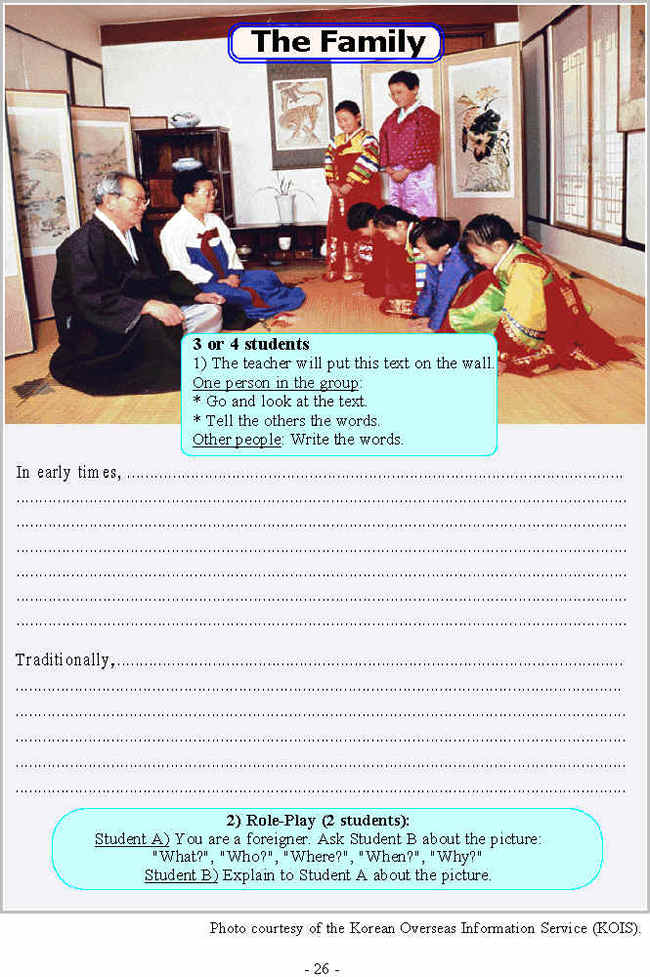
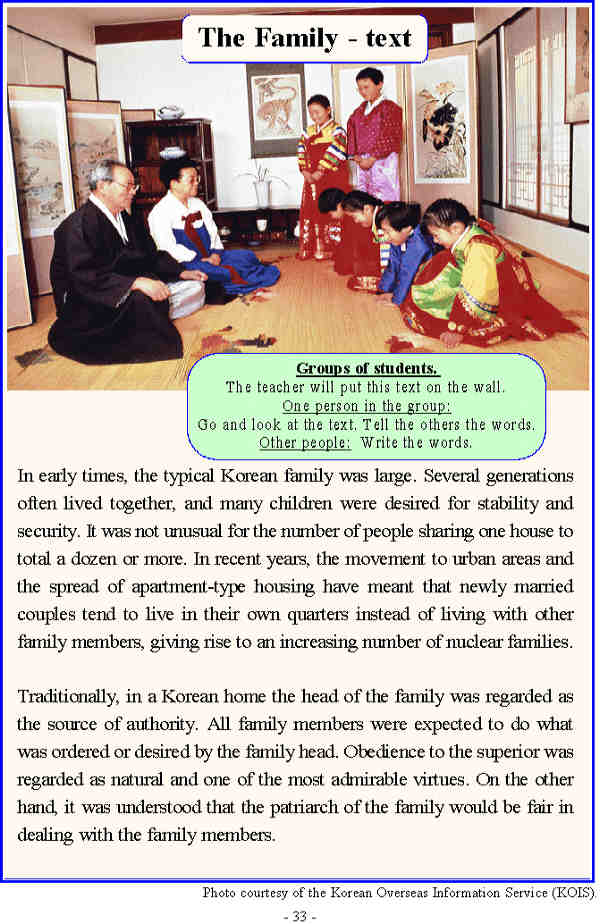
Lesson 3: (a) The Family (Worksheet) (b) The Family (Text) (c) The Family (Teacher's Notes)
Lesson 4: The Syllable Game
Then I divided the class into 5 groups of 8 students. Each group had 4 teaching pairs.
| Lesson 1 | Lesson 2 | Lesson 3 | Lesson 4 | |
| Group A | Kota and Airi | May and Yui | Haruka and Emi | Miki and Saki |
| Group B | Mai and Chika | Kotaro and Shohei | Hiroki and Makoto | Hamaya and Matsun |
| Group C | Shunsuke and Hikaru | Masato and Tatsuki | Shunta and Satoru | Takumi and Eiki |
| Group D | Takahiro and Ai | Flowers and Machiko | Marin and Yurika | Yoshi and Ryouhei |
| Group E | Satoshi and Wataru | Ayu and Moe | Shiho and Kanako | Yui U and Takayuki |
Then, each student was given the following blogging assignment (taken from our class blog):
I would like you to write the lesson plan in your blog specifying the following. Next week, you and your partner will conduct a 10 minute lesson based on your plan.
Activity: What kind of activity is it? Adjust the activity so that it encourages acquisition, interaction, or focus on form. Your activity can cover more than one of these.Strategies: What kind of learning strategies does it encourage?Learning styles: What kind of learning style is most appropriate for your activity?Communicative competence: What kind of communicative ability does it encourage and why?Procedures: Write the steps you will take to carry out the activity. At the ending of your activity, there should be some kind of reflection to help students realize the skill/strategy you wanted them to practice.
See my sample lesson for an example
The text books we use are the TKT Course and 新しい時代の英語科教育法と実践 . The items that I asked students to specify(Activities, strategies, learning styles and communicative competence) were concepts that we studied in the textbooks. When we did the actual practice lessons, all groups did Lessons 1, 2, 3, 4 in that order. We were able to finish on time easily. What impressed me was that each pair of students taught their lessons differently depending on their goal. This meant that they were thinking very deeply about their teaching which I think is great. The problem areas were first, with five groups teaching at once it is hard to understand what each group is doing. I had two other teachers come to class that day to help me but I will not always have these kinds of resources. Second, I was not able to look at all the blogs before the class and give feedback on the lesson plans. I was just too busy. I was fortunate in that one of the other teachers volunteered to read the students' blogs. Third, sometimes when you are so busy orchestrating students' group work, keeping time, etc. it is hard to give students good comments on their lessons. Despite the problems, I am going to continue to use this format next semester. Although I need to think of ways that I can follow the students' lessons better, the most important thing is that the students, themselves, learn from this experience and determine themselves how they should improve.Although you will be team-teaching, you should write the lesson plan in your own blog. It is ok to write the same thing as your partner.
Wednesday, February 06, 2013
Using Vocabulary Notebooks: Tips For Organization
Between April and August, I wrote tons about using vocabulary notebooks (hereafter VNs) and then abruptly stopped. (You can see the posts here). VNs were basically "vocabulary sheets" that could be put into a two-ringed binder (See a sample below).
Although I continued to use them from October (when the second semester for university starts in Japan), I was too busy with other things to devote as much time to experimenting with them. This semester I did not really expand on VN activities, but I did improve in incorporating them more smoothly into the curriculum. This semester, of 22 students, I would say that 20 routinely entered words into their VNs. The key to this success was 1) making VNs an essential part of the class evaluation while trying to encourage independent learning and 2) being more organized. I will explain both below:
1. Making VNs an essential part of class evaluation but encouraging some independent learning:
We routinely had quizzes about words that students wrote in their VNs and I routinely collected students' vocabulary sheets. Although it would be great if students would autonomously update their own VNs to satisfy their need for learning English words, without any kind of external measures from the teacher, students will not update their VNs.
However, when we had readings outside of the textbook, students would choose the words that they wanted to learn. Also, when we had quizzes, I let students choose which words to write on the quiz. For example, if students wrote 4 vocabulary sheets from a unit, they would choose about 3 words per page. For the quiz, I would give students a blank vocabulary sheet and they would fill it in. Also, they did not have to write the phonetic symbols for each word but they would have to write where the accent was. Lastly, they would only have to write the "derivations" and "important information" for about two thirds of the words. The reasons for this is that in can be too tedious to write all the lexical information for words you want to learn and for a lot of words receptive knowledge will suffice. Here is an actual quiz:
In addition to the quiz, I would collect students' vocabulary sheets after their quizzes and give them marks of ✓+, ✓1/2, ✓, ✓-, depending on how much effort they put into their sheets. Last semester I realized that students wrote a lot of incorrect information into their sheets and would actually correct this information. This semester, though, I did not do that. However, I believe there was less erroneous information in students' VNs this semester. The reason was, I think, is that they chose the words to write productive information (derivations, "important information," example sentences) for and did not have to write this information for words that they did not intend to learn. Additionally, they had a semester's worth of experience using VNs and they were more used to the practice of finding the word information. Nevertheless, I think that frequently students did write incorrect information. However, I could not spare the time to check the sheets, this is an issue.
At the ending of the semester, students had a self-evaluation sheet which contained their grades for each assignment and quiz. Students had to calculate their numerical grade in the last class and then tell me whether they deserved an A+, A, B, C or D. (At many Japanese universities, they do not use numerical grades). Of course, students' VN marks were also on the evaluation sheet (see below). Actually, I accidentally forgot to record some of the grades for students VN sheets (especially if they turned them in late), so with the self-evaluation sheets students were able to confirm to me that they had filled out their sheet even if there was no mark. A real evaluation sheet is shown below:
2. Organization
Although I continued to use them from October (when the second semester for university starts in Japan), I was too busy with other things to devote as much time to experimenting with them. This semester I did not really expand on VN activities, but I did improve in incorporating them more smoothly into the curriculum. This semester, of 22 students, I would say that 20 routinely entered words into their VNs. The key to this success was 1) making VNs an essential part of the class evaluation while trying to encourage independent learning and 2) being more organized. I will explain both below:
1. Making VNs an essential part of class evaluation but encouraging some independent learning:
We routinely had quizzes about words that students wrote in their VNs and I routinely collected students' vocabulary sheets. Although it would be great if students would autonomously update their own VNs to satisfy their need for learning English words, without any kind of external measures from the teacher, students will not update their VNs.
However, when we had readings outside of the textbook, students would choose the words that they wanted to learn. Also, when we had quizzes, I let students choose which words to write on the quiz. For example, if students wrote 4 vocabulary sheets from a unit, they would choose about 3 words per page. For the quiz, I would give students a blank vocabulary sheet and they would fill it in. Also, they did not have to write the phonetic symbols for each word but they would have to write where the accent was. Lastly, they would only have to write the "derivations" and "important information" for about two thirds of the words. The reasons for this is that in can be too tedious to write all the lexical information for words you want to learn and for a lot of words receptive knowledge will suffice. Here is an actual quiz:
In addition to the quiz, I would collect students' vocabulary sheets after their quizzes and give them marks of ✓+, ✓1/2, ✓, ✓-, depending on how much effort they put into their sheets. Last semester I realized that students wrote a lot of incorrect information into their sheets and would actually correct this information. This semester, though, I did not do that. However, I believe there was less erroneous information in students' VNs this semester. The reason was, I think, is that they chose the words to write productive information (derivations, "important information," example sentences) for and did not have to write this information for words that they did not intend to learn. Additionally, they had a semester's worth of experience using VNs and they were more used to the practice of finding the word information. Nevertheless, I think that frequently students did write incorrect information. However, I could not spare the time to check the sheets, this is an issue.
At the ending of the semester, students had a self-evaluation sheet which contained their grades for each assignment and quiz. Students had to calculate their numerical grade in the last class and then tell me whether they deserved an A+, A, B, C or D. (At many Japanese universities, they do not use numerical grades). Of course, students' VN marks were also on the evaluation sheet (see below). Actually, I accidentally forgot to record some of the grades for students VN sheets (especially if they turned them in late), so with the self-evaluation sheets students were able to confirm to me that they had filled out their sheet even if there was no mark. A real evaluation sheet is shown below:
2. Organization
One of the things I struggled with last semester was that I had a difficult time keeping track of the number of vocabulary sheets I asked them to write and students were also confused about how many they should have. This semester, on the course vocabulary resource page I recorded each time I asked students to record words in their vocabulary sheet from readings we did, songs we listened to, or discussions that we had. I also recorded when they had a quiz based on a particular sheet or when I collected the sheets to see that they had been writing in the VNs (see below)
Also, students wrote their names and the topic for the words on each vocabulary sheet. I used a new system to have students turn is assignments including VN sheets. Each student at the beginning of class would be given a clear file with their number on the outside (students were given a number from 1 - 23 at the beginning of the semester. They were numbered this way on the class list I received from the university). When students turned in a VN sheet, they would put it in their clear file. This made it MUCH easier for me to keep track of the sheets. If I had students hand them in with no files and received a big stack of VN sheets, I know that I would have lost many of the sheets.
Thursday, January 24, 2013
What I Learned About Teacher Education in Thailand
For 13 days I rotated around three unique schools and saw three unique groups of student-teachers teach at each school. In my post before I left for Thailand, I wrote:
At the Thai schools we had three groups of people working together on planning the ideal English class. These groups had different life experiences and views on teaching, they were Japanese college professors (who were American!), Thai and non-Thai English teachers working in Bangkok or Ayutthaya, and Japanese pre-service teachers. We had different ways in how we perceived good topics, appropriate activities, our ideal image of teachers, how to interact with students, and how to use materials.
I think that for the classes that were most successful, the pre-service teachers, the Thai teachers, and the American teachers were able to exchange dialogue about the classes, understand each other, and negotiate changes that everyone could be happy with. For the classes that were not as successful (all the classes were actually good, I think), the pre-service teachers, Thai teachers, and American teachers were not quite able to reach a common ground. Nevertheless, the opportunity to collaborate on planning these classes was an incredible experience which taught me about myself, my students, and the Thai teachers; it also brought us all closer together. This trip taught me about how difficult and exhausting communication can it made me a more open and honest communicator and made me feel more alive.
in Thailand I want to see how students will fix their own lessons and how this experience will change their view of what effective teaching and their image of themselves as teachers.In the blog, I try hard not to write about people or schools in such a way that would reveal information they would not want shared. I am a little worried that what I would write might reveal certain details that schools and or the student teachers would prefer not to be shared. However, I do think that I can share what fascinated me the most about this whole experience.
At the Thai schools we had three groups of people working together on planning the ideal English class. These groups had different life experiences and views on teaching, they were Japanese college professors (who were American!), Thai and non-Thai English teachers working in Bangkok or Ayutthaya, and Japanese pre-service teachers. We had different ways in how we perceived good topics, appropriate activities, our ideal image of teachers, how to interact with students, and how to use materials.
I think that for the classes that were most successful, the pre-service teachers, the Thai teachers, and the American teachers were able to exchange dialogue about the classes, understand each other, and negotiate changes that everyone could be happy with. For the classes that were not as successful (all the classes were actually good, I think), the pre-service teachers, Thai teachers, and American teachers were not quite able to reach a common ground. Nevertheless, the opportunity to collaborate on planning these classes was an incredible experience which taught me about myself, my students, and the Thai teachers; it also brought us all closer together. This trip taught me about how difficult and exhausting communication can it made me a more open and honest communicator and made me feel more alive.
Wednesday, January 16, 2013
Using the Japanese Portfolio for Student Teachers of Languages in a Class Discussion
I am in Thailand right now but need to get my mind off it. So, I am going to write about using the J-Postl. The J-POSTL or the Japanese Porfolio for Student Teachers of Languages is adapted from E-POSTL or the European Portfolio for Student Teachers of other Languages. The J-POSTL consists of 100 descriptors that students can use to assess their teaching ability. The descriptors help students assess their knowledge or ability related to their context, teaching methodologies, using resources, planning lessons, conducting lessons, etc. The descriptors are useful in that they can raise students' awareness of the techniques, skills, and knowledge that very good teachers have. For example, look at the following descriptors for conducting lessons:
The problem with J-POSTL is the sheer number of descriptors can make it a little overwhelming. However, the developers of the portfolio recommend that students only do a few descriptors at a time. I tried to do just this last month. My students in my teaching methodologies class did a one day teaching practice at an elementary school where they conducted a foreign language activity (English activity) using the standard elementary school English textbook, "Hi, Friends"After their practice lesson, we had a class discussion using part of the J-POSTL. For the discussion our goal was to Determine the essential skills necessary for conducting foreign language activities in elementary school, this is what I did:
In steps 4 and 5, I told students that they could add their own items if they so wished. The final list of the most important items consisted of the students' original items rather than those of J-POSTL.
I thought that this was VERY interesting. I think it means that it is difficult to tell students to look at their classes from a perspective that is different from their own. The J-POSTL makes A LOT of sense to me because I am an experienced teacher. Student-teachers, however, are new to teaching and they might perhaps focus more on the very basics such as "enjoy the class" rather than the detailed techniques, knowledge, and skills written in J-POSTL. Also, it could have been the nature of the task itself that influenced students' answers. Nevertheless, I was surprised that every item that students voted as most important were their own original ones.
I should be writing about my students' teaching in Thailand right now, but actually being able to think about my orderly and predictable life in Japan has been a little therapeutic for me.
-
73 I can start a lesson in an engaging way.
-
74 I can be flexible when working from a lesson plan and respond to student interests as the lesson progresses.
75 I can adjust my time schedule when unforeseen situations occur.
76 I can time and change classroom activities to reflect individual students’ attention spans.
- I gave students a list of descriptors from J-POSTL about using resources, lesson planning, and conducting a lesson (using a lesson plan, content, interaction with students, classroom management, classroom language). I have written the list of descriptors I used at the bottom of this page.
- I asked students to write a circle next to they thought they were able to do in the lesson, a cross next to what you were not able to do, and write a triangle next to what they thought was not relevant. (5 minutes)
- Each teaching group of students (7 groups of students each conducted a class) watched a video of their class. If their thinking changed, they could change their answers they wrote in 2. (15 minutes)
- Each teaching group comes to a consensus about the 5 items they thought they were most successful in accomplishing in their classes and the 5 items they were least successful in accomplishing. (20 minutes)
- Next, students made seven new groups so that each new group consisted of a member from each of the original groups (like a jigsaw task). They shared the results of 4. with their new group members. After that, as a group, they chose what they thought were the four most important items for conducting foreign language activities in elementary school and gave reasons why. (20 minutes)
- Lastly, each group presented their top four items. I wrote them on the computer (using a projector of course) and as a class we chose the top 5 items.
In steps 4 and 5, I told students that they could add their own items if they so wished. The final list of the most important items consisted of the students' original items rather than those of J-POSTL.
| Number of Votes | Item |
| 40 | Enjoy the class |
| 23 | Use English as much as you can. |
| 20 | Don’t use Japanese too much |
| 16 | Try to speak easy English |
| 12 | Prepare for the class perfectly |
| 12 | Prepare for many activities |
I thought that this was VERY interesting. I think it means that it is difficult to tell students to look at their classes from a perspective that is different from their own. The J-POSTL makes A LOT of sense to me because I am an experienced teacher. Student-teachers, however, are new to teaching and they might perhaps focus more on the very basics such as "enjoy the class" rather than the detailed techniques, knowledge, and skills written in J-POSTL. Also, it could have been the nature of the task itself that influenced students' answers. Nevertheless, I was surprised that every item that students voted as most important were their own original ones.
I should be writing about my students' teaching in Thailand right now, but actually being able to think about my orderly and predictable life in Japan has been a little therapeutic for me.
Appendix: Items from J-POSTL used in the class discussion
RESOURCES
47 I can identify and evaluate a range of coursebooks/materials appropriate for the age, interests and the language level of the students.
48 I can select texts and language activities from coursebooks appropriate for my students.
49 I can locate and select listening and reading materials appropriate for the needs of my students from a variety of sources, such as literature, mass media and the Internet.
50 I can make use of ideas, lesson plans and materials included in teachers’ handbooks and resource books.
51 I can design learning materials and activities appropriate for my students.
52 I can recommend dictionaries and other reference books useful for my students.
53 I can guide students to use the Internet for information retrieval.
LESSON PLANNING
A. Identification of Learning Objectives
54 I can identify the Course of Study requirements and set learning aims and objectives suited to my students’ needs and interests.
55 I can plan specific learning objectives for individual lessons and/or for a period of teaching.
56 I can set objectives which challenge students to reach their full potential.
57 I can set objectives which take into account the differing levels of ability and
special educational needs of the students.
58 I can set objectives for four main skills of listening, speaking, reading and writing
respectively, according to the focus of individual lessons and/or period of teaching. 59 I can set objectives which encourage students to reflect on their learning.
59. I can set objectives which encourage students to reflect on their learning.
47 I can identify and evaluate a range of coursebooks/materials appropriate for the age, interests and the language level of the students.
48 I can select texts and language activities from coursebooks appropriate for my students.
49 I can locate and select listening and reading materials appropriate for the needs of my students from a variety of sources, such as literature, mass media and the Internet.
50 I can make use of ideas, lesson plans and materials included in teachers’ handbooks and resource books.
51 I can design learning materials and activities appropriate for my students.
52 I can recommend dictionaries and other reference books useful for my students.
53 I can guide students to use the Internet for information retrieval.
LESSON PLANNING
A. Identification of Learning Objectives
54 I can identify the Course of Study requirements and set learning aims and objectives suited to my students’ needs and interests.
55 I can plan specific learning objectives for individual lessons and/or for a period of teaching.
56 I can set objectives which challenge students to reach their full potential.
57 I can set objectives which take into account the differing levels of ability and
special educational needs of the students.
58 I can set objectives for four main skills of listening, speaking, reading and writing
respectively, according to the focus of individual lessons and/or period of teaching. 59 I can set objectives which encourage students to reflect on their learning.
59. I can set objectives which encourage students to reflect on their learning.
CONDUCTING A LESSON
A. Using Lesson Plans
73 I can start a lesson in an engaging way.
74 I can be flexible when working from a lesson plan and respond to student interests as the lesson progresses.
75 I can adjust my time schedule when unforeseen situations occur.
76 I can time and change classroom activities to reflect individual students’ attention
spans.
A. Using Lesson Plans
73 I can start a lesson in an engaging way.
74 I can be flexible when working from a lesson plan and respond to student interests as the lesson progresses.
75 I can adjust my time schedule when unforeseen situations occur.
76 I can time and change classroom activities to reflect individual students’ attention
spans.
B. Content
77 I can relate what I teach to students’ knowledge, current events in local context, and the culture of those who speak it.
C. Interaction with Students
78 I can keep and maximize the attention of students during a lesson.
79 I can encourage student participation and student interaction whenever possible.
80 I can cater for a range of learning styles.
81 I can help students to develop appropriate learning strategies.
D. Classroom Management
82 I can create opportunities for and manage individual, partner, group and whole class work.
83 I can manage and use instructional media (flashcards, charts, pictures, audio-visual aids, etc.) effectively
E. Classroom Language
84 I can conduct a lesson in the target language, and if necessary use Japanese effectively.
85 I can encourage students to use the target language in their activities.
77 I can relate what I teach to students’ knowledge, current events in local context, and the culture of those who speak it.
C. Interaction with Students
78 I can keep and maximize the attention of students during a lesson.
79 I can encourage student participation and student interaction whenever possible.
80 I can cater for a range of learning styles.
81 I can help students to develop appropriate learning strategies.
D. Classroom Management
82 I can create opportunities for and manage individual, partner, group and whole class work.
83 I can manage and use instructional media (flashcards, charts, pictures, audio-visual aids, etc.) effectively
E. Classroom Language
84 I can conduct a lesson in the target language, and if necessary use Japanese effectively.
85 I can encourage students to use the target language in their activities.
Subscribe to:
Posts (Atom)